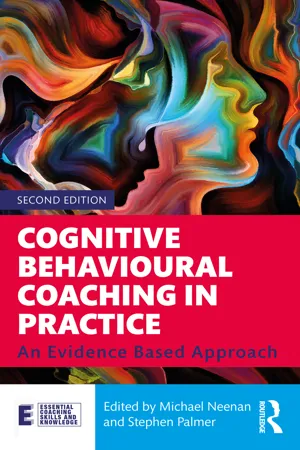
Cognitive Behavioural Coaching in Practice
eBook - ePub

Cognitive Behavioural Coaching in Practice

An Evidence Based Approach

  1. 284 pages
  2. English
  3. ePUB (mobile friendly)
  4. Available on iOS & Android
eBook - ePub

Cognitive Behavioural Coaching in Practice

An Evidence Based Approach

About this book

This fully updated second edition of Cognitive Behavioural Coaching in Practice explores various aspects of coaching from within a cognitive behavioural framework. In response to the continued growth in the popularity and scope of coaching and cognitive behavioural therapy, Michael Neenan and Stephen Palmer again bring together experts in the field to discuss topics including procrastination, stress, coaching alliance, motivational interviewing, goal selection and self-esteem.

The book is illustrated throughout with coach–coachee dialogues that include a commentary of the aims of the coach during the session. This second edition is fully updated and includes three new chapters on single-session coaching, health and wellbeing coaching and coaching supervision.

Part of the Essential Coaching Skills and Knowledge series, this comprehensive volume will be essential reading for coaches, as well as therapists, counsellors and psychologists.

Trusted byĀ 375,005 students

Access to over 1.5 million titles for a fair monthly price.

Study more efficiently using our study tools.

Information

Publisher
Routledge
Year
2021
Print ISBN
9780367461386
eBook ISBN
9781000467024

Chapter 1
Understanding and tackling procrastination

Michael Neenan
DOI: 10.4324/9781003027164-2

Introduction

Coaching aims to bring out the best in people in order to help them achieve their desired goals. While a lot of the coaching literature is full of exciting promises of unleashing your potential, reinventing yourself or living your dream life by implementing dynamic action plans, the ā€˜unexciting’ side of coaching can involve tackling some of the usual change-blocking problems familiar to therapists such as perfectionism, procrastination, excessive self-doubt, low frustration tolerance, lack of persistence and self-depreciation. Unless these psychological blocks are overcome, little progress is likely to be made in achieving the person's coaching goals. Therefore, it is important for coaches, particularly those without a professional background in psychology, to increase their knowledge of psychological factors that interfere with as well as promote change. As Lee (2003: 2) observes:
This expansion in scope challenges coaches to be more sophisticated in their understanding of psychology. They need to develop skills and experience that enable them to move more freely between the psychological and practical. They need to understand a wider range of theoretical models and frameworks, and to be able to relate psychological insights to business performance [and personal change].
A theoretical model for understanding and tackling psychological blocks in general and procrastination in particular is rational emotive behaviour therapy (REBT; Ellis, 1994), founded in 1955 by Albert Ellis, an American clinical psychologist (REBT is one of the approaches within the field of CBT). A short account of the approach now follows. REBT proposes that rigid and extreme thinking (irrational beliefs) lie at the core of psychological disturbance. For example, faced with a coachee who is sceptical about the value of coaching, the coach makes himself very anxious and overprepares for each session by insisting, ā€˜I must impress her with my skills [rigid belief – why can't he let the coachee make up her own mind?] because if I don't this will prove I’m an incompetent coach’ (an extreme view to adopt of his role if the coachee is unimpressed). Rigid thinking is often expressed in must, should, have to and got to statements – commands and demands we place upon ourselves, others and life conditions. Derived from these rigid beliefs are three major and extreme conclusions: awfulising (nothing could be worse and nothing good can ever come from anything bad); low frustration tolerance (LFT; frustration and discomfort are too hard to bear) and depreciation of self and/or others (a person can be given a single global rating [e.g. useless] that defines their essence or worth). It's important to note that depreciation of the role, ā€˜I’m an incompetent coach’ as in the above example, does not automatically extend to the self, ā€˜Therefore, I’m no good’. Check with your coachees to see if this extension has occurred.
What lies at the core of psychological health? Flexible and non-extreme thinking (rational beliefs): flexible thinking is couched in non-dogmatic preferences, wishes, wants and desires, and flowing from these flexible beliefs are three major and non-extreme beliefs: anti-awfulising (things could always be worse and valuable lessons can be learnt from coping with adversity); high frustration tolerance (HFT; frustration and discomfort are worth bearing in order to achieve your goals) and acceptance of self and/or others (individuals are too complex to be given a single global rating but aspects of the person can legitimately be rated, e.g. bad timekeeping doesn't make you a bad person). The concepts of REBT have been applied for several decades to tackling problems in the workplace (Ellis, 1972; Dryden and Gordon, 1993a; DiMattia and IJzermans, 2011) and, more recently, to coaching (Anderson, 2002; Bernard and David, 2018; Neenan and Dryden, 2020).
When REBT is used outside of a therapy setting, it can be called rational emotive behavioural coaching (REBC) and the terms ā€˜irrational beliefs’ and ā€˜psychological disturbance’ can be replaced by ā€˜unhelpful beliefs and behaviours’ and ā€˜troublesome emotions’. The person in the coaching example (later in the chapter) was familiar with REBT language and wished to use it.

What is procrastination?

Procrastination derives from the Latin word procrastinare which means ā€˜defer till the morning’ and can be described as putting off until later what our better judgement tells us ought (preferably) to be done now and thereby incurring unwanted consequences through such dilatory behaviour. The ā€˜putting off’ occurs because the person is actively seeking more interesting or pleasurable activities to engage in rather than experience now the discomfort or difficulty associated with doing the avoided tasks. Procrastination needs to be distinguished from planned delay when there are legitimate reasons for postponing action such as collecting more information before making an important decision (though this can segue into procrastination if the person becomes worried about making the wrong decision). Also, it would be incorrect to dismiss procrastination as mere laziness because the latter state is a disinclination to exert oneself while the former state frequently involves carrying out other tasks, being busy, in order to avoid getting on with the priority task which requires action now. Wessler and Wessler (1980: 104) state that ā€˜almost any behavior can be the object of procrastination’.
Procrastination is often described as ā€˜the thief of time’. As procrastination is a lack of self-management, a more personal way of describing it is that you are stealing your own time through your continuing inaction (Neenan and Dryden, 2020). Another view of procrastination is that you give away your time free of charge – time that you might pay anything for on your deathbed to stay alive a little longer. So much time can be wasted through procrastination that you might believe you have several consecutive lives to lead instead of only one. People who become increasingly frustrated about their procrastination habits fear that they are wasting their lives, yet they avoid doing what would help them to make more productive use of their time. This is what Knaus (1998: 7) calls the fundamental procrastination paradox: ā€˜When we try to buy time by procrastinating, we condemn ourselves to running out of time’.
Some surveys suggest that up to 20% of the adult population is chronically affected by procrastination (Persaud, 2005). Procrastination usually occurs in three main areas (Dryden, 2000a; Knaus, 2010):
  1. Personal maintenance: putting off action regarding health, personal cleanliness, housework, finances, personal administration and upkeep of property;
  2. Self-development: putting off action concerning job and social opportunities, personal interests, educational advancement and finding partners; and
  3. Honouring commitments to others: hoping that earlier promises made will be forgotten by these others as what was promised now seems burdensome to undertake.
Dryden (2000a) distinguishes between chronic situation-specific procrastination (e.g. constantly missing deadlines for filing tax returns) and chronic cross-situational procrastination which affects a number of important areas of a person's life (e.g. avoiding whenever possible tedious or boring tasks that require more than minimal effort to complete them). Chronic procrastination can have high costs:
It has been associated with depression, guilt, low exam grades, anxiety, neuroticism, irrational thinking, cheating and low self-esteem. As a result, procrastination probably accounts for much of why many never realize their full potential and so it can be an extremely disabling psychological condition.
(Persaud, 2005: 237)
In essence, chronic avoidance usually means chronic suffering (Lazarus et al., 1993).
The major challenge in tackling procrastination is that it acts as ā€˜an impediment to correcting itself’ (Knaus: 2016: 5). This means it resists its own reform because the sustained work needed to produce change is precisely what's lacking in procrastination, so it might seem an insurmountable problem – but individuals can develop their own graduated programme of reform (i.e. of their procrastination-linked thoughts, feelings and behaviours) if they are determined enough to do so.

What stops productive action?

Hauck (1982: 18) comments that poor self-discipline is an unsurprising human trait as ā€˜avoiding a difficult situation seems like the most natural course to take because we are so easily seduced by immediate satisfactions’. Freeman and DeWolf (1990: 234) state that ā€˜immediate enjoyment is what procrastination is all about. Ice cream instead of struggle’. Dryden (2000b) observes that procrastination is often a behavioural way of protecting yourself from experiencing an unpleasant emotional state such as feeling highly irritated if you start working on a boring task you wish you did not have to do. From her research, Sapadin (2013) has identified six personality styles related to procrastination:
  1. The perfectionist is one who is reluctant to start or finish a task in case it proves to be less than perfect and therefore is seen to fail in their own and/or others’ eyes;
  2. The dreamer wants life to go smoothly and avoids difficult challenges. Grandiose ideas are not translated into achievable goals. Ill at ease with daily reality, they retreat into fantasy;
  3. The worrier fears things going wrong and being overwhelmed by events (lots of ā€˜What if …?’ horrors); risk or change is avoided and they have little confidence in their ability to make decisions or tolerate discomfort;
  4. The defier is resistant and argumentative towards others’ instructions or suggestions because this means they are being told what to do or other people are trying to control them. An indirect form of defiance is passive-aggressiveness such as saying ā€˜yes’ to others’ request when the person really means ā€˜nO' because they are not prepared to take on the responsibility of doing it within the allotted time;
  5. The crisis-maker likes to display bravado in declaring they cannot get motivated until the eleventh hour or believes this is when they do their best work; ā€˜living on the edge’ gives them an adrenaline rush. They have a low threshold for boredom in life. Leaving things until the last minute often means that they don't get done on time or opportunities for improving their ā€˜best work’ are missed; and
  6. The pleaser (overdoer) takes on too much work because they can't say ā€˜nO' to others and consequently their own needs and priorities are often pushed to the end of the queue. With so much to do and always racing against the clock to get it all finished, procrastination becomes an indirect way of signalling to others ā€˜Please, don't give me any more work’.
Sapadin (2013) suggest that individuals display a mix of procrastination styles: some are more prominently displayed than others. From the REBT perspective, underpinning these various procrastination styles there are likely to be found ego disturbance and discomfort disturbance beliefs (Dryden and Neenan, 2004). Ego disturbance relates to the demands that we impose on ourselves and the consequent negative self-ratings that we make when we fail to live up to these demands. An ego disturbance belief likely to be found in perfectionists is ā€˜I must do a superb job or else I’m a failure’. Discomfort disturbance or LFT is related to the domain of human comfort and occurs when we make dogmatic demands that comfortable life conditions must exist and when they don't, to see these difficult or unpleasant conditions as unbearable. A discomfort disturbance belief likely to be found in dreamers is ā€˜I shouldn't have to work hard to fulfil my dreams. I can't stand having to get my mind around all those boring details’. Of course, clients can have both types of beliefs underpinning their procrastination. For example, with perfectionists, as well as fear of failure, some may have LFT beliefs related to their need to reach their high standards effortlessly (e.g. ā€˜I shouldn't have to struggle!’).
Can procrastination ever be justified? Hauck (1980: 138) s...

Table of contents

  1. Cover Page
  2. Endorsements Page
  3. Half-Title Page
  4. Series Page
  5. Title Page
  6. Copyright Page
  7. Dedication
  8. Contents
  9. Editors and contributors
  10. Foreword to the First Edition, Anthony M Grant
  11. Foreword to the Second Edition, Prof Suzy Green
  12. Preface
  13. Introduction, Michael Neenan and Stephen Palmer
  14. 1 Understanding and tackling procrastination
  15. 2 Motivational interviewing, Tim Anstiss and Jonathan Passmore
  16. 3 The coaching alliance in cognitive behavioural coaching, Alanna Henderson and Stephen Palmer
  17. 4 Socratic questioning, Michael Neenan
  18. 5 Developing self-acceptance through coaching, Stephen Palmer and Helen Williams
  19. 6 Stress and performance coaching, Kristina Gyllensten and Stephen Palmer
  20. 7 Health and wellbeing coaching, Siobhain O'Riordan and Stephen Palmer
  21. 8 Developing a coaching culture at work, Alison Whybrow and Siobhain O'Riordan
  22. 9 Understanding and developing resilience, Michael Neenan and Windy Dryden
  23. 10 Single-Session Cognitive-Behavioural Coaching (SSCBC), Windy Dryden
  24. 11 Coaching supervision, Michael Neenan
  25. Afterword, Michael Neenan and Stephen Palmer
  26. Appendices
  27. Resources
  28. Index

Frequently asked questions

Yes, you can cancel anytime from the Subscription tab in your account settings on the Perlego website. Your subscription will stay active until the end of your current billing period. Learn how to cancel your subscription
No, books cannot be downloaded as external files, such as PDFs, for use outside of Perlego. However, you can download books within the Perlego app for offline reading on mobile or tablet. Learn how to download books offline
Perlego offers two plans: Essential and Complete
  • Essential is ideal for learners and professionals who enjoy exploring a wide range of subjects. Access the Essential Library with 800,000+ trusted titles and best-sellers across business, personal growth, and the humanities. Includes unlimited reading time and Standard Read Aloud voice.
  • Complete: Perfect for advanced learners and researchers needing full, unrestricted access. Unlock 1.5M+ books across hundreds of subjects, including academic and specialized titles. The Complete Plan also includes advanced features like Premium Read Aloud and Research Assistant.
Both plans are available with monthly, semester, or annual billing cycles.
We are an online textbook subscription service, where you can get access to an entire online library for less than the price of a single book per month. With over 1.5 million books across 990+ topics, we’ve got you covered! Learn about our mission
Look out for the read-aloud symbol on your next book to see if you can listen to it. The read-aloud tool reads text aloud for you, highlighting the text as it is being read. You can pause it, speed it up and slow it down. Learn more about Read Aloud
Yes! You can use the Perlego app on both iOS and Android devices to read anytime, anywhere — even offline. Perfect for commutes or when you’re on the go.
Please note we cannot support devices running on iOS 13 and Android 7 or earlier. Learn more about using the app
Yes, you can access Cognitive Behavioural Coaching in Practice by Michael Neenan, Stephen Palmer, Michael Neenan,Stephen Palmer in PDF and/or ePUB format, as well as other popular books in Psychology & Education in Psychology. We have over 1.5 million books available in our catalogue for you to explore.