The large and complex challenges the world is facing, the growing prevalence of huge data sets, and the new and developing ways for addressing them (artificial intelligence, data science, machine learning, etc.), means it is increasingly vital that academics and professionals from across disciplines have a basic understanding of the mathematical underpinnings of effective, optimized decision-making. Without it, decision makers risk being overtaken by those who better understand the models and methods, that can best inform strategic and tactical decisions.
Introduction to Optimization-Based Decision-Making provides an elementary and self-contained introduction to the basic concepts involved in making decisions in an optimization-based environment. The mathematical level of the text is directed to the post-secondary reader, or university students in the initial years. The prerequisites are therefore minimal, and necessary mathematical tools are provided as needed. This lean approach is complemented with a problem-based orientation and a methodology of generalization/reduction. In this way, the book can be useful for students from STEM fields, economics and enterprise sciences, social sciences and humanities, as well as for the general reader interested in multi/trans-disciplinary approaches.
Features
Collects and discusses the ideas underpinning decision-making through optimization tools in a simple and straightforward manner
Suitable for an undergraduate course in optimization-based decision-making, or as a supplementary resource for courses in operations research and management science
Self-contained coverage of traditional and more modern optimization models, while not requiring a previous background in decision theory
Frequently asked questions
Yes, you can cancel anytime from the Subscription tab in your account settings on the Perlego website. Your subscription will stay active until the end of your current billing period. Learn how to cancel your subscription.
No, books cannot be downloaded as external files, such as PDFs, for use outside of Perlego. However, you can download books within the Perlego app for offline reading on mobile or tablet. Learn more here.
Perlego offers two plans: Essential and Complete
Essential is ideal for learners and professionals who enjoy exploring a wide range of subjects. Access the Essential Library with 800,000+ trusted titles and best-sellers across business, personal growth, and the humanities. Includes unlimited reading time and Standard Read Aloud voice.
Complete: Perfect for advanced learners and researchers needing full, unrestricted access. Unlock 1.4M+ books across hundreds of subjects, including academic and specialized titles. The Complete Plan also includes advanced features like Premium Read Aloud and Research Assistant.
Both plans are available with monthly, semester, or annual billing cycles.
We are an online textbook subscription service, where you can get access to an entire online library for less than the price of a single book per month. With over 1 million books across 1000+ topics, weโve got you covered! Learn more here.
Look out for the read-aloud symbol on your next book to see if you can listen to it. The read-aloud tool reads text aloud for you, highlighting the text as it is being read. You can pause it, speed it up and slow it down. Learn more here.
Yes! You can use the Perlego app on both iOS or Android devices to read anytime, anywhere โ even offline. Perfect for commutes or when youโre on the go. Please note we cannot support devices running on iOS 13 and Android 7 or earlier. Learn more about using the app.
Yes, you can access Introduction to Optimization-Based Decision-Making by Joao Luis de Miranda in PDF and/or ePUB format, as well as other popular books in Business & Applied Mathematics. We have over one million books available in our catalogue for you to explore.
Chapter 1 First Notes on Optimization for Decision Support
DOI: 10.1201/9781315200323-1
This chapter describes several applications of decision-making directed toward school education, toward childrenโs and young studentsโ learning, illustrated through different optimization instances in a simple and instructive way.
1.1 Introduction
We live in a world with increased pressures on resources, from extraction to distribution, including residues valorization and materials reuse. Thus, the focus is on the optimal utilization of scarce resources, and is illustrated by a simple integer linear programming (LP) problem and related instances. The problemโs difficulty grows from basic levels to the secondary level, in tandem with the problem-solving capacities of children and young students.
The problem instances are aimed at different levels of school education, with instances numerically bounded and calculations simplified. There are three basic levels of school education:
First level: From 6 to 9 years old, up to 4 years of school.
Second level: Between 10 and 11 years old, up to 6 years of school.
Third level: From 12 to 14 years old, up to 9 years of school.
A more difficult level is the fourth level (secondary, senior high school; usually 15โ17 years old, up to 12 years of school), because this level also relies on computing skills. With greater instances and less solution time, an LP formulation is required, which is developed and a procedure is applied. It must be noted that some places include LP modeling in the mathematics curricula at secondary level. Therefore, the fourth instance provides students with a good opportunity: on the one hand, they are required to treat a more complex problem or instance; on the other hand, they are empowered to obtain the optimal solution for this type of problem, i.e., LP instances.
In addition, the significance of both scarce resources and related marginal values is addressed:
It consists of either an open-ended scenario or the typical โWhat if?โ analysis, where students with different knowledge levels (first, second, or higher levels) are challenged.
Partial or complementary questions are properly ordered, allowing students to develop their own solution methods, which they perform autonomously.
Using either teamwork (two or three students in each group) or individually, tutorial supervision promotes the goals at each level, ensuring that they are accomplished.
The tutorial goals include self-contained strategies that young students can build on to solve the problem instances; for that, the instances are not defined or partitioned in a tight format.
Thus, the topics within the four instances can overlap either the first and second levels or the second and third levels; in addition, it is also possible that a first-level student may attain the final results of the higher levels, and even solve all the problem instances.
1.2 First Steps
The problem is tailored to the first level and the calculations are simplified using a bounded instance: only integer non-negative numbers are included, and the sums and subtractions do not reach 20.
These first steps require only basic notions to support decision-making, such as enumeration, basic algebraic operations (addition, subtraction, multiplication, division), simple combinatorial counting, and direct comparison of several alternative solutions. Thus, the skills required are elementary, related to the numeric natural system, the four basic operations, and their properties to simplify calculations.
1.2.1 The Furniture Factory Problem: First Level
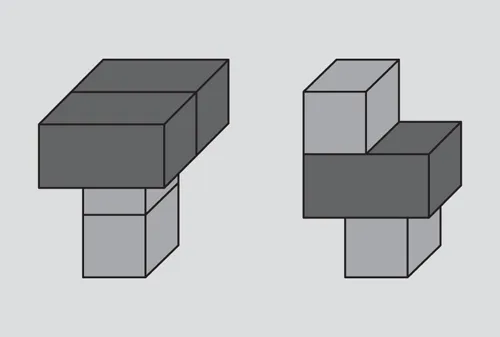
Noddy is trying to help Big Ears build some tables (each table is worth four chocolate cakes) and some chairs (each chair is worth three chocolate cakes) according to Figure 1.1a.
FIGURE 1.1a Furniture factory problem: First level.
However, there are only eight small-red and three big-blue pieces (Figure 1.1b).
FIGURE 1.1b Availability of pieces: Eight small-red and three big-blue pieces.
How many tables and chairs does Noddy need to build to earn the most chocolate cakes?
Instance: Eight small-red pieces and three big-blue pieces.
Optimal solution: Zero tables and three chairs; the value is 9 (0 ร 4 + 3 ร 3) and two small-red pieces are left.
Second solution (sub-optimal): One table and one chair; the value is 7 (1 ร 4 + 1 ร 3), but four small-red pieces are left.
How do you know you have reached the end?
This question addresses optimality, and the notion of an optimal solution; it occurs when the solution cannot be improved further, as it is not possible to build more chairs or tables, nor to undo one chair (lost value is 3) to make one table (added value is 4).
A set of โWhat if?โ questions address the marginal value notion, specifically for the big-blue pieces. Namely,
What if โฆ
There is one more big-blue piece?
It could build one more chair (gaining 3), obtaining a new maximum value of 12 (corresponding to 4 ร 3).
There is again one more big-blue piece?
It could build one more table (gaining 4) while undoing a chair (losing 3); therefore, the marginal value is 1 (4 โ 3) and the total value is 13, corresponding to one table and three chairs (1 ร 4 + 3 ร 3).
There is another big-blue piece to add?
Again, it could build one more table (gaining 4) while undoing a chair (losing 3); therefore, the marginal value remains 1 and the total value is 14 (2 ร 4 + 2 ร 3); this situation is repeated two more times, until the components of the two other chairs are made available to build two additional tables, obtaining a total of 16 (4 ร 4 + 0 ร 3) with a marginal value of 1 for each new big-blue piece.
There is yet another big-blue piece to add?
No more additional tables can be produced, as there are no more chairs to undo; therefore, the marginal value is zero and the optimal solution is the previous solution.
1.3 Introducing Proportionality
Proportionality and related notions are preferentially introduced in the second level, while instances data are proportionally increased, and operations with fractional numbers are also introduced. Additionally, comparative reasoning can be stimulated, while the attributes of the optimal solution are considered. In this way, the main goals for first- and second-level education can be achieved.
By introducing simple variations on the instance data and promoting a sensitivity or โWhat if?โ analysis, the problem approach is open-ended. These topics can be integrated as complementary questions, asked after the students have correctly reasoned the optimal solution and the marginal values.
1.3.1 The Furniture Factory Problem: Second ...
Table of contents
Cover
Half-Title
Series
Title
Copyright
Dedication
Contents
Foreword
Preface
Author
CHAPTER 1 First Notes on Optimization for Decision Support