- 392 pages
- English
- PDF
- Available on iOS & Android
eBook - PDF
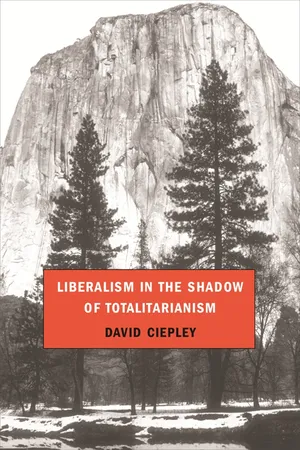
Liberalism in the Shadow of Totalitarianism
About this book
This book argues that, more than any other factor, it was the encounter with totalitarianism that dissolved the ideals of American progressivism and crystallized the ideals of postwar liberalism. The New Deal began as a revolution in favor of progressive governance--executive-centered and expert-guided. But as David Ciepley shows, by the late 1930s, intellectuals and elites, reacting against the menace of totalitarianism, began to shrink from using state power to guide the economy or foster citizen virtues. All of the more statist governance projects of the New Deal were curtailed or abandoned, regardless of success, and the country placed on a more libertarian-corporatist trajectory, both economically and culturally. In economics, attempts to reorient industry from private profit to public use were halted, and free enterprise was reaffirmed. In politics, the ideal of governance by a strong, independent executive was rejected--along with notions of "central planning," "social control," and state imposition of "values"--and a politics of contending interest groups was embraced. In law, the encounter with totalitarianism brought an end to judicial deference, the embrace of civil rights and civil liberties, and the neutralist reinterpretation, and radicalization, of both. Finally, in culture, the encounter sowed the seeds of our own era--the era of the culture wars--in which traditional America has been mobilized against these liberal legal advances, and against the entire neutralist, "relativist," "secular humanist" reinterpretation of America that accompanies them.
Information
Table of contents
- Cover
- Title Page
- Copyright
- Dedication
- Contents
- Acknowledgments
- Introduction
- Part I. State-Building before the Totalitarian Encounter
- Part II. Totalitarianism and the Economy: The Renaissance of Free Enterprise
- Part III. Totalitarianism and Democratic Politics: The Rise of Interest Group Pluralism
- Part IV. Totalitarianism and the Court: From Higher Law to Neutrality
- Conclusion: The Dysfunctions of Antitotalitarian Liberalism
- Notes
- Index
Trusted by 375,005 students
Access to over 1.5 million titles for a fair monthly price.
Study more efficiently using our study tools.
Frequently asked questions
Yes, you can cancel anytime from the Subscription tab in your account settings on the Perlego website. Your subscription will stay active until the end of your current billing period. Learn how to cancel your subscription
No, books cannot be downloaded as external files, such as PDFs, for use outside of Perlego. However, you can download books within the Perlego app for offline reading on mobile or tablet. Learn how to download books offline
Perlego offers two plans: Essential and Complete
- Essential is ideal for learners and professionals who enjoy exploring a wide range of subjects. Access the Essential Library with 800,000+ trusted titles and best-sellers across business, personal growth, and the humanities. Includes unlimited reading time and Standard Read Aloud voice.
- Complete: Perfect for advanced learners and researchers needing full, unrestricted access. Unlock 1.5M+ books across hundreds of subjects, including academic and specialized titles. The Complete Plan also includes advanced features like Premium Read Aloud and Research Assistant.
We are an online textbook subscription service, where you can get access to an entire online library for less than the price of a single book per month. With over 1.5 million books across 990+ topics, we’ve got you covered! Learn about our mission
Look out for the read-aloud symbol on your next book to see if you can listen to it. The read-aloud tool reads text aloud for you, highlighting the text as it is being read. You can pause it, speed it up and slow it down. Learn more about Read Aloud
Yes! You can use the Perlego app on both iOS and Android devices to read anytime, anywhere — even offline. Perfect for commutes or when you’re on the go.
Please note we cannot support devices running on iOS 13 and Android 7 or earlier. Learn more about using the app
Please note we cannot support devices running on iOS 13 and Android 7 or earlier. Learn more about using the app
Yes, you can access Liberalism in the Shadow of Totalitarianism by David Ciepley in PDF and/or ePUB format, as well as other popular books in History & North American History. We have over 1.5 million books available in our catalogue for you to explore.