- 648 pages
- English
- PDF
- Available on iOS & Android
eBook - PDF
The Federalist
About this book
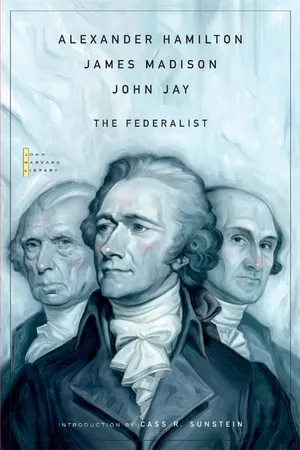
Published serially in several New York papers between October 1787 and August 1788, the eighty-five Federalist Papers written by Alexander Hamilton, James Madison, and John Jay under the pseudonym "Publius" advocated ratification of the proposed U.S. Constitution. Together these articles constitute one of the greatest American contributions to political thought. In his introductory essay, Cass R. Sunstein argues that in rejecting the claims of classical republicanism Publius embraces deliberative democracy, and reminds us that Publius's arguments bear on current debates and "offer lessons for making war and making peace, and for domestic emergencies of many different kinds." The John Harvard Library text reproduces that of the first book edition (1788), modernizing spelling and capitalization.
Information
Table of contents
- Cover
- Title Page
- Copyright
- Contents
- Introduction: The Enlarged Republic
- Note on the Text
- A Chronology of Events
- The Federalist
- Chapter 1. Introduction
- Chapter 2. The Natural Advantages of Union
- Chapter 3. Unionas a Requisite for National Safety
- Chapter 4. Relations with Foreign Powers
- Chapter 5. Separate Confederacies and Foreign Powers
- Chapter 6. Disunionand Dissension Among the States
- Chapter 7. Causes of Wars Among the States if Disunited
- Chapter 8. Consequences of Wars between States
- Chapter 9. Unionas a Barrier to Faction and Insurrection
- Chapter 10. The Size and Variety of the Unionas a Check on Faction
- Chapter 11. The Value of Unionto Commerce and the Advantages of a Navy
- Chapter 12. Unionand the National Revenue
- Chapter 13. Unionand Economy in Government
- Chapter 14. Representative Republics and Direct Democracies
- Chapter 15. Defects of the Confederation
- Chapter 16. Inability of the Confederation to Enforce Its Laws
- Chapter 17. The Future Balance of State and National Powers
- Chapter 18. The Greek Confederacies
- Chapter 19. Medieval and Modern Confederacies
- Chapter 20. The Netherlands Confederacy
- Chapter 21. Defects of the Present Confederation
- Chapter 22. The Confederation: Lack of Powers and of Proper Ratification
- Chapter 23. The Necessity of an Energetic and Active National Government
- Chapter 24. To Provide for the Common Defense
- Chapter 25. The States and the Common Defense
- Chapter 26. The Powers of Congress and the Common Defense
- Chapter 27. The Enforcement of the Supreme Law of the Land
- Chapter 28. A National Army and Internal Security
- Chapter 29. The Regulation of the Militia
- Chapter 30. A General Power of Taxation
- Chapter 31. The Necessity of a National Power of Taxation
- Chapter 32. Exclusive and Concurrent Powers of Taxation
- Chapter 33. The Constitutionality of National Tax Laws
- Chapter 34. Concurrent Authority in Taxation
- Chapter 35. Further Reasons for an Indefinite Power of Taxation
- Chapter 36. Internal Taxes: Direct and Indirect
- Chapter 37. Problems Confronting the Federal Convention
- Chapter 38. Inconsistencies of Opponents of Ratification
- Chapter 39. Republicanism, Nationalism, Federalism
- Chapter 40. The Authority of the Convention
- Chapter 41. Powers Delegated to the General Government: I
- Chapter 42. Powers Delegated to the General Government: II
- Chapter 43. Powers Delegated to the General Government: III
- Chapter 44. Restrictions on Powers of the States
- Chapter 45. Powers and Continuing Advantages of the States
- Chapter 46. State and Federal Powers Compared
- Chapter 47. The Separation of Powers: I
- Chapter 48. The Separation of Powers: II
- Chapter 49. Appeal to the People in Cases of Disagreement
- Chapter 50. Periodical Appeals to the People
- Chapter 51. Checks and Balances
- Chapter 52. The House of Representatives
- Chapter 53. Annual and Biennial Elections
- Chapter 54. The Apportionment of Representatives and of Taxes
- Chapter 55. The House and Knowledge of Local Circumstances
- Chapter 56. Adequacy of Representation in the House
- Chapter 57. The Popular Basis of the House
- Chapter 58. The Future Size of the House
- Chapter 59. National Regulation of Congressional Elections
- Chapter 60. Safety in National Control of Elections
- Chapter 61. Uniformity in the National Control of Elections to the House
- Chapter 62. The Nature and the Stabilizing Influence of the Senate
- Chapter 63. The Necessity of a Senate
- Chapter 64. The Senate and the Treaty Power
- Chapter 65. The Senate: Appointments and Impeachments
- Chapter 66. The Senate: Further Consideration of the Impeachment Power
- Chapter 67. The Executive
- Chapter 68. The Method of Electing the President
- Chapter 69. Comparison of the President with Other Executives
- Chapter 70. Advantages of a Single Executive
- Chapter 71. The Presidential Term of Office
- Chapter 72. Re-Eligibilityof the President
- Chapter 73. The Presidential Salary and Veto
- Chapter 74. The Military and Pardoning Powers of the President
- Chapter 75. The President and the Treaty Power
- Chapter 76. The President and the Appointing Power
- Chapter 77. The Powers of the President Concluded
- Chapter 78. The Judges as Guardians of the Constitution
- Chapter 79. The Position of the Judiciary
- Chapter 80. Jurisdiction of the Federal Courts
- Chapter 81. Distribution of the Judicial Power
- Chapter 82. The State and the Federal Courts
- Chapter 83. Trial by Jury
- Chapter 84. The Lack of a Bill of Rights
- Chapter 85. Conclusion
- Selected Bibliography
- Index
Trusted by 375,005 students
Access to over 1.5 million titles for a fair monthly price.
Study more efficiently using our study tools.
Frequently asked questions
Yes, you can cancel anytime from the Subscription tab in your account settings on the Perlego website. Your subscription will stay active until the end of your current billing period. Learn how to cancel your subscription
No, books cannot be downloaded as external files, such as PDFs, for use outside of Perlego. However, you can download books within the Perlego app for offline reading on mobile or tablet. Learn how to download books offline
Perlego offers two plans: Essential and Complete
- Essential is ideal for learners and professionals who enjoy exploring a wide range of subjects. Access the Essential Library with 800,000+ trusted titles and best-sellers across business, personal growth, and the humanities. Includes unlimited reading time and Standard Read Aloud voice.
- Complete: Perfect for advanced learners and researchers needing full, unrestricted access. Unlock 1.5M+ books across hundreds of subjects, including academic and specialized titles. The Complete Plan also includes advanced features like Premium Read Aloud and Research Assistant.
We are an online textbook subscription service, where you can get access to an entire online library for less than the price of a single book per month. With over 1.5 million books across 990+ topics, we’ve got you covered! Learn about our mission
Look out for the read-aloud symbol on your next book to see if you can listen to it. The read-aloud tool reads text aloud for you, highlighting the text as it is being read. You can pause it, speed it up and slow it down. Learn more about Read Aloud
Yes! You can use the Perlego app on both iOS and Android devices to read anytime, anywhere — even offline. Perfect for commutes or when you’re on the go.
Please note we cannot support devices running on iOS 13 and Android 7 or earlier. Learn more about using the app
Please note we cannot support devices running on iOS 13 and Android 7 or earlier. Learn more about using the app
Yes, you can access The Federalist by Alexander Hamilton,James Madison,John Jay in PDF and/or ePUB format, as well as other popular books in History & Early American History. We have over 1.5 million books available in our catalogue for you to explore.