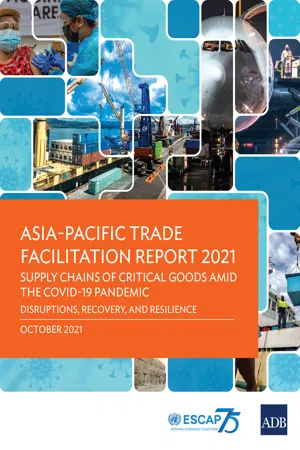
Supply chain disruptions caused by the coronavirus disease (COVID-19) pandemic have underscored the need for digital and paperless trade procedures to facilitate trade. This report reviews the impact of trade facilitation initiatives on trade costs in Asia and the Pacific since the pandemic began. A special chapter examines the pandemic's impact on the supply chains of critical goods such as vaccines, personal protective equipment, and food, and provides policy suggestions toward enhancing supply chain resilience along with trade facilitation. This is the third biennial progress report on trade facilitation implementation in Asia and the Pacific jointly prepared by the Asian Development Bank and the United Nations Economic and Social Commission for Asia and the Pacific.
- 86 pages
- English
- ePUB (mobile friendly)
- Available on iOS & Android
eBook - ePub
About this book
Information
1 Introduction
In the last 2 decades, trade flows have risen as firms have fragmented production activities. As they have strived to lower costs and improve efficiency, they have divided single production processes into multiple components and activities, often spread across geographic locations beyond national boundaries. This resulted in complex supply chains driven by trade and investment liberalization, lower transport costs, and advances in logistics and communication technologies. Though external factors have disrupted supply chains from time to time, including disasters triggered by natural hazards, financial crises, and epidemics, they have also resiliently recovered from such disruptions.
The coronavirus disease (COVID-19) pandemic, as noted, put considerable strain on global supply chains. Rising infections and national lockdowns and isolation rules slowed or even temporarily stopped the flow of goods across borders. Border closures, export controls, and additional health and safety protocols for shippers disrupted the flow of goods. This clearly revealed supply chain vulnerabilities. Lack of diversification across suppliers or countries for critical raw materials stalled manufacturing, endangering many livelihoods. On the demand side, mobility restrictions and anxiety over unavailability of essential goods raised prices, leading countries to ban exports to meet domestic demand. Unlike the previous disruptions, which were localized and developed over time, the impact of COVID-19 has been unprecedented, affecting global trade and incomes in a short span of time.
More particularly, the pandemic significantly stressed medical goods supply and food availability, threatening people’s health and well-being. While vaccines were developed at an unprecedented speed, deploying these to the global community, including Asia and the Pacific, has posed many challenges. Only a few countries are able to produce vaccines, trade restrictions and domestic stockpiling have challenged manufacturing at a global scale. Insufficient funding for adequate transport, logistics, and temperature-controlled storage infrastructure has hampered developing economies’ access to vaccines. It was also a challenge to boost the production of personal protective equipment (PPE) such as face masks and respirators during the pandemic, as most global production was outsourced to the People’s Republic of China (PRC) and lean inventory management systems across global supply chains could not respond quickly enough to surging global demand. Meanwhile, export bans and trade regulations challenged food trade, especially early in the pandemic, as major exporters of food staples such as wheat and rice imposed export restrictions, causing prices to spike in major importing countries. Mobility restrictions, lockdowns, and unavailability of transport also hampered domestic production of various food crops, including access to seeds and fertilizers, crop harvests, and distribution to urban centers. This also restricted port operations for distribution of imported food.
As the pandemic continued, addressing supply chain issues became crucial for the safe and quick delivery of goods and services. Governments across the globe made policy decisions to sustain business operations and improve availability of critical goods. They created fast-track lanes at border crossings, streamlined certification, relaxed regulation on trade in medical goods and food, and exempted related sectors from lockdown restrictions.
Discussions of supply chains will continue beyond the pandemic as countries resume their economic growth and revisit supply chain challenges and increase resiliency.
This theme chapter analyzes sources and impacts of previous disruptions and the current pandemic, the responses of firms and governments, and suggests policy for the way forward. Section 2 presents background on the sources of and responses to supply chain disruptions before and during the pandemic. The section also presents a framework on supply chain resilience, based on which, section 3 discusses areas of vulnerabilities and capabilities of supply chains for these essential goods. Section 4 presents case studies, looking at supply chains of essential commodities such as vaccines, PPE, and food heavily affected during the pandemic. Section 5 concludes with policy recommendations for greater resilience of cross-border supply chains.
2 Supply Chain Disruptions
2.1 | Causes of Disruptions
Supply chains have been disrupted to a greater or lesser extent by natural hazards such as typhoons, tsunamis, and earthquakes, as well as epidemic disease (Box 1). Table 1 lists major events that significantly disrupted supply chains and the estimated economic impacts. For example, the tsunami and nuclear fallout in 2011 in Japan affected automotive supply chains, with double-digit percentage declines in vehicle output in the PRC, Thailand, and the United States. Japan’s industrial production and exports dropped 7% and 8%, respectively, during the second quarter of the year (Pau et al. 2018). During the flooding of Thailand’s Chao Phraya river in 2011, many industrial parks were inundated, and the country’s automobile production dropped over 60% in the fourth quarter of that year.
Box 1: Disasters Triggered by Natural Hazards in Asia and the Pacific
In the past 2 decades, about 40% of disasters triggered by natural hazards have happened in Asia and the Pacific, with 44% in the Americas and Africa. Hydrological (floods) and meteorological (storms) are the most frequent disasters, consistent with the rest of the world. Among subregions, the top three are Southeast Asia, East Asia, and South Asia, with a combined 86% of total disasters experienced by these regions.
Distribution of Disasters by Region, 2000–2021

Notes: For an event to be considered a disaster, it must satisfy at least one of the following criteria: (i) 10 or more deaths, (ii) 100 or more people affected/injured/homeless, or (iii) official declaration of the country of a state of emergency and/or appeal for international assistance.
Source: Asian Development Bank calculations using the International Disaster Database. http://www.emdat.be (accessed June 2021).
Table 1: Selected Supply Chain Disruptions
Consequences/Damage | Post-Event Changes |
Disaster triggered by natural hazards | |
Tohoku earthquake and tsunami—Japan, March 2011 | |
• Power outages for months and some ports out of operation for more than a month. • Almost 20,000 dead or missing with substantial destruction of physical capital. • Economic damage around $210 billion. • Manufacturing output fell 15% in March and did not recover until July. • Japanese auto market share in the United States dropped from 40% in March to 30% in July and only repositioned back in 2012. | • Invested in accurate tsunami warning devices, installed seawalls and breakwaters. • Raised stocks and inventory of parts, diversified production, and created alternative manufacturing capabilities. • Opted for more standardized vehicle parts to improve efficiency and enable alternative production. |
Flood—Thailand, 2011 | |
• 19,000 destroyed homes. • 2.5 million displaced people/813 dead. • 17,578 square kilometers of impacted farmlands. • $46.5 billion of economic damages and losses ($32 billion in manufacturing sector). • Reduced the world’s industrial production by 2.5%. | • Redesigned their supply chain network to be more diversified in terms of location. • The Government of Thailand established the National Catastrophe Insurance Fund of Thailand to create a Catastrophe Insurance Policy. • Invested on infrastructure projects to mitigate flooding. |
Trade restriction | |
2007–2008 food price crisis | |
• Export restrictions, panic buying of major rice-importing countries. • World rice prices increased by 117% to 149% in the first quarter of 2008. | • ASEAN member countries establishing rice reserves, facilitating regional rice trade, food security information system, and innovations through research and development. |
Economic crisis | |
2007–2008 financial crisis | |
• Around 67,000 factories in the PRC have gone bankrupt. • 35% decrease in exports across Asia. • Intra-Asia trade decreased 48% at the highest. • Global trade decreased by two-thirds in 2009 from 2008. | • Refocused on stability and risk management but with less emphasis on cost reduction. |
Health crisis | |
2003 Severe acute respiratory syndrome (SARS) outbreak | |
• 8,5000 infected / 912 deaths. • Estimated GDP loss of $13 billion combined for the PRC; Singapore; Hong Kong, China; and Taipei,China. • Overall economic cost 0.5%–1% of annual GDP across the Asia-Pacific Economic Cooperation economies. • Loss in tourism, leisure, and transport: $8.5 billion in the PRC, $1.4 billion in Malaysia, and $1.3 billion in Hong Kong, China. • Hong Kong, China experienced high unemployment up to 8.7% until the outbreak was contained. | • Short-term adjustments business continuity plans such as working from home, video conferencing, setting up operations at parallel sites, or shifting operations to other locations. • There were no major changes in the supply chain. However, the travel bans and quarantine made firms consider diversifying their production rather than one big facility in a single location. |
Ebola 2014–2016 outbreak in West Africa | |
• Agricultural production declined and cross-border trade decreased as restrictions on movements, goods, and services increased. • 28,600 confirmed cases and 11,325 deaths by the end of the outbreak. • Estimated to have cost of $4.3 billion total for countries affected. • Investments in Guinea, Liberia, and Sierra Leone dramatically decreased. | • UNICEF identified issues in manufacturing capacities for PPEs from their supplier and swiftly decided to form new contracts with different suppliers to ramp up PPE production. • UNICEF provided long-range forecasts and established long-term arrangements with different suppliers to solve bottlenecks in their PPE supplies. |
1918 Influenza pandemic (Spanish flu) | |
• Estimated about 500 million infected and at least 50 million dead around the world. • In the typical country, real per capita GDP declined by 6% and private consumption by 8%. • Countries that suffered a 2% average death rate are thought to have experienced an estimated 26% drop in real stock returns. | • Information not available. |
ASEAN = Association of Southeast Asian Nations, GDP= gross domestic product, PPE = personal protective equipment, PRC = People’s Republic of China, UNICEF = United Nations Children’s Fund.
Sources: Barro, Ursúa, Weng (2020); Bénassy-Quéré et al. (2009); Boehm, Flaaen, and Pandalai-Nayar (2019); CDC (2015); CDC (n.d.); CRED (2011); Goentzel (2015); Haraguchi and Lall (2015); Keat (2009); Koshimura and Shuto (2015); Kumar (2012); Leckcivilize (2012); Mefford (2009); Noy and Shields (2019); Rushton et al. (2005); Tajitsu (2016); Wailes et al. (2012).
Despite Asia and the Pacific’s vulnerability to natural hazards, several disasters triggered by these hazards in the last 2 decades have caused only shor...
Table of contents
- Front Cover
- Title Page
- Copyright Page
- Contents
- Tables, Figures, and Boxes
- Foreword by Armida Salsiah Alisjahbana, ESCAP
- Foreword by Bambang Susantono, ADB
- Acknowledgments
- Abbreviations
- Highlights
- Digital and Sustainable Trade Facilitation
- Supply Chains of Critical Goods amid the COVID-19 Pandemic—Disruptions, Recovery, and Resilience
- Footnotes
- Back Cover
Trusted by 375,005 students
Access to over 1.5 million titles for a fair monthly price.
Study more efficiently using our study tools.
Frequently asked questions
Yes, you can cancel anytime from the Subscription tab in your account settings on the Perlego website. Your subscription will stay active until the end of your current billing period. Learn how to cancel your subscription
No, books cannot be downloaded as external files, such as PDFs, for use outside of Perlego. However, you can download books within the Perlego app for offline reading on mobile or tablet. Learn how to download books offline
Perlego offers two plans: Essential and Complete
- Essential is ideal for learners and professionals who enjoy exploring a wide range of subjects. Access the Essential Library with 800,000+ trusted titles and best-sellers across business, personal growth, and the humanities. Includes unlimited reading time and Standard Read Aloud voice.
- Complete: Perfect for advanced learners and researchers needing full, unrestricted access. Unlock 1.5M+ books across hundreds of subjects, including academic and specialized titles. The Complete Plan also includes advanced features like Premium Read Aloud and Research Assistant.
We are an online textbook subscription service, where you can get access to an entire online library for less than the price of a single book per month. With over 1.5 million books across 990+ topics, we’ve got you covered! Learn about our mission
Look out for the read-aloud symbol on your next book to see if you can listen to it. The read-aloud tool reads text aloud for you, highlighting the text as it is being read. You can pause it, speed it up and slow it down. Learn more about Read Aloud
Yes! You can use the Perlego app on both iOS and Android devices to read anytime, anywhere — even offline. Perfect for commutes or when you’re on the go.
Please note we cannot support devices running on iOS 13 and Android 7 or earlier. Learn more about using the app
Please note we cannot support devices running on iOS 13 and Android 7 or earlier. Learn more about using the app
Yes, you can access Asia-Pacific Trade Facilitation Report 2021 by in PDF and/or ePUB format, as well as other popular books in Computer Science & Desktop Applications. We have over 1.5 million books available in our catalogue for you to explore.