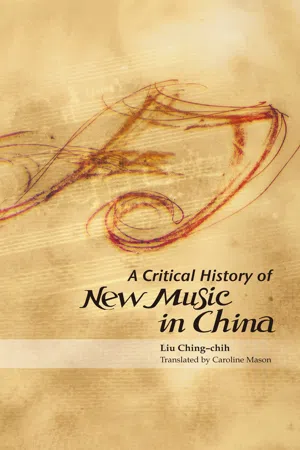
By the end of the nineteenth century, Chinese culture had fallen into a stasis, and intellectuals began to go abroad for new ideas. What emerged was an exciting musical genre that C. C. Liu terms "new music." With no direct ties to traditional Chinese music, "new music" reflects the compositional techniques and musical idioms of eighteenth- and nineteenth-century European styles. Liu traces the genesis and development of "new music" throughout the twentieth century, deftly examining the social and political forces that shaped "new music" and its uses by political activists and the government.
- 960 pages
- English
- PDF
- Available on iOS & Android
eBook - PDF
A Critical History of New Music in China
About this book
Information
Publisher
The Chinese University of Hong KongeBook ISBN
9789629963606
Year
2010Table of contents
- Half title page
- Title page
- Copyright
- Contents
- List of Musical Examples
- List of Plates
- Translator’s Note
- Frontispiece
- Prologue
- 1. Introduction: New Music in China and Its Theoretical Foundations
- 2. The Origins of New Music (1885–1919): The Westernisation of Military Music and the Birth of Schoolsong
- 3. New Music in the May Fourth Period (1919–1937)
- 4. The Mass Singing Movement and Musical Creation in the Anti-Japanese War Period (1937–1945)
- 5. New Music Education and Creation during the Civil War (1946–1949) and in the Seventeen Years after the Founding of the People’s Republic of China (1949–1966)
- Chapter 6. Yangbanxi and the Music of the Cultural Revolution (1966–1976): Revolutionary Modern Peking Opera, Ballet, Symphonic Music and Songs
- 7. Musical Creation after the Cultural Revolution and New Wave Music
- 8. New Music and Composers in Taiwan, Hong Kong and Macao
- 9. Review and Reflection: Historical Review (1885–1985) and the Sinicisation and Modernisation of New Music
- 10. New Development (1996–2006): Mainland China, Overseas, Taiwan and Hong Kong
- Epilogue
- Notes
- Appendix i
- Appendix ii
- Appendix iii
- References
- Glossary
- Chart I
- Chart II
- Index of Names
- Index of Subjects
Trusted by 375,005 students
Access to over 1.5 million titles for a fair monthly price.
Study more efficiently using our study tools.