Over a ten-year period, Professor Ma carried out cross-disciplinary research in Hong Kong focused on the effectiveness of structural family therapy for Chinese patients suffering from anorexia nervosa. She found that although the Chinese patients received the same diagnosis as their Western counterparts, their experiences throughout the stages of the disease differed significantly due to interpersonal contexts and subjective cultural factors. The present collection synthesizes this clinical experience into a culturally specific, socially relevant, and clinically useful family treatment model for patients.
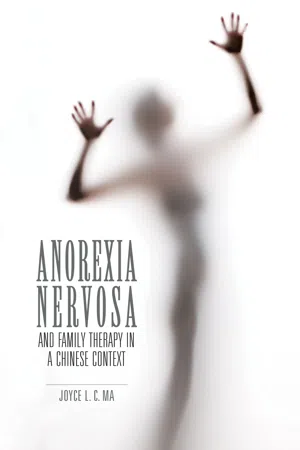
- 284 pages
- English
- PDF
- Available on iOS & Android
eBook - PDF
Anorexia Nervosa and Family Therapy in a Chinese Context
About this book
Information
Publisher
The Chinese University of Hong KongeBook ISBN
9789629964603
Year
2011Table of contents
- Title Page
- Copyright
- Contents
- Acknowledgments
- Preface
- 1. Introduction
- Part I. Anorexia Nervosa
- 2. Medical Aspects of Anorexia Nervosa
- Part II. The Family TreatmentModel and Clinical Issues inManaging Anorexia Nervosa
- 3. Underlying Theoretical Perspectives
- 4. The Family Treatment Model
- 5. Treatment Process
- 6. Developing a Therapeutic Relationship
- 7. Risk Assessment and Clinical Management
- Part III. The Journey of Healing:Case Illustrations
- Prelude
- 8. Coping With Anorexia Nervosa in anExtended Chinese Family, Jia
- 9. Breaking the Silence by Interdisciplinary Collaboration
- 10. Anorexia Nervosa in a Poor Family
- Part IV. Perceived Treatment Effectiveness andTreatment Efficacyof Family Therapy
- 11. Perceived Treatment Effectiveness of Family Therapy
- 12. Perceived Treatment Efficacy of Family TherapyFrom the Perspective of the Therapist and the Families and Concluding Remarks
- Appendices
- Appendix 1. Voices of the Chinese Emaciated Young People
- Appendix 2. Voices of the Afflicted Families
- Appendix 3. Interview Guide for Pretreatment Interview
- Appendix 4. Interview Guide for Posttreatment Interview
- References
- Index
Trusted by 375,005 students
Access to over 1.5 million titles for a fair monthly price.
Study more efficiently using our study tools.