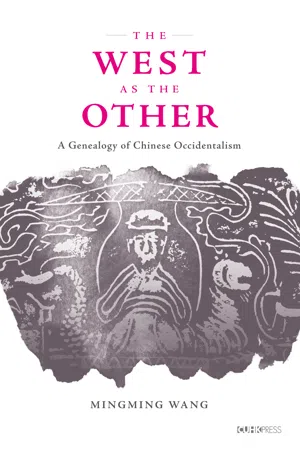
Long before the Europeans reached the East, the ancient Chinese had elaborate and meaningful perspectives of the West. In this groundbreaking book, Wang explores their view of the West as other by locating it in the classical and imperial China, leading the reader through the history of Chinese geo-cosmologies and world-scapes. Wang also delves into the historical records of Chinese "world activities, " journeys that began from the Central Kingdom and reached towards the "outer regions." Such analysis helps distinguish illusory geographies from realistic ones, while drawing attention to their interconnected natures.Wang challenges an extensive number of critical studies of Orientalist narratives (including Edward Said's Orientalism), and reframes such studies from the directionological perspectives of an "Oriental" civilization. Most significantly, the author offers a fundamental reimagining of the standard concept of the other, with critical implications not only for anthropology, but for philosophy, literature, history, and other interrelated disciplines as well.
- 400 pages
- English
- PDF
- Available on iOS & Android
eBook - PDF
About this book
Information
Publisher
The Chinese University of Hong KongeBook ISBN
9789629964894
Year
2014Table of contents
- Half Title Page
- Title Page
- Copyright
- Contents
- List of Figures
- Preface
- Acknowledgements
- Notes on Transliteration and Bibliography
- 1. Introduction: Rethinking “the West”
- 2. King Mu (Mu Tianzi) andthe Journey to the West
- 3. “Illusionary” and “Realistic” Geographies
- 4. Easternizing the West, Westernizing the East
- 5. Chaos and the West
- 6. “Western Territories” (Xiyu),India, and “South Sea” (Nanhai)
- 7. Beyond the Seas:Other Kingdoms and Other Materials
- 8. Islands, Intermediaries,and “Europeanization”
- 9. Conclusion:Towards Other Perspectives of the Other
- Postscript
- Notes
- Glossary
- Bibliography
- Index
Trusted by 375,005 students
Access to over 1.5 million titles for a fair monthly price.
Study more efficiently using our study tools.