Learning to Emulate the Wise is the first book of a three-volume series that constructs a historically informed, multidisciplinary framework to examine how traditional Chinese knowledge systems and grammars of knowledge construction interacted with Western paradigms in the formation and development of modern academic disciplines in China.Within this volume, John Makeham and several other noted sinologists and philosophers explore how the field of "Chinese philosophy" (Zhongguo Zhexue) was born and developed in the early decades of the twentieth century, examining its growth and relationship with European, American, and Japanese scholarship and philosophy. The work discusses an array of representative institutions and individuals, including FengYoulan, Fu Sinian, Hu Shi, Jin Yuelin, Liang Shuming, Nishi Amane, Tang Yongtong, Xiong Shili, Zhang Taiyan, and a range of Marxist philosophers. The epilogue discusses the intellectual-historical significance of these figures and throws into relief how Zhongguozhexue is understood today.
eBook - PDF
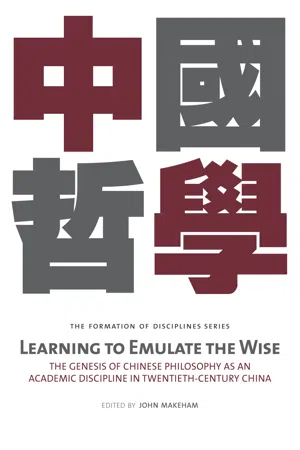
Learning to Emulate the Wise 中國哲學
The Genesis of Chinese Philosophy as an Academic Discipline in Twentieth-Century China
- 416 pages
- English
- PDF
- Available on iOS & Android
eBook - PDF
Learning to Emulate the Wise 中國哲學
The Genesis of Chinese Philosophy as an Academic Discipline in Twentieth-Century China
About this book
Information
Publisher
The Chinese University of Hong KongeBook ISBN
9789629964788
Year
2012Table of contents
- Half Title Page
- Title Page
- Copyright
- Frontispece
- Acknowledgments
- Contents
- About the Series
- List of Contributors
- Introduction
- Part I. From Philosophy to Zhexue
- 1. Nishi Amane and the Birth of “Philosophy” and “Chinese Philosophy”
- 2. The Role of Masters Studies in the Early Formation of Chinese Philosophy
- 3. Zhang Taiyan, Yog¯ac¯ara Buddhism, and Chinese Philosophy
- Part II. The Beida and Tsinghua Schools of Philosophy
- 4. Developing the Academic Discipline of ChinesePhilosophy
- 5. Hu Shi and the Search for System
- 6. Introducing Buddhism as Philosophy
- 7. Daoism as Academic Philosophy
- 8. Jin Yuelin’s Ambivalent Status as a “Chinese Philosopher”
- Part III. The Critics’ Voices
- 9. Fu Sinian’s Views on Philosophy, Ancient ChineseMasters, and Chinese Philosophy
- 10. Marxist Views on Traditional Chinese Philosophy Pre-1949
- Epilogue
- Index
Trusted by 375,005 students
Access to over 1.5 million titles for a fair monthly price.
Study more efficiently using our study tools.