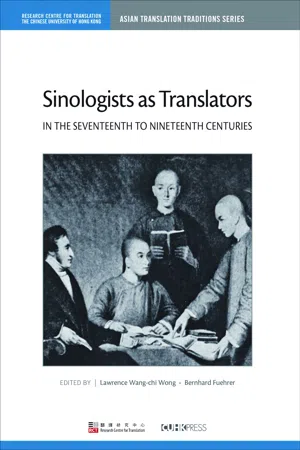
This is a collection of eleven papers from the first and second international conferences "Sinologists as Translators in the 17–19th Centuries." With a focus on the historical context of contributions by early Sinologists and their translations of works in Chinese, papers within this volume explore why certain works were chosen for translation, how they were interpreted, translated, or even manipulated, and the impact they made, especially in establishing the discipline of Sinology in various countries. This book aims to reconstruct a wider historical and intellectual context from which certain translations emerged, and also to further expand the field through the extensive use of hitherto overlooked archive material so as to open up fresh avenues for research.
eBook - PDF
Sinologists as Translators in the Seventeenth to Nineteenth Centuries
- 460 pages
- English
- PDF
- Available on iOS & Android
eBook - PDF
Sinologists as Translators in the Seventeenth to Nineteenth Centuries
About this book
Information
Publisher
The Chinese University of Hong KongeBook ISBN
9789629966072
Year
2015Table of contents
- About the Series
- Title Page
- Copyright
- Series Editor’s Preface
- Table of Contents
- Acknowledgements
- Introduction
- 1. Translating the Confucian Classics:The Lunyu in the Confucius Sinarum Philosophus (1687)
- 2. The Manuscript of the Daodejing in the British Library
- 3. Filial Piety, the Imperial Works, and Translation:Pierre-Martial Cibot and The Book of Filial Piety
- 4. Location, Location, Location:Peter Perring Thoms (1790–1855), Cantonese Localism, andthe Genesis of Literary Translation from the Chinese
- 5.“Objects of Curiosity”:John Francis Davis as a Translator of Chinese Literature
- 6. Early French Sinology and the Question of“Plagiarizing” Re-translation:The Case of Heinrich Kurz’ German Rendition of Huajian ji
- 7. August Pfizmaier (1808–1887) and His Translationsfrom Chinese Poetry
- 8. Translation and the British Colonial Mission:The Career of Samuel Turner Fearon and the Establishment ofChinese Studies in King’s College London
- 9. Kingsmill’s Shijing “Translations” into Sanskrit andthe Idea of “Congenial Languages” at the End of theNineteenth Century
- 10. Early Translations of Chinese Literature into German:The Example of Wilhelm Grube (1855–1908) andHis Translation of Investiture of the Gods
- 11. Collaborators and Competitors:Western Translators of the Yijing in the Eighteenth andNineteenth Centuries
- Contributors
Trusted by 375,005 students
Access to over 1.5 million titles for a fair monthly price.
Study more efficiently using our study tools.