The Silk Manuscripts from Zidanku, Changsha (Hunan), are the only pre-Imperial Chinese manuscripts on silk found to-date. Dating to the turn from the 4th to the 3rd centuries BC (Late Warring States period), they contain several texts concerning basic cosmological concepts, including one manuscript (Manuscript 1) with a diagrammatic arrangement and surrounded by pictorial illustrations. As such, they constitute a unique source of information complementing and going beyond what is known from transmitted texts.This is the first in a two-volume monograph on the Zidanku manuscripts, reflecting almost four decades of research by Professor Li Ling of Peking University. While the philological study and translation of the manuscript texts is the subject of Volume Two, this first volume presents the archaeological context and history of transmission of the physical manuscripts. It records how they were taken from their original place of interment in the 1940s and taken to the United States in 1946; documents the early stages in the research on the finds from the Zidanku tomb and its re-excavation in the 1970s; and accounts for where the manuscripts were kept before becoming the property, respectively, of the Arthur M. Sackler Foundation, New York (Manuscript 1), and the Freer and Sackler Galleries, Smithsonian Institution (Manuscripts 2 and 3). Superseding previous efforts, this is the definitive account that will sets the record straight and establishes a new basis for future research on these uniquely important artifacts.----------"The Chu Silk Manuscripts from Zidanku, the oldest documents on silk with writing and images, are among the most exciting and enigmatic remnants from Chinese antiquity. Ever since their discovery in 1942 and their transferal to the US in 1946 scholars have grappled with how to interpret them. This now is the authoritative study. It is the collaborative effort of Li Ling, China's foremost paleographer, and Lothar von Falkenhausen, the unrivalled expert on Chinese epigraphy in the US—a felicitous example of Sino-American cooperation."—Lothar LedderoseSenior Professor, Institute of East Asian Art History, Heidelberger Akademie der Wissenschaften"The 1942 discovery of the Zidanku manuscript was a seminal event in the study of early Chinese paleography and religion. Now seventy years later, Li Ling's definitive monograph unveils the mysteries surrounding its discovery, transmission, preservation, and decipherment to an international audience. This volume compiles and assesses with immaculate accuracy and critical acumen all extant relevant material that Li Ling uncovered during his over thirty-year pursuit for answers in and out of China among archaeologists, historians, paleographers, and conservation scientists—a true model of interdisciplinary and international research, and an inspiration to all scholars in early China studies."—Jenny F. SoSenior Curator for Early Chinese Art (1990–2000), Freer|Sackler Galleries, Smithsonian Institution"This important book by Professor Li Ling is the result of a lifetime's work of investigation into the Chu manuscripts from Zidanku, and recounts their fate from their discovery in the 1940s up to today. Professor Lothar von Falkenhausen has generously put his expertise at the service of the translation of this monumental work, perfectly reflecting one of the most valuable qualities of its author: his art of expressing the most difficult things simply and in a unique style in order to make them accessible to the greatest number of people."—Marianne BujardÉcole Pratique des Hautes Études, Paris"Professor Li Ling's splendid book offers to the Western public the first ever comprehensive monograph on the Chu Silk Manuscripts from Zidanku in Changsha (Hunan), including the archaeological context of their discovery. This masterful research, to which he has devoted more than thirty years, is not only a minute investigation—the most extensive of its kind on the famous manuscripts—but also a very valuable contribution to our understanding of the intellectual life of the Late Warring States period."—Alain ThoteÉcole Pratique des Hautes Études, Paris
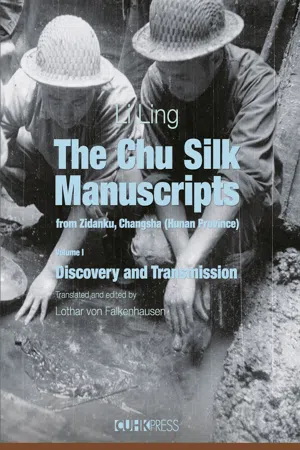
eBook - PDF
The Chu Silk Manuscripts from Zidanku, Changsha (Hunan Province)
Volume 1: Discovery and Transmission
- 252 pages
- English
- PDF
- Available on iOS & Android
eBook - PDF
The Chu Silk Manuscripts from Zidanku, Changsha (Hunan Province)
Volume 1: Discovery and Transmission
About this book
Information
Publisher
The Chinese University of Hong KongeBook ISBN
9789882370975
Year
2019Table of contents
- Half Title page
- Copyright page
- Title page
- Table of Contents
- Introduction
- Translator’s Preface
- Part A The Chu Tomb at Zidanku
- I. Accounts of the Discovery
- II. The 1973 Excavation
- III. List of Items Unearthed from the Chu Tomb at Zidanku
- IV. Figures
- (1) Maps of Changsha and Photos of the Site
- (2) Plan of the Zidanku Chu Tomb
- (3) Burial Chamber and Coffins
- (5) The Bamboo Containers and the Silk Manuscripts
- (6) Bronze Weapons: The Sword
- (7) The Jade bi Disk (with Its Band)
- (8) Ceramic Vessels
- (9) Lacquered and Wood Objects
- (10) Textiles
- Part B Related Documents
- I. Examination and Verification of the Late Zhou Silk Manuscript
- (1) Explanations
- (2) Front Matter and Author’s Preface
- (3) Philological Study of the Silk Manuscripts
- (4) Transcription of the Silk Manuscript
- (5) On the Illustrations of the Silk Manuscript
- (6) The Tomb of the Silk Manuscript
- (7) The Manuscript Basket Containing the Silk Manuscript
- (8) Various Objects Unearthed with the Silk Manuscript
- (9) “Biography of the Heroic Wife of the Cai Family fromChangsha”
- II. First Preliminary Excavation Report
- (1) Explanations
- (2) A Newly Discovered Silk Painting from a Warring States–Period Chu Tomb at Changsha
- III. Second Preliminary Excavation Report
- (1) Explanations and Introduction
- (2) The Warring States–Period Burial-Chamber Tomb atZidanku, Changsha
- IV. Dossier on the Removal of theChu Silk Manuscripts to the United States
- (1) Prefatory Remarks by the Journal Editors
- (2) Letter from Cai Jixiang to Shang Chengzuo
- (3) Dossier on the Silk Manuscripts
- (4) Afterword by Shang Zhitan
- V. Relevant Letters from Cai Jixiang to John H. Cox
- (1) First Letter (July 18, 1946)
- (2) Second Letter (ca. November 6, 1946)
- (3) Third Letter (ca. November 28, 1946)
- VI. Fu Peihe’s Interactions with John H. Coxon Behalf of Cai Jixiang
- (1) Cai Jixiang to an Unknown Addressee
- (2) Cai Jixiang to Fu Peihe (January 30 or February 20, 1947)
- (3) Fu Peihe to Cai Jixiang (July 26, 1947)
- (4) Fu Peihe to Cai Jixiang (October 2, 1947)
- (5) Fu Peihe to Cai Jixiang (ca. 1950)
- VII. Wu Zhucun’s Interactions with John H.Cox on Behalf of Cai Jixiang
- (1) John H. Cox to Wu Zhucun (July 7, 1948)
- (2) Wu Zhucun to Cai Jixiang (July 16, 1948)
- (3) Cai Jixiang to Wu Zhucun (August 9, 1948)
- (4) Wu Zhucun to Cai Jixiang (September 24, 1948)
- (5) Appendix: Excerpts of the Transcript of Wu Zhucun’sRecollections (February 5, 1956)
- VIII. How Frederic D. Schultheis Brought the Silk Manuscripts to the United States
- (1) Explanations
- (2) Frederic D. Schultheis to Arthur M. Sackler (November22, 1967)
- (3) Memorandum
- (4) Arthur M. Sackler to Frederic D. Schultheis (November28, 1967)
- (5) Frederic D. Schultheis to Arthur M. Sackler (November30, 1967)
- (6) Arthur M. Sackler to Frederic D. Schultheis (December 4, 1967)
- (7) Frederic D. Schultheis to Arthur M. Sackler (December 9,1967)
- IX. Arthur M. Sackler’s Last Wish
- (1) Explanations
- (2) Excerpt from Lois Katz, “The Arthur M. Sackler Collections”
- (3) Excerpt from Miranda McClintick, “The Arthur M. Sackler Gallery at the Smithsonian Institution, Washington,D.C.: A New Museum of Asian and Near Eastern Art”
- (4) Arthur M. Sackler, “A Tribute to Kuo Mo-jo"
- X. Paul Singer’s Recollections
- (1) Explanations
- (2) The Ch’u Silk Manuscript
- XI.Further Records Involving John H. Cox
- (1) Explanations
- (2) Short Memorandum from the John H. Cox Archive at the University of Chicago
- (3) Li Ling to John H. Cox (January 22, 1993)
- (4) Dr. Thomas Lawton to Professor Li Ling ( June 11, 1993)
- (5) John H. Cox to Dr. Thomas Lawton (April 30, 1993)
- XII. The Changing Whereabouts of the Zidanku SilkManuscripts in the United States
- (1) Overview
- (2) Receipt Issued by the William Rockhill Nelson Gallery of Art to Frederic D. Schultheis
- (3) Cardboard Box Cover in the Cox Archive, with Registration Tags from the Fogg Art Museum
- (4) Receipt on the Return of the Zidanku Silk Manuscripts by the Freer Gallery of Art (December 9, 1947)
- (5) Documents Relating to the Withdrawal by John H. Coxof Antiquities Previously Loaned to the Metropolitan Museum of Art
- (6) Records of the Arthur M. Sackler Foundation aboutZidanku Silk Manuscript 1
- (7) Record of John Hadley Cox’s Donation of the ZidankuSilk-Manuscript Fragments to the Freer and Sackler Galleriesof Art
- XIII. Letter to Milo Cleveland Beach Signed byTwenty-Seven International Scholars
- Part C Related Photographs
- 1. Changsha
- 2. Changsha: College of Yale-in-China, Yali Middle School, and the Hsiang-Ya Medical College
- 3. Tomb Looting at Changsha during the 1930s
- 4. Cai Jixiang and His Family
- 5. Mingxiacun No. 5, Shanghai: Home of Cai Jixiang from 1937 to1943
- 6. Shanghai: Wugong Hotel, Cai Jixiang’s Place of Lodging in 1946
- 7. Shanghai: Gascogne Apartments, John Cox’s Place of Lodging in 1946
- 8. Li Ling
- 9. Bai Rongjin
- Part D Timeline
- 1897–1927
- 1928–1936
- 1937–1945
- 1946–1949
- 1950–1960
- 1961–1965
- 1966–1970
- 1971–1980
- 1981–1990
- 1991–2013
- Bibliography
Trusted by 375,005 students
Access to over 1.5 million titles for a fair monthly price.
Study more efficiently using our study tools.