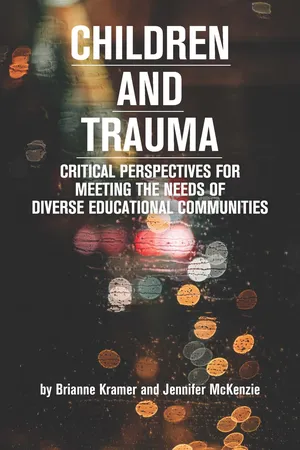
According to the American Psychological Association (APA, 2015), trauma is an emotional response to a terrible event, which can lead to difficulties with emotional regulation, social relationships, and the development of physical symptoms. Traumatic experiences may include physical or sexual abuse, neglect, experiencing or witnessing violence, war, suicides, and disasters. Because of the prevalence of students with traumatic experiences in K-12 schools, development and use of trauma-informed practices (TIP) is currently increasing in educational spaces across the United States as educators and others who work with children become more aware of how socio-emotional development and exposure to trauma places children on a pathway through adulthood. Because of growth in these areas, it is important for educators and others who work with children to have a resource to consult. Children and Trauma: Critical Perspectives for Meeting the Needs of Diverse Educational Communities provides teachers, administrators, and others involved in education with an understanding of trauma-informed practices and explains how they can be used in the classroom. Additionally, school districts could utilize this text to implement professional development, particularly if they are considering creating a districtwide trauma-informed system. Perfect for courses such as: Trauma-Informed Educational Practice | Psychology | Educational Psychology | Foundations of Education | Pedagogy | Methods of Emotional or Behavioral Disorders | Teaching Methods | Diversity in Education | Social Work | Human Development
eBook - PDF
Children and Trauma
Critical Perspectives for Meeting the Needs of Diverse Educational Communities
- 379 pages
- English
- PDF
- Available on iOS & Android
eBook - PDF
Children and Trauma
Critical Perspectives for Meeting the Needs of Diverse Educational Communities
About this book
Information
Topic
EducationSubtopic
Education GeneralTable of contents
- Cover
- Half-Title
- Title
- Copyright
- Dedication
- Contents
- Acknowledgments
- Introduction
- Chapter 1: A Bioecological Model for School-Based Trauma Informed Practice (Theresa Kruczek)
- Chapter 2: Trauma, Adversity, and the Classroom Teacher: Systematically Planning for Safety and Resiliency (Doyle Pruitt and Peter Kozik)
- Chapter 3: Integrated Theories for Integrated Childhoods: How Bioecological Systems Theory and Relational Cultural Theory Shape Trauma-Informed Care in Schools (Joel Arvizo-Zavala, Yifat Levenstein, and Amira Trevino)
- Chapter 4: Ensuring the Success of Young Children: Trauma-Informed Practice in the Preschool Classroom (Marla J. Lohmann, Johanna P. Higgins, and Jennifer Rossman)
- Chapter 5: Understanding the Impact of Trauma on School-Age Children and Their Families (Jennifer Foster and Aneesh Kumar)
- Chapter 6: Helping the Helpers in Education (Jody A. Kunk-Czaplicki and R. Jason Lynch)
- Chapter 7: Research and Teaching Methods for Children Who Have Experienced Trauma (Meghan Kessler and Michele Miller)
- Chapter 8: Relationship Over Reproach: One School’s Efforts in Fostering Resilience Through Trauma-Informed Practices (Carrie Giboney Wall)
- Chapter 9: A Trauma-Informed School District Case Study: Iron County School District (Maren Hirschi and Shawn Christiansen)
- Chapter 10: Strategies to Meet the Needs of Students with Trauma (Natalia Assis, Mark Reid, Angela Proctor, and Thomas Brooks)
- Chapter 11: The Impact of Trauma on Rural Communities (Susanne James, Anni Reinking, and Jayme Swanke)
- Chapter 12: Trauma’s Impact on Urban School Districts: An Action Plan for Educators (Jennifer Hernandez)
- Chapter 13: The Need for a New Trauma-Informed Framework: Integrating Social Justice Education (Brianne Kramer)
- Chapter 14: rACEism: Addressing Adverse Childhood Experiences (ACEs) of African American Youth in K–12 Education and Beyond (Laura Danforth, John W. Miller, Jr., and Jaqueline Burse)
- Chapter 15: Indigenous Methodologies for Teaching in a Trauma-Informed Health Education Program (Sarah Allen, Rae Deernose, Alma Knows His Gun McCormick, Shannen Keene, Brianna Bull Shows, John Hallett, Mark Schure, Suzanne Held, and Christiane Parrish)
- Chapter 16: Blurred Lines: Trauma and Educational Disability (Jennifer M. McKenzie)
- Chapter 17: Responding to Trauma: Considerations of Attachment of Youth in Foster Care (Amanda Hill)
- Chapter 18: A Call to Action: Recommendations for Teacher Advocacy in the Aftermath of 2020 (Brianne Kramer, Jennifer M. McKenzie, and John Rodari Meisner)
- Conclusion
- Editor and Author Biographies
- Index
Trusted by 375,005 students
Access to over 1.5 million titles for a fair monthly price.
Study more efficiently using our study tools.
Frequently asked questions
Yes, you can cancel anytime from the Subscription tab in your account settings on the Perlego website. Your subscription will stay active until the end of your current billing period. Learn how to cancel your subscription
No, books cannot be downloaded as external files, such as PDFs, for use outside of Perlego. However, you can download books within the Perlego app for offline reading on mobile or tablet. Learn how to download books offline
Perlego offers two plans: Essential and Complete
- Essential is ideal for learners and professionals who enjoy exploring a wide range of subjects. Access the Essential Library with 800,000+ trusted titles and best-sellers across business, personal growth, and the humanities. Includes unlimited reading time and Standard Read Aloud voice.
- Complete: Perfect for advanced learners and researchers needing full, unrestricted access. Unlock 1.5M+ books across hundreds of subjects, including academic and specialized titles. The Complete Plan also includes advanced features like Premium Read Aloud and Research Assistant.
We are an online textbook subscription service, where you can get access to an entire online library for less than the price of a single book per month. With over 1.5 million books across 990+ topics, we’ve got you covered! Learn about our mission
Look out for the read-aloud symbol on your next book to see if you can listen to it. The read-aloud tool reads text aloud for you, highlighting the text as it is being read. You can pause it, speed it up and slow it down. Learn more about Read Aloud
Yes! You can use the Perlego app on both iOS and Android devices to read anytime, anywhere — even offline. Perfect for commutes or when you’re on the go.
Please note we cannot support devices running on iOS 13 and Android 7 or earlier. Learn more about using the app
Please note we cannot support devices running on iOS 13 and Android 7 or earlier. Learn more about using the app
Yes, you can access Children and Trauma by Brianne Kramer,Jennifer McKenzie in PDF and/or ePUB format, as well as other popular books in Education & Education General. We have over 1.5 million books available in our catalogue for you to explore.