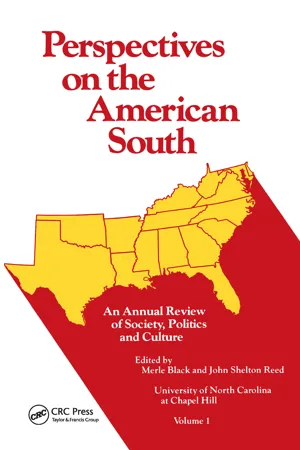
First Published in 1981. In Perspectives on the American South we hope to gather, yearly, essays that deal with the society, politics, and culture of the region. This first book in the series contains 27 articles, representing the work of some 30 scholars, and including the disciplines of history, sociology, anthropology, political science, and geography. The papers have been organized around four broad topics: violence in the region, southern politics, comparative studies of the region, and the South's ethnic and cultural groups.
eBook - ePub
Perspectives on the American South
An Annual Review of Society, Politics, and Culture
- 422 pages
- English
- ePUB (mobile friendly)
- Available on iOS & Android
eBook - ePub
Perspectives on the American South
An Annual Review of Society, Politics, and Culture
POLITICS IN THE SOUTH
DOI: 10.4324/9781315025674-8
IDEOLOGICAL REALIGNMENT AND THE NATIONALIZATION OF SOUTHERN POLITICS: PARTY ACTIVISTS AND CANDIDATES IN VIRGINIA
Alan I. Abramowitz
DOI: 10.4324/9781315025674-9
The possibility of a party realignment in the American South has fascinated students of electoral behavior and southern politics for the past quarter century.1 Almost all of the research on this topic, however, has been concerned with voting behavior. The central argument of this study is that a party realignment also involves a change in the nature of the choices that are offered the electorate by party elites. In the United States, since the New Deal, the national Democratic and Republican parties have generally presented the electorate with a choice between liberal and conservative political philosophies. This study examines the clarity of choices presented to voters by party elites—activists and candidates—in Virginia, a southern state that has recently witnessed the rapid development of two-party competition.
The South has long been recognized as the most distinctive region of the United States. In the past two decades, the South has also undergone greater change than any other region of the United States. The civil rights revolution, urbanization, population movement, and economic development have altered the face of southern society. These developments have also produced dramatic changes in southern politics. The black vote is now a force to be reckoned with throughout the South. Overt appeals to white racial prejudice by candidates for office have virtually disappeared.2 Two-party competition is well established in presidential elections and has emerged in many contests for statewide office.3 Taken together, these changes seem to indicate a gradual nationalization of southern politics.
The transformation of the South is far from complete, however. The region remains poorer, less urbanized, and less industrialized than the North, with a higher proportion of blacks and Protestants and a lower proportion of union members, Roman Catholics, and Jews. Southerners as a group tend to be more socially conservative, nationalistic, and religious than non-southerners, with stronger attachments to their local communities.4 Two-party competition has not yet extended below the level of the more visible statewide offices and most southern state legislatures remain overwhelmingly Democratic. As of 1977, Republicans held barely 10 percent of the legislative seats in the South. Moreover, despite the growing importance of the black vote and the decline of race-baiting as a campaign tactic, southern Democrats can still be distinguished from their northern colleagues. Even with a fellow southern Democrat in the White House, the conservative coalition of Republicans and southern Democrats remains a potent force in Congress on many issues.5
The South has changed, yet it remains distinctive. This study is concerned with two of the most important political changes that have occurred in the South in the past quarter century: the uneven development of a two-party system and the ideological realignment of the Democratic Party. Because the nationalization of party politics is more advanced than in most other southern states, Virginia provides a useful setting for studying changes that are gradually affecting many other parts of the region. We are interested in how far the process of ideological realignment has advanced within the Democratic Party, what forces are producing or inhibiting this realignment, and what the future may hold for the party system.
Realignment theory provides a framework for analyzing southern political change. We must modify the theory to apply it to party elites, however. The concept of party realignment was introduced by Key to denote a relatively rapid shift in the strength and social composition of party electoral coalitions which becomes evident in a "critical election," such as the 1932 presidential contest.6 Key and the Michigan SRC group later modified this theory to recognize that the process of realignment may be more protracted and extend through several successive elections in what was termed a "realigning electoral era."7 More recent research has tended to confirm this view. Anderson has shown that the New Deal realignment was accomplished largely by means of the mobilization of new and previous non-voters over a period of several elections rather than a sudden conversion of former Republican voters into Democrats.8 Likewise, Sundquist has analyzed aftershocks of the New Deal realignment evident for several decades after the first Roosevelt election, while Ladd and Hadley have shown that the composition of the party coalitions in the electorate evolves continuously in response to social and economic developments.9
If we view realignment as a secular process, it is clear that the southern electorate has undergone a partial realignment since the end of World War II. Although the Depression and New Deal initially reinforced the traditional allegiance of the southern electorate to the Democratic Party, the commitment of the national Democratic Party to racial and economic liberalism in the post-War years precipitated a southern revolt against Democratic presidential candidates beginning in 1948 with the Dixiecrat candidacy of Strom Thurmond and culminating in Richard Nixon's sweep of the South in 1972. Republican inroads were also evident in Senate, House, and gubernatorial elections. By the early seventies, Republicans held approximately one-fourth of the congressional seats and several of the statehouses of the old Confederacy. Few southern states had not witnessed strong Republican challenges for major statewide offices.10 At the same time, the proportion of white southerners identifying with the Democratic Party was declining dramatically, although Republican identification did not increase correspondingly. Instead, southern whites increasingly identified themselves as independents, a label consistent with their ballot-splitting proclivities at the polls.11
The electoral side of the story of southern realignment is well known. There is another side to the political changes that have occurred in the South, however, for the process of realignment involves political elites as well as the electorate. Despite the well-known generalization that mass opinion often follows elite opinion, political scientists have not paid much attention to the role of political elites in the process of realignment.12 Elites determine what choices are presented to the electorate. A party realignment involves a change in the nature of the choices that the parties offer the electorate, either by the emergence of a new party or by a redefinition of the ideological positions of the existing parties.13 In the South, party realignment has involved both the emergence of a "new" party in the region, the Republicans, and the liberalization of the Democratic Party.
The political realignment of the South since the end of World War II can be traced initially to a growing strain between the leadership of the national Democratic Party which depended increasingly on a northern, urban-based coalition of labor and ethnic minority groups, and the traditional conservative, rural-based leadership of the Democratic Party in the South. Southern liberalism, always in a precarious position, was weakened after World War II by the identification of economic liberal ism with northern interference in the South's most basic social customs—white supremacy and segregation.14
Opposition to the racial and economic liberalism of the national Democratic Party was the catalyst of realignment in the South, but other, longer-term forces have contributed to this process, especially economic development and migration. A growing urban-based professional and managerial class has provided the Republican Party with a durable base of support in the metropolitan areas of the South.15 Many of the members of this new middle class are migrants from the North who have brought their Republican voting habits with them. At the same time, urbanization and populatio...
Table of contents
- Cover Page
- Half Title Page
- Series Page
- Title Page
- Copyright Page
- Introduction Page
- Contents Page
- Contributors Page
- Violence in the South
- Politics in the South
- Comparative Studies of the South
- Ethnic and Cultural Groups in the South
Trusted by 375,005 students
Access to over 1.5 million titles for a fair monthly price.
Study more efficiently using our study tools.
Frequently asked questions
Yes, you can cancel anytime from the Subscription tab in your account settings on the Perlego website. Your subscription will stay active until the end of your current billing period. Learn how to cancel your subscription
No, books cannot be downloaded as external files, such as PDFs, for use outside of Perlego. However, you can download books within the Perlego app for offline reading on mobile or tablet. Learn how to download books offline
Perlego offers two plans: Essential and Complete
- Essential is ideal for learners and professionals who enjoy exploring a wide range of subjects. Access the Essential Library with 800,000+ trusted titles and best-sellers across business, personal growth, and the humanities. Includes unlimited reading time and Standard Read Aloud voice.
- Complete: Perfect for advanced learners and researchers needing full, unrestricted access. Unlock 1.5M+ books across hundreds of subjects, including academic and specialized titles. The Complete Plan also includes advanced features like Premium Read Aloud and Research Assistant.
We are an online textbook subscription service, where you can get access to an entire online library for less than the price of a single book per month. With over 1.5 million books across 990+ topics, we’ve got you covered! Learn about our mission
Look out for the read-aloud symbol on your next book to see if you can listen to it. The read-aloud tool reads text aloud for you, highlighting the text as it is being read. You can pause it, speed it up and slow it down. Learn more about Read Aloud
Yes! You can use the Perlego app on both iOS and Android devices to read anytime, anywhere — even offline. Perfect for commutes or when you’re on the go.
Please note we cannot support devices running on iOS 13 and Android 7 or earlier. Learn more about using the app
Please note we cannot support devices running on iOS 13 and Android 7 or earlier. Learn more about using the app
Yes, you can access Perspectives on the American South by Merle Black, John Shelton Reed, Merle Black,John Shelton Reed in PDF and/or ePUB format, as well as other popular books in History & North American History. We have over 1.5 million books available in our catalogue for you to explore.