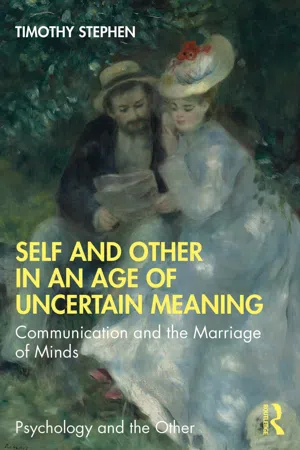
Self and Other in an Age of Uncertain Meaning explores the nature and origins of widespread problems of self in modern societies. It examines the paradoxical interplay between the modern world's many benefits and freedoms, and its mounting social challenges and psycho-emotional impacts.
Over time the character of consciousness has shifted in concert with societal trends. The experienced world has become more nuanced, fragmented, and uncertain, as well as increasingly personal and intimate, reshaping social relationships. Chapters analyze the interdependence of language, mind, intimacy, the self, and culture, arguing that as the coevolution of these five factors produced the modern world, many features of contemporary culture have become disruptive to security of being. The book explores the importance to the vital sense of self in constructing relationships based in mutual recognition of moral and intellectual equality between partners.
Rich with examples from everyday experience, this text offers profound insights for those interested in sociology, psychoanalysis, psychology, communication, history, and culture.
eBook - ePub
Self and Other in an Age of Uncertain Meaning
Communication and the Marriage of Minds
- 328 pages
- English
- ePUB (mobile friendly)
- Available on iOS & Android
eBook - ePub
Self and Other in an Age of Uncertain Meaning
Communication and the Marriage of Minds
About this book
Information
1 Interpersonal climate change
DOI: 10.4324/9781003010234-1
Man’s search for meaning is the primary motivation in life.
Victor Frankl, Man’s Search for Meaning: An introduction to logotherapy1
The best and worst of times
During the last decades of the twentieth century, scholars with expertise spanning the humanities and social sciences were engaged in intensive analysis of the consequences for America of a number of worrying trends, trends that have continued and, indeed, have increased in intensity and visibility. These include political fracturing and polarization, and gradual decay in the quality of public discourse; changing patterns of intimacy and marital and family life that have rendered intimate involvements more vulnerable to disruption; Americans’ withdrawal from meaningful community interconnection into what appears to be obsessively individualistic pursuits; growing disillusion with traditional roles and distrust of institutions; and, commonly, a subtle but stressful psychological fragmentation as economic tensions have chipped away the boundaries between work and home, and between one job and another, forcing many Americans to enact multiple roles simultaneously, to be in one place physically and somewhere else psychologically. In particular, alarm was raised over evidence of increasing absorption in problems of personal identity. Indeed, by the end of the twentieth century, “finding yourself” had become an exceptionally common concern, as it remains today.
These problems are all part of a common package, whose roots are historically deep. As long ago as 1953 – decades before the invention of earbuds, the selfie stick, the Game Boy, ADHD, or the Oculus Quest – drawing from a literature that had been accumulating for decades before him, eminent Berkeley sociologist Robert Nisbet proclaimed that America had become a country of “distracted multitudes and of solitary, inward-turning individuals.”2 Though nearly 70 years old, this description ought to sound familiar to even the most casual observer of America today. And whatever of this was apparent in Nisbet’s time is far more prominent now. In his day, the social column of the small-town local paper listed the names of those who came into town on the weekend to shop or go to the movies, and, before the feature film, audiences in the town’s crowded theater sang together, following the bouncing rhythm ball on the screen. So, if Nisbet could say in 1953 that America was “inward-turning,” what language remains for us to use to express our situation, where local newspapers are battling extinction, and not only is singing in a public movie theater unthinkable, but theaters have been downsized, chopped up, and multiplexed, the short subjects, newsreels, and sing-alongs replaced with relentless advertising. And, anyway, most families stay at home, everyone watching something different on their tablet or smartphone. Small wonder that, by the end of the twentieth century, social scientists were becoming alarmed about what was going on.
The internet arrived in the midst of this discussion like an EF5 tornado stepping up to the podium at an otherwise languid college debate over the reality of weather extremes. In the two decades since the launch of the World Wide Web, and one since the widespread adoption of smartphones and texting, there’s been a dizzying range of impacts of digital technologies on the lives of Americans, with important consequences for the manner in which self-identity – our sense of who we are – is established and maintained, and the ways in which we involve ourselves with others, in intimate relationships, families, communities, and at work. And, although there have been many welcome innovations, there’s also growing cause for concern. Comparing the impacts of digital life on interpersonal process to a vast, unauthorized and uncontrolled social experiment, the nation’s leading commentator on digital culture, MIT psychologist Sherry Turkle, asserted recently that, “the unhappy findings are in: we are connected as we’ve never been connected before, and we seem to have damaged ourselves in the process”3 – and this before the tragic and unsettlingly iconic death of Mexico City’s Oscar Aguilar, who accidentally pulled the trigger instead of the shutter release while pointing a loaded pistol at his temple, posing for a cool selfie to upload to his Facebook page.4
With the recent arrival of so many new technologies of communication, “the digital age” provides a possible label for this period, but the impacts of digital technologies, visible as they are, aren’t the only prominent hallmark of this era. This is also a time in which previous notions of what it means to be human – including our powers of conscious will, our volition in matters of moral responsibility, and the basis for emotional response – are being vigorously challenged in some areas of science, where, in its extreme (but hardly uncommon) form, there’s a view that we are more the robot slaves of our brain chemistry and our DNA than the conscious masters of our own lives. At the center of this perspective is a depleted understanding of the nature and function of language – its role in creating and sustaining mind and connecting one mind to another and, beyond, to the broader circumstances of interpersonal life and the surrounding culture, which, as we will see, have been in a state of ongoing change throughout history.
Generally, the direction of this change has been toward an ever-more prominent role of communication in the management of inner experience and personal identity (where, especially in the last 100 years, expanded freedoms of choice have increased the need for consultation and social support), greater recognition of communication’s importance in navigating America’s expanding diversity, a broadening (and often unnerving) recognition that a great deal of knowledge and truth are not fixed and timeless but relative to changing context and social experience, and that, critically, in these circumstances, communication has become both the means for creating structures of shared meaning that bridge increasingly separated minds and the essential glue that keeps social relationships together and the sense of self in place.
Yet, in contrast to this, today, evolutionary psychologists promote the idea that subjective experience (for example, of being attracted to your partner) is mainly biological (“chemistry”), and that thoughts and preferences aren’t the products of consciousness and imagination, but are produced in the service of our genes in their effort to steer behavior so as to increase the odds they will be reproduced and proliferate in the gene pool. Language, mind, and culture have virtually no role in this mechanical vision of relationships formed and controlled by hard-wired processes of the body. (If you buy into this, it might make sense for you to sign up with the company GenePartner, which proposes to find your best intimate partner based on DNA samples swabbed from your cheek.) Others in cognitive neuroscience take this even further, contending that your essential consciousness, your sense of self and other, is just an illusion of your body and your computer-like brain. Why take up ideas from evolutionary psychology and cognitive neuroscience in a book on language, mind, culture, and intimate experience? One reason is that it’s easier to appreciate the strengths of one set of ideas if there’s a clear alternative point of contrast. If this was an early geography book arguing that the world was a sphere, it would be useful to take a look at what the flat-earth model does and doesn’t account for.
There’s another reason for taking up interpersonally relevant ideas from evolutionary psychology and cognitive neuroscience. It’s not unusual to find controversial hypotheses like theirs batted back and forth across the corridors of university departments, where new, experimental strains of thought usually don’t escape and do the public any real harm. But this fracas has spilled onto the street with immediate and concrete consequences for many in modern societies. Having recently shed its former expertise in the arts of talk and interpretation to take cues instead from evolutionary psychology and neuroscience, medical psychiatry now tells us the fidgety person is no longer as he once was: a fully conscious and agentic person who, perhaps, needs to be supported in his struggle with the stresses of complicated contemporary life and, moreover, who needs to understand and control impulse through conscious acts of self-restraint. Now, he’s ever more likely to be regarded as the victim of the controversial new medical condition popularly referred to as ADHD, which, postulated as a neurological disease, would be unreasonable to expect anyone to control through an exercise of will. Never mind though, the doctor has a pill.
In fact, according to reports in the New York Times, doctors are now prescribing those particular pills (e.g., Adderall, Concerta, Ritalin) to more than 3.5 million American children,5 including as many as 10,000 toddlers younger than 3,6 generating more than $7 billion per year in sales revenues for pharmaceutical companies.7 As we’ll see in a later chapter, the number of areas of psychological and interpersonal experience redefined by psychiatric authorities in this way, as diseases of the material brain often addressed with drug treatment, has vaulted from about 100 in Robert Nisbet’s time to more than 350 today (that averages about four new mental disorders proclaimed by the psychiatric authorities every year for the last 60 years). As a result, the number of Americans with a diagnosable psychiatric disorder has risen from a rate of approximately 1 in 1,000 at the beginning of the twentieth century8 to today’s level of 1 in 5, if one can believe the National Institute of Mental Health.9
In 2016, American doctors wrote 594 million prescriptions for just the top 25 psychiatric drugs,10 compounds designed to regulate the moods, cognitions, and emotions that shape and color our core interpersonal experiences: happiness, sadness, love, elation, anxiety, and so on. If these prescriptions were spread evenly across the population, this works out to 1.8 scripts for a psychiatric drug for every man, woman, and child in the United States. In actuality, the prescription rate for psychiatric drugs is reckoned at one in six adult Americans, with 80 percent of those on psychiatric drugs using them long term.11 It’s estimated that a new prescription for the popular anti-anxiety drug Xanax is written at a rate of one every second of every day (which means that some 30 Americans received a prescription for their anxiety disorders in the time it took you to read this paragraph), that one in ten Americans has a prescription for an antidepressant drug (e.g., Zoloft, Prozac, Paxil), and that this rate stands at a stunning one in four among middle-aged American women. Here is evidence that something troubling is happening in modern American life
In America’s past, someone experiencing psycho-emotional difficulties might have gone to an analyst to start a course of talk therapy. The presumption was that inner experience was linked to processes of mind – especially, dysfunctional ideas of self – which ongoing intimate talk with a therapist could expose and gently nudge into a happier configuration. But, today, medical psychiatry has largely abandoned talk therapy and exploration of mind in favor of drug therapies tenuously linked to ideas from neuroscience and evolutionary psychology. In part, in psychiatry, these ideas reflect an optimism that neuroscience discoveries will eventually succeed in grounding psychiatric practice in material science. But they also appeal, in part, as they do to some in areas such as politics and marketing, because they promise significant new efficiencies in managing people. The hope is to be able to bypass the mind and talk (obviously, talk is slow, and what we say is subject to intentional and unintentional distortion), and instead get readouts on our values, motivations, and thoughts in the biomechanical traces of blood flow in the brain, in measures of skin conductivity, or pupil dilation, or blood chemistry, or the pulse, or in patterns of response on countless scales and measures of abstract traits and dispositions cooked up by psychologists in the service of their theories and absorbed into the broader culture as though they were real (e.g., Type A personality, IQ, introverts and extroverts, etc.). Here, the conscious mind is regarded as an accidental artifact, and communication a kind of expressive sideshow.
An extension of this type of approach into the realm of intimate relations would propose that you solve your marital problems by taking a pill – psychologist and psychopharmacology advocate Lauren Slater suggests MDA.12 Others have suggested surreptitiously spritzing your partner with aerosolized oxytocin to pump up their warmth toward you,13 or even spiking the public water supply with lithium as a solution to burgeoning suicide rates.14 If this strikes you as bizarre or far-fetched, consider the blockbuster drugs Miltown and Equanil, marketed in the mid-twentieth century on claims that they would help women better manage the stresses of their notoriously subordinated and alienating marital roles.15 Miltown and Equanil (the original “mother’s little helpers” made famous by the Rolling Stones) pro...
Table of contents
- Cover Page
- Half Title Page
- Series Page
- Title Page
- Copyright Page
- Table of Contents Page
- Preface Page
- 1 Interpersonal climate change
- PART 1 Language, mind, and intimacy
- PART 2 The origins of uncertainty
- PART 3 The shape of the modern self
- References
- Index
Trusted by 375,005 students
Access to over 1.5 million titles for a fair monthly price.
Study more efficiently using our study tools.
Frequently asked questions
Yes, you can cancel anytime from the Subscription tab in your account settings on the Perlego website. Your subscription will stay active until the end of your current billing period. Learn how to cancel your subscription
No, books cannot be downloaded as external files, such as PDFs, for use outside of Perlego. However, you can download books within the Perlego app for offline reading on mobile or tablet. Learn how to download books offline
Perlego offers two plans: Essential and Complete
- Essential is ideal for learners and professionals who enjoy exploring a wide range of subjects. Access the Essential Library with 800,000+ trusted titles and best-sellers across business, personal growth, and the humanities. Includes unlimited reading time and Standard Read Aloud voice.
- Complete: Perfect for advanced learners and researchers needing full, unrestricted access. Unlock 1.5M+ books across hundreds of subjects, including academic and specialized titles. The Complete Plan also includes advanced features like Premium Read Aloud and Research Assistant.
We are an online textbook subscription service, where you can get access to an entire online library for less than the price of a single book per month. With over 1.5 million books across 990+ topics, we’ve got you covered! Learn about our mission
Look out for the read-aloud symbol on your next book to see if you can listen to it. The read-aloud tool reads text aloud for you, highlighting the text as it is being read. You can pause it, speed it up and slow it down. Learn more about Read Aloud
Yes! You can use the Perlego app on both iOS and Android devices to read anytime, anywhere — even offline. Perfect for commutes or when you’re on the go.
Please note we cannot support devices running on iOS 13 and Android 7 or earlier. Learn more about using the app
Please note we cannot support devices running on iOS 13 and Android 7 or earlier. Learn more about using the app
Yes, you can access Self and Other in an Age of Uncertain Meaning by Timothy Stephen in PDF and/or ePUB format, as well as other popular books in Psychology & Communication Studies. We have over 1.5 million books available in our catalogue for you to explore.