Exalting Jesus in Colossians and Philemon is part of the Christ-Centered Exposition Commentary series. Edited by David Platt, Daniel L. Akin, and Tony Merida, this commentary series, to include 47 volumes when complete, takes a Christ-centered approach to expositing each book of the Bible. Rather than a verse-by-verse approach, the authors have crafted chapters that explain and apply key passages in their assigned Bible books.
Readers will learn to see Christ in all aspects of Scripture, and they will be encouraged by the devotional nature of each exposition presented as sermons and divided into chapters that conclude with a “Reflect and Discuss” section, making this series ideal for small group study, personal devotion, and even sermon preparation. It’s not academic but rather
presents an easy reading, practical, and friendly commentary.
The Christ-Centered Exposition Commentary series will include 47 volumes when complete. The authors of Exalting Jesus in Colossians and Philemon are Daniel Akin and R. Scott Pace.
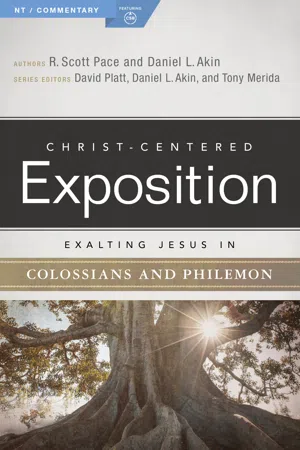
eBook - ePub
Exalting Jesus in Colossians & Philemon
- 288 pages
- English
- ePUB (mobile friendly)
- Available on iOS & Android
eBook - ePub
Exalting Jesus in Colossians & Philemon
About this book
Information
Print ISBN
9780805498103
Subtopic
Studi bibliciColossians
Welcome to the Family!
COLOSSIANS 1:1-8
Main Idea: As believers in Jesus Christ, we are adopted as members into God’s family to share in the divine privileges of salvation and to participate in the mission of the gospel.
I. As Members of God’s Family, We Have Reasons to Be Glad (1:1-2).
A. We should celebrate our personal callings (1:1).
B. We should celebrate our spiritual community (1:2).
II. Express Your Confidence in the Gospel’s Work in Others (21-22).
A. We give thanks for our saving faith (1:3-4a).
B. We give thanks for our sincere love (1:4b).
C. We give thanks for our secure hope (1:5a).
II. Express Your Confidence in the Gospel’s Work in Others (21-22).
A. The truth of God is the gospel message (1:5b-6).
B. The truth of God is a global message (1:6-8).
The personalized approach Paul takes in each of his letters emphasizes the importance of his greeting and its contents. Since the apostle was not responsible for planting the church at Colossae, his lack of personal rapport and familiarity required a more affirming disposition (2:1-2). The tone of Paul’s letter to the Colossians was one of encouraging exhortation, and his epistolary greeting and expression of thanksgiving typify his demeanor toward them. Although his goal was ultimately corrective, and the Christological issues facing the church were of the highest doctrinal significance, he did not use a stern rebuke and confrontational approach as he did with the Galatians (Gal 1:6-9; 3:1). Instead, he chose a more personable and winsome tone that reflected his genuine enthusiasm for the Colossians’ faith, and he lovingly urged them to progress further in their understanding and devotion to Christ.
In the early 1990s, one of the most famous advertising slogans was, “Membership has its privileges.” This well-known mantra was promoted by American Express in an effort to elevate the perceived status of its cardholders and to invite those who could qualify to benefit from its exclusive rewards. Their advertisement piqued the interest of those who were unfamiliar with their program and celebrated the status of those who were already involved.
While they may have coined that particular phrase in their campaign, the concept itself was nothing new. In fact, the apostle Paul had described the same reality centuries before credit cards or country clubs even existed. But the membership he described was not to a financial entity; it was membership in a family. This membership is not reserved for those with elite status, it cannot be earned based on merit, and its rewards are not calculated by an earthly standard. But it does come with immeasurable benefits.
The opening section in this letter describes the ultimate membership offer that God extends to all of us. In its original context, Paul’s greeting served to welcome the Colossians to the family of faith, to celebrate the divine privileges they now shared, and to inspire their faithful service in the gospel mission. For followers of Jesus Christ, the opening to Colossians provides the same contemporary purpose, as it reminds us of three important spiritual truths.
As Members of God’s Family, We Have Reasons to Be Glad
Colossians 1:1-2
Paul’s personal introduction to the church at Colossae follows the form of a typical epistolary greeting. He announces himself, along with Timothy, as the author, states his credentials, identifies the recipients, and extends a personal salutation. The broader audience of “the saints in Christ” indicates the public nature of the letter and Paul’s intention to address the church as a whole (v. 2, cf. 4:16). But in speaking to God’s family of faith, he strategically uses the standard elements of his greeting to encourage them with realities we all can celebrate.
We Should Celebrate Our Personal Callings (1:1)
Paul introduces himself as “an apostle of Christ Jesus.” This parallels many of his other letters (Rom 1:1; 1 Cor 1:1; 2 Cor 1:1; Gal 1:1; Eph 1:1; Col 1:1; 1 Tim 1:1; 2 Tim 1:1; Titus 1:1), but it is of particular importance for the Colossians for two related reasons: their lack of personal familiarity with Paul (2:1) and the crucial nature of the doctrinal issues he planned to address. His authority as an apostle—one who had encountered the resurrected Lord (Acts 1:21-22; cf. 1 Cor 15:7-9), one who received his message directly from Christ (Gal 1:15-17), and one who was recognized among the authorized church leaders (Gal 2:6-9; cf. Acts 9:27-28)—serves as the basis by which he will assertively declare the doctrinal truth regarding Christ and will convincingly refute the false teachers.
While Paul is establishing his authority and exerting influence, he is not boasting of his prominence and exhibiting arrogance. The modifying phrases for his identity as an apostle, “of Christ Jesus” and “by God’s will,” emphasize Christ’s ultimate authority over his life and God’s grace in his appointment (cf. 1 Cor 15:9-10; 1 Tim 1:12-15). The apostle also humbly includes “Timothy our brother” as a co-sender of the letter.1 Similarly, later he elevates the status of Epaphras, “our dearly loved fellow servant,” as a “faithful minister of Christ” despite his lack of any formal position (1:7).
Through Paul’s introductory testimony we are reminded that God has a plan for each of us. Though your position may not have an official title or status, the Lord calls each one of us to serve according to his will for our lives. As a follower of Christ and participant in his kingdom, every believer has significance and purpose because each has been called by God individually. Whether as pastors, schoolteachers, public servants, or dedicated employees, we members of his kingdom family can celebrate our personal callings!
We Should Celebrate Our Spiritual Community (1:2)
Although our individual callings can be celebrated, Paul’s greeting also emphasizes the communal nature of our salvation and the joy it should produce. He addresses the believers “at Colossae” as “saints in Christ” and as “faithful brothers and sisters” (v. 2). Paul uses the term saints to speak of their positional status “in Christ” as God’s holy ones (cf. 1:4,12,26) who are distinguished from the world and literally set apart. He also refers to them as “faithful brothers and sisters,” highlighting the familial relationship they share “in Christ” and their persevering devotion.2
Paul extends his customary greeting, “grace . . . and peace,” to them, which further defines their identity through their relationship with “God” as “our Father.” As recipients of God’s grace, they now enjoy peace with God and stand in right relationship with him (Rom 5:1-2). Therefore, Paul commends these ongoing, sacred gifts as a prayerful greeting and reminder of the gospel basis that unites them as God’s people.
One of the most glorious truths about our salvation is the reality of our acceptance into God’s family. Because of his great love for us (1 John 3:1), and through our personal faith in Jesus (John 1:12), we are adopted as his children (Rom 8:15; Gal 4:4-7) and enjoy a special relationship with God as our heavenly Father. Our common faith in Christ also unites us together as “brothers and sisters,” as a family who loves and supports one another. Additionally, as members of God’s spiritual family, we are joined together as members of Christ’s body (Col 1:18,24; cf. Eph 4:4-6) who collectively serve Christ and strengthen one another (Col 3:12-17; cf. Eph 4:15-16).
Paul’s greeting in his sister letter to the Ephesians relishes the countless blessings that our adoption entitles every believer to receive (Eph 1:3-14). This same tone of celebration marks the apostle’s opening remarks to the Colossians. The familial language throughout these two introductory verses stresses the spiritual community that the believers in Colossae now constitute and the eternal community to which they now belong. As contemporary Christians and members of God’s eternal family, we share these same blessings and should relish our spiritual community as we encourage one another to fulfill our spiritual calling. We certainly have reasons to be glad!
As Members of God’s Family, We Have Reasons to Be Grateful
Colossians 1:3-5a
In addition to having reasons to be glad, we also have reasons to be grateful. Paul transitions from his introductory greeting to an intercessory prayer. His prayer for the Colossians is twofold; it focuses on praising God for their salvation (vv. 3-8) and petitioning God for their sanctification (vv. 9-14). Paul’s appeal on their behalf also serves a dual purpose for his readers as it is both instructive and informative.
By way of example, his prayer instructs us how we should pray for others. The frequency of his prayers for the Colossians is implied by the participial phrase, “when we pray for you,” and by the modif...
Table of contents
- Acknowledgments
- Series Introduction
- Colossians
- Philemon
- Works Cited
- Scripture Index
Trusted by 375,005 students
Access to over 1.5 million titles for a fair monthly price.
Study more efficiently using our study tools.
Frequently asked questions
Yes, you can cancel anytime from the Subscription tab in your account settings on the Perlego website. Your subscription will stay active until the end of your current billing period. Learn how to cancel your subscription
No, books cannot be downloaded as external files, such as PDFs, for use outside of Perlego. However, you can download books within the Perlego app for offline reading on mobile or tablet. Learn how to download books offline
Perlego offers two plans: Essential and Complete
- Essential is ideal for learners and professionals who enjoy exploring a wide range of subjects. Access the Essential Library with 800,000+ trusted titles and best-sellers across business, personal growth, and the humanities. Includes unlimited reading time and Standard Read Aloud voice.
- Complete: Perfect for advanced learners and researchers needing full, unrestricted access. Unlock 1.5M+ books across hundreds of subjects, including academic and specialized titles. The Complete Plan also includes advanced features like Premium Read Aloud and Research Assistant.
We are an online textbook subscription service, where you can get access to an entire online library for less than the price of a single book per month. With over 1.5 million books across 990+ topics, we’ve got you covered! Learn about our mission
Look out for the read-aloud symbol on your next book to see if you can listen to it. The read-aloud tool reads text aloud for you, highlighting the text as it is being read. You can pause it, speed it up and slow it down. Learn more about Read Aloud
Yes! You can use the Perlego app on both iOS and Android devices to read anytime, anywhere — even offline. Perfect for commutes or when you’re on the go.
Please note we cannot support devices running on iOS 13 and Android 7 or earlier. Learn more about using the app
Please note we cannot support devices running on iOS 13 and Android 7 or earlier. Learn more about using the app
Yes, you can access Exalting Jesus in Colossians & Philemon by Dr. Daniel L. Akin,Dr. R. Scott Pace,Daniel L. Akin in PDF and/or ePUB format. We have over 1.5 million books available in our catalogue for you to explore.