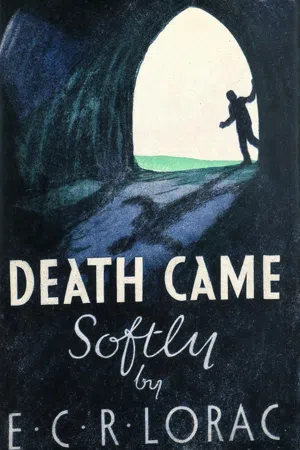
This crime puzzle features Chief Inspector Robert Macdonald, who is a "London Scot" and an avowed bachelor with a love for walking in the English countryside. But what will he make of the body found dead in a cave?
eBook - ePub
Death Came Softly
About this book
Information
Subtopic
Crime & Mystery LiteratureIndex
Literature1
When Eve Merrion first saw Valehead House she was conscious of a sense of exasperation. House hunting is a weary business, and house agents, in Mrs. Merrion’s opinion, enjoyed sending their clients on wild goose chases to view impossible properties. Seeing the size of the great house when she first glimpsed it between the beech trees, Eve Merrion nearly turned her car and drove back the way she had come. Valehead was obviously too big a house for any individual to take as a private residence.
“It’s quite out of the question,” she said to herself. “It’d be impossible to run it, impossible to get servants, and it’s miles away from anywhere, and probably as inconvenient as a house can be.”
Nevertheless, Mrs. Merrion did not turn her car and retrace the mile of difficult surface which the agents had described as “the drive.” The house might be “impossible,” but as she stared at the gracious white building standing so serenely in the sunshine on the little plateau above the water meadows, Mrs. Merrion felt impelled to get closer to it. The dignity of the long Italianate building, so stylized and symmetrical, set among the wild, rich Devonshire woodland, was an experience worth having. Obviously the day would count as another wasted day from the point of view of house hunting, but it promised an experience of unusual beauty which would compensate for waste of precious time and yet more precious gasoline.
She drove on slowly over the rutted, bumpy “drive,” the beech woods closing in on her again. On her left the ground rose steeply in a great scarp of red earth and red rock. The branches of the beech trees, clad in the enchantment of Maytime foliage, hung low over the roadway, and the ground below them was misted with bluebells. White cow-parsley foamed over the bank, and the rose-red of campion shone like an enameled enrichment. To her right there was a short, steep drop to the river and the lakes, and water irises crowded along the water’s edge—not only the familiar yellow iris of English water meadows, but flowers of violet and blue and lilac, lovely alien blossoms, were established there. Eve Merrion adored flowers. Gardening was her passion, and she drove slowly on, becoming more and more absorbed, as her eye caught drifts of wild daffodils—their flowers over now—and clumps of the small Italian tulips with-frilled petals which grow wild on the hillsides around Florence.
The drive took a sharp turn to the right and cleared the woods, and Eve Merrion drove on over a white bridge whose delicate ironwork tracery showed the same Italianate design which she had noted in the distant house. She caught her breath as she cleared the bridge and saw the banks of rhododendrons which lined the drive across the river: rose and white, lilac and purple and crimson, the flowers bloomed in a prodigal mass of color which seemed almost incredible. A sharp rise took her up the bank on the farther side of the rushing stream and she swung her car around a curve and up onto the level plateau in front of the south porch of Valehead House.
As she alighted, Eve noticed the trees on the level turf to the side of the house—cedar of Lebanon, cupressus, Irish yew—and a vast magnolia, its glossy foliage almost hidden behind the myriad rose-pink chalices of its great flowers. She had hardly an eye for the house at all; she could only stare at the trees and flowers. Beyond, farther up the valley, camellias were in flower, rose-red, crimson, coral, as vivid and prolific as the trees beside Lake Maggiore. Walking around to the side of the house, Eve Merrion followed a neglected garden path which led from terrace to terrace by a series of shallow steps. She wandered through an overgrown rose garden, past a rock garden whose beauty was almost smothered by encroaching bramble and wild clematis, and a desire seized her to set to work and cut back the choking branches which were killing the dwarf maples, with their fine-cut rose-red leaves, and smothering the primulas and saxifrage and rock rose and gentian. Wandering on, she left the formal garden and followed a wooded glade above the stream until she reached a circular lake half hidden by close-growing trees and shrubs. Bamboos made a thicket at one side: arbutus and eucalyptus shaded it, and close around the waterside were hydrangeas and azaleas. The hydrangeas were only just in bud, but Eve imagined them as they would be in blossom—a veritable sea of blue flowers around the lake where moorhens nested, and herons trailed their long legs as they rose from the shining water. She stood still, listening to the sound of the river and the bird song all around her: gazed fascinated at the yellow and orange and peach color of the azaleas: saw the rose-red blossom of some strange flowering tree with hanging flowers like fuchsias, and beyond, the banks of rhododendron and the shining camellias. “I don’t care what the house is like. I’m going to have it. I must have it,” she said to herself. “I’m going to be living here when those hydrangeas are in flower.”
“So I hear you have taken a house in Devonshire.”
Emmeline Stamford looked at her sister with a slight lift of her fine eyebrows, her lips curving in what Eve had once described as “her Mona Lisa smile.” Before they were both married Eve and Emmeline had been very good friends indeed, but during the last dozen years they had grown apart, their interests lying in widely diverging directions.
Eve, who had just passed her thirty-fifth birthday, had recently lost her husband. Axel Merrion had been a metallurgist, a man of great intellectual powers yet of marked humanity, interested in all that pertained to the advancement of human knowledge and well-being. Led by his wisdom, fired by his enthusiasm for all that was noblest in human thought, Eve Merrion had developed from a kindly, light-hearted girl into a mature woman of wide information and generous mind. Her sister, Emmeline, had married an officer in the Indian Army, and her environment since her marriage had crystallized all that was conventional in her. “Empire, Prestige, Dignity”—these were Emmeline’s values, described laughingly by Eve as “E.P.D.” In the narrow sphere of army life and thought, Emmeline had grown into what her sister ruefully described as “a perfect lady, perfect within the limitations of social convention.” Emmeline, at thirty-three, was a beautiful woman, still slender, her fine skin unspoiled by tropical suns, though there were wrinkles around her fine dark eyes, and something in her expression told of weariness and disillusionment. Emmeline Stamford was always beautifully turned out, her appearance finished and exquisite, despite the fact of her small dress allowance. Axel Merrion had been a wealthy man—his fortune was now his widow’s—but Eve, with an indefinite amount of money to spend on clothes, had she wished to spend it, never achieved the beautifully clad appearance of her sister. Eve had grown stouter as she grew older; her figure was robust rather than elegant, her skin weatherbeaten, her hands showing plainly enough that she enjoyed digging and potting, but she also had a beauty of her own, and good health showed in her sunburned face and wide-set, clear gray eyes.
Emmeline Stamford was staying in a private hotel in Kensington, and it was here that Eve came to see her a week after her visit to Valehead House. Emmeline eyed her older sister with affectionate amusement, noting that Eve’s tailored suit was put on “anyhow,” her beautiful brown hair still dressed in a bun screwed up at the base of her fine solid head. Eve pulled off her hat and ran her fingers through her hair in a gesture which recalled the fat, happy, untidy child of twenty-five years ago.
“Yes, I’ve taken a house in Devon, Emma. I know you’ll say I’m mad. I dare say I am mad, but I couldn’t help it. The garden—oh, my dear, it’s lovely next to heaven. It’s simply unbelievable.”
“So it may be, my dear—but what about the house? I hope it’s not too big.”
Eve flung herself down in a chair and laughed, her beautiful white teeth shining like pearls in her wide, generous mouth.
“It’s much too big, Emma. In fact, it’s enormous, but it’s perfectly adorable.”
Emmeline frowned a little. “Much too big? Meaning? How many rooms are there?”
“I didn’t count. Thirty at least. Some of them are perfect, others are awful. There are two great paneled rooms facing the magnolia trees, and a gorgeous entrance hall with a parquet floor, and some really lovely bedrooms—enormous great rooms with vast windows looking right down the valley and over the woods—”
“My dear Eve! A house with thirty rooms . . . it sounds quite mad. Where on earth is it?”
“Miles from anywhere,” said Eve cheerfully. “It’s about twelve miles from Enster and ten miles from Bewley Abbas, hidden in one of the wooded north Devon valleys. It’s the most amazing place to come upon unexpectedly, after driving along miles of narrow twisty roads, sunk between high hedges—that lovely long white house, set among incredible flowers. Emma darling, the sight of all those rhododendrons and camellias was like heaven—‘other Eden, demi-paradise’ . . .”
“My dear Eve!” Emmeline Stamford’s cool, rather bored voice broke in on her sister’s rhapsodies. “I’m willing to believe that the flowers are marvelous. It’s the house which strikes me as incredible. About thirty rooms, miles from anywhere, hidden at the end of narrow Devonshire lanes. . . . It sounds like a nightmare to me. Are you proposing to live in all the thirty rooms—and to clean them—or have you found an incredible staff of servants to run the place? Are there any drains in your dream house, or did you not ask about anything so sordid after you had seen the camellias?”
Eve Merrion laughed again, quite good-humoredly.
“Sorry, Emma. I’m telling things all the wrong way round, just as I always do. There are perfectly good drains, and water supply, and electricity as well. The house has been empty for a year, but some wealthy Americans had it before then, and they put in some super bathrooms, and central heating and an electric kitchen. Everything like that is all right.”
“Then why was this paradise of a house to let?”
“Because, my dear, it’s too big for most sensible people to consider, and it’s too far off the main road. Now listen to me, Emma, and you’ll see that I’m not so mad as you think. Admittedly the house is bigger than what I set out to look for, but consider everybody who may come to live in it. First, there’s me, and my three kids, Brian, Dennis and Jennifer, plus old Nanny and Carter and his wife, who are quite keen to try it. Then there’s you—if you’ll only come and share it while you’re in England, and your two boys in the school holidays. Then there’s Father. You know the poor darling is simply aching to find some quiet spot where he can get on with writing his magnum opus, and where he can have room to spread out his books and his papers and his secretary. He would bring Brady and his wife to ‘do’ for him, because he’s used to them, and there’s a caretaker in the house who understands the furnaces and everything, and he would stay on as houseman. It’s really not so mad as it sounds—and it’s awfully beautiful, Emma. You simply couldn’t help being happy there, and children would adore it.”
“I see you’ve thought it out in detail,” replied Emmeline Stamford, her cool, detached voice tinged with the faintest note of acerbity. “It’s true that I said I should like to share a house in the country with you, Eve, but I was really thinking of somewhere in Surrey or Sussex, or even Hampshire. Somewhere easily get-at-able.”
“Yes, my dear. Easily get-at-able—for night bombers. You don’t know what bombing means, Emma, and what security for one’s children means. It may be quiet now, but you never know when hell may be let loose again. No nice get-at-able spots on the bus route for the London bombers for my kids, thank you. I thought of that, too. Valehead is so isolated it’s not worth a bomb. The kids will be safe there, if there’s safety anywhere.”
“Yes, I see your point about the children,” replied Emmeline, “but I can’t say that this Valehead place sounds my own idea of bliss. It must be utterly isolated. I was looking forward to seeing something of my friends, you know, after all these months of traveling to get home. I’d rather hoped your little Surrey house would take us. I thought you were fond of it.”
“Five Gables? Of course I was fond of it, in a way, but it was always a second-best, Emma. I wanted to have a place in the country and a garden, and Axel had to be near London. I couldn’t condemn him to hours of traveling every day just because I wanted to be in the country. Five Gables was a compromise between what I wanted and what had to be. It was quite nice in its way, but I always feel that Surrey is really a glorified suburb. It’s all tacked onto London, a sort of dormitory and week-end resort for wealthy stockbrokers, rather than real country. In any case, the house is commandeered, you know. It’s not mine while the war lasts.”
“I see. That settles that,” said Emmeline. “Well, you certainly seem to have taken a plunge into what you call ‘real country.’ You must be paying a small fortune for this Valehead place, Eve.”
“But I’m not! It’s ridiculously cheap. It won’t cost any more than our ghastly great flat in Chelsea plus the upkeep of Five Gables,” protested Eve, and Emmeline Stamford shrugged her graceful shoulders.
“In any case, the cost of it isn’t my business, Eve. I know that, but I’ve had to think such a lot about ways and means that I get rather obsessed on the subject of money. Of course, I realize that you look at things on a different scale altogether.”
Eve Merrion flushed rather unhappily. This subject of money had been a difficulty between the two sisters for years. Eve’s husband had been wealthy, Emmeline’s husband was not. With only a small private income in addition to his army pay, Major Stamford had had all he could do to meet the expenses of educating his children in the way he wanted them to be educated. Any schools other than public schools did not exist in Major Stamford’s opinion, and public schools meant expensive prep schools as a preliminary. Eve Merrion, wholeheartedly generous, had once impulsively offered to undertake the cost of educating Emmeline’s older boy. Instead of accepting the generous offer in the spirit in which it was made, the Stamfords had resented it as a reflection upon their own means in contrast with the Merrions’, and had refused it in a manner far from gracious. Eve remembered this uncomfortable episode when Emmeline mentioned the topic of expenses in connection with Valehead House, and she hesitated somewhat before she answered.
“I do feel I’m behaving rather like a pig, Emma,” she said ruefully. “It’s true I gave way to impulse in taking Valehead House. I wanted it so much. It’s not the house, although it’s a lovely house. It’s the garden and the setting. The place once belonged to a childless couple who were passionately fond of gardens. The wife, so I was told, had been brought up in Italy, and she owned a Villa near Stresa. She determined to find an English garden where she could grow the flowers she loved in Italy, and she found the place she wanted in the Vale of Fairwater—Valehead House. It was she who planted the camellias and magnolias and primulas and irises, as well as the cypresses and vines and eucalyptus and tulip trees. She looked after that garden for fifty years, and spent a fortune on it. They say she had fifteen gardeners working on it, and she planted bulbs and flowers of all kinds right up into the woods. She must have worshipped the place. When she died, about five years ago, no one else wanted to look after a garden like that. It’s all overgrown and wild, her lovely flowers and shrubs being choked—dying of neglect. When I saw it, I wanted to make the garden live again. . . .”
“With the aid of fifteen gardeners?” put in Emmeline, her voice half amused, half irritated. “I doubt if you’ll get them these days.”
“Oh, Emma dear, of course I shan’t. I don’t want to. In any case, the kitchen gardens are being cultivated by a firm of market gardeners, and the woodland rides will just have to go on being wild—they’re lovely anyway. But there’s a certain amount I could do—the rose garden and the rock garden, and the lakeside where the hydrangeas grow. Emma, it’s so lovely. When you see it, you’ll understand why I wanted it so much. I don’t think I’ve ever wanted anything for my own as I wanted that garden.”
Emmeline regarded her sister quizzically. “What a funny woman you are, Eve. . . . You talk about wanting something. Haven’t you been happy, then, all these years, with your huge flat in Chelsea and your ‘pis aller’ in the suburban county of Surrey? Was life all a ‘pis aller’?”
Again Eve Merrion flushed, and this time there was indignation in her gray eyes. “That’s not fair, Emma. You know it’s not true. I’ve been as happy in my married life as any woman on earth could be. O...
Table of contents
- 1
- 2
- 3
- 4
- 5
- 6
- 7
- 8
- 9
- 10
- 11
- 12
- 13
- 14
- 15
- 16
Trusted by 375,005 students
Access to over 1.5 million titles for a fair monthly price.
Study more efficiently using our study tools.
Frequently asked questions
Yes, you can cancel anytime from the Subscription tab in your account settings on the Perlego website. Your subscription will stay active until the end of your current billing period. Learn how to cancel your subscription
No, books cannot be downloaded as external files, such as PDFs, for use outside of Perlego. However, you can download books within the Perlego app for offline reading on mobile or tablet. Learn how to download books offline
Perlego offers two plans: Essential and Complete
- Essential is ideal for learners and professionals who enjoy exploring a wide range of subjects. Access the Essential Library with 800,000+ trusted titles and best-sellers across business, personal growth, and the humanities. Includes unlimited reading time and Standard Read Aloud voice.
- Complete: Perfect for advanced learners and researchers needing full, unrestricted access. Unlock 1.5M+ books across hundreds of subjects, including academic and specialized titles. The Complete Plan also includes advanced features like Premium Read Aloud and Research Assistant.
We are an online textbook subscription service, where you can get access to an entire online library for less than the price of a single book per month. With over 1.5 million books across 990+ topics, we’ve got you covered! Learn about our mission
Look out for the read-aloud symbol on your next book to see if you can listen to it. The read-aloud tool reads text aloud for you, highlighting the text as it is being read. You can pause it, speed it up and slow it down. Learn more about Read Aloud
Yes! You can use the Perlego app on both iOS and Android devices to read anytime, anywhere — even offline. Perfect for commutes or when you’re on the go.
Please note we cannot support devices running on iOS 13 and Android 7 or earlier. Learn more about using the app
Please note we cannot support devices running on iOS 13 and Android 7 or earlier. Learn more about using the app
Yes, you can access Death Came Softly by E. C. R. Lorac in PDF and/or ePUB format, as well as other popular books in Literature & Crime & Mystery Literature. We have over 1.5 million books available in our catalogue for you to explore.