Cybersecurity experts present an accessible, informative, and fully illustrated guide to protecting yourself, your assets, and your loved ones online.
As we live more of our lives online, we need to be more aware of the risks we face—and what we can do to protect ourselves. We all know that our identities can be stolen, and that intellectual property can be copied and sold. But even scarier things are now possible. Vehicle systems can be hacked, our power grid can be sabotaged, and terrorists are getting more sophisticated by the day.
In
The Cyber Attack Survival Manual, you learn hands-on tips and techniques for fighting back. Author Nick Selby, a police detective who specializes in busting cybercriminals, gathers a consortium of experts in digital currency, crimeware, intelligence, and more in order to share the latest and best security techniques.
The Cyber Attack Survival Manual covers:
Everyday security: How to keep your identity from being stolen, protect your kids, protect your cards, and much more.
Big Stories: Silk Road, Ashley Madison, FBI vs. Apple, WikiLeaks, Bitcoin, and what they mean to individuals and society at large.
Global issues: the NSA, how hackers can crash your car, and looming threats from China and elsewhere.
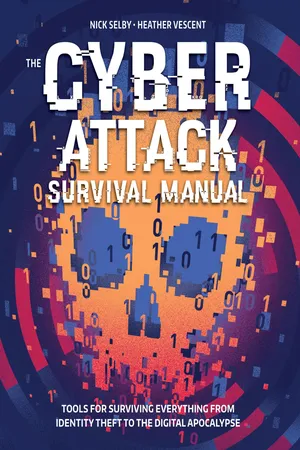
eBook - ePub
The Cyber Attack Survival Manual
Tools for Surviving Everything from Identity Theft to the Digital Apocalypse
- 248 pages
- English
- ePUB (mobile friendly)
- Available on iOS & Android
eBook - ePub
The Cyber Attack Survival Manual
Tools for Surviving Everything from Identity Theft to the Digital Apocalypse
About this book
Information


Your bank account is suddenly, mysteriously overdrawn. Everyone in your address book gets a desperate email from you asking for money. You fail what should have been a routine background check. Your TV starts getting unusual error messages. What’s going on? Cybercrime can, quite literally, hit you where you live—and it’s getting more common all the time as our lives get more connected and hackers more sophisticated. The chapters that follow tell you what to do when Internet bad guys make it personal—stealing your identity or your money, invading your privacy, bullying your kids, or even threatening your life. We also highlight some unexpected vulnerabilities in your smart phone, your browsing habits, and your household appliances, as well how to keep your personal information safe and secure.

CHAPTER 1
KEEP YOUR
IDENTITY SAFE
IDENTITY THIEVES CAN BUY, SELL, OR CAPTURE YOUR IDENTITY AND USE THE INFORMATION TO GET MONEY AND SERVICES`—OR USE YOUR NAME, CREDIT RATING, OR INSURANCE TO TAKE OUT A LOAN OR GET FREE MEDICAL CARE.
There are myriad ways for the bad guys to get your information and use it for all sorts of nefarious purposes—mainly, stealing your money, although occasionally for other kinds of fraud or to cover their tracks when committing additional crimes. That’s one of the big reasons identity theft can be so devastating. If a criminal steals your credit card information, your bank will likely refund you the money that was lost. If the same criminal impersonates you to run an international child pornography ring, however, then your problems just got a whole lot worse… especially since many law enforcement folks aren’t up on the latest types of cybercrime, so “that wasn’t me” might not go over well.
How does it happen? We’ll examine the many methods of identity theft in the pages that follow, and we’ll also show you how you can protect yourself from being a victim or fight back if you already are. The methods of ID theft range from the seriously low tech (such as digging through your trash for unshredded financial documents or stealing those new credit cards that the bank sends you unexpectedly) to sophisticated database breaches and other hacks staged half the world away by large crime syndicates to fund cyberterrorism operations.
AMERICA’S FIRST IDENTITY FRAUD Philip Hendrik Nering Bögel had some financial problems, and he was a creative thinker. So in 1793, when things got too hot for the Dutchman (who was wanted for embezzlement at the time), he did what any forward-thinking identity thief would do today: He hot-footed it out of the Netherlands, setting forth on this continent a new city, conceived in parsimony, and dedicated to the proposition that Bögel deserved better. Calling himself “Felipe Enrique Neri, Baron de Bastrop,” Bögel started being awfully helpful to early Texas leaders Moses and Stephen F. Austin in obtaining land grants. After being named Texas land commissioner, Bögel came to settle a Texas city that he named after himself. Today, visitors to Bastrop, Texas, population 5,340, can celebrate how America’s earliest successful ID fraud operation netted one guy a whole city.
T/F
FALSE Attackers are smart, and they seek the easiest path to their ultimate target. Often, that easiest path runs through your computer is you. You may say, “I just have photos of my grandkids on my hard drive.” But your machine is connected to the internet, making it a target. Hackers can hijack your computer and join it into a secret global network for spam, attacks on other computers, and more nefarious activities. While they’re at it, they might just steal your banking information as well. It is also not unknown for hackers to destroy a computer, so that even those family photos that are priceless to you, while worthless to others, end up lost with the dead computer.
MANY TYPES OF IDENTITY THEFT Criminals impersonate you online for a range of different reasons and in a variety of ways. For cyberstalkers (see pages 50-51 for Amanda Nickerson’s story), the impersonation is usually part of a larger cyberbullying effort. But in most cases, the motivations are financial. Whether it’s designed to get bank cards or bank loans in your name, obtain credit in your name, or impersonate you to use your existing credit, identity theft is usually a gateway cybercrime—an initial act, atop which lie other criminal schemes. So really, “identity theft” should be thought of as a family, or a category, of cybercrime.
Even though it’s common for victims to be reimbursed by banks or credit card companies, the damage done by ID theft can affect you for years. Your credit score and history are the main ways that banks, car dealers, and other lenders determine the risk of extending you credit, and the black marks can be hard to erase.
A Taxing Scheme One of the fastest growing crimes in America is tax return fraud, which can net identity thieves thousands of dollars for each successful impersonation they make to the IRS. The criminals get hold of your Social Security number and personal information, and then create a tax return in your name that shows a modest overpayment on your part. The return is filed online using software, and within days, the IRS sends out a refund to “you”—at the address given by the thief. The refund is typically made using prepaid Visa cards, which can be easily exchanged for cash or property.
FORMS OF IDENTITY THEFT
Fraudsters don’t just steal your driver’s license or credit card. They’ll take your whole identity and make use of any part they can.

STRANGERS WITH CANDY In 2004, some InfoSec folks did a little experiment in which they offered passersby on the street a candy bar if they would tell them their work logins and passwords. To their surprise, some 70 percent were willing to part with the information—half of them did so even without the chocolatey bribe. You’d think that would have been a wake-up call. And indeed, governmental agencies and private-sector companies spend millions of dollars on training to make employees aware of proper security procedures and how important it is to follow them. How’s that going? Well, when the experiment was repeated in London in 2008, there was no difference.
Whether the reasons are cultural or technical, the fact is, people are just really bad at keeping their passwords secret. They just don’t take it seriously. What’s even more galling to those who work with companies and individuals to improve security comprehension is that “your password” is still taken literally. By which I mean that most people to this day use just one password for many or all of their accounts—and a weak one, at that (see page 28 for more on creating a secure password).
You might think that this problem would have already been solved with the creation of password manager apps, which significantly reduce the toil and trouble of thinking up (let alone remembering) strong new passwords, such as the ever-popular 98cLKd2rh29#@36kasgJ!. Plus, the programs are easy to use and can automatically change the passwords for all your online accounts.
So in 2016, when a security consultant decided to try the chocolate bar trick again, this time staging it as a contest in which the person with the “best” login and password would win prizes ranging from candy to a bottle of Champagne, he finally got different results: They were even worse than before.
GUARD THOSE DIGITS You should think thrice before handing over your Social Security number (or, outside the U.S., your national identity number), even if a legitimate office is requesting it from you. This number is a universal identifier, and you’ve probably been asked for it multiple times a year, every time you open a bank account, take out a loan, or verify your personal information. It always pays to think about why it would be needed and to refuse to provide it unless it is absolutely necessary. If you’re paying cash, never give out the number. I would rather put down a $75 deposit to get electricity or phone service than provide the utility company with my Social Security number—plenty of utilities have been routinely hacked, and ID theft in America thrives on this ubiquitous identifier. If the service provider doesn’t need it, don’t provide it to them.
TINFOIL HATS It’s a common joke that some people are so paranoid, they line their ...
Table of contents
- Front Cover
- Title Page
- CONTENTS
- THIS BOOK IS ALREADY OUT OF DATE (AND THAT’S OKAY)
- ALSO, THIS BOOK WILL FREAK YOU OUT (THAT’S OKAY TOO)
- HACK YOUR LIFE
- HACK SOCIETY
- HACK THE WORLD
- SUMMARY
- WHAT’S NEXT
- GLOSSARY
- INDEX
- Copyright
Trusted by 375,005 students
Access to over 1.5 million titles for a fair monthly price.
Study more efficiently using our study tools.
Frequently asked questions
Yes, you can cancel anytime from the Subscription tab in your account settings on the Perlego website. Your subscription will stay active until the end of your current billing period. Learn how to cancel your subscription
No, books cannot be downloaded as external files, such as PDFs, for use outside of Perlego. However, you can download books within the Perlego app for offline reading on mobile or tablet. Learn how to download books offline
Perlego offers two plans: Essential and Complete
- Essential is ideal for learners and professionals who enjoy exploring a wide range of subjects. Access the Essential Library with 800,000+ trusted titles and best-sellers across business, personal growth, and the humanities. Includes unlimited reading time and Standard Read Aloud voice.
- Complete: Perfect for advanced learners and researchers needing full, unrestricted access. Unlock 1.5M+ books across hundreds of subjects, including academic and specialized titles. The Complete Plan also includes advanced features like Premium Read Aloud and Research Assistant.
We are an online textbook subscription service, where you can get access to an entire online library for less than the price of a single book per month. With over 1.5 million books across 990+ topics, we’ve got you covered! Learn about our mission
Look out for the read-aloud symbol on your next book to see if you can listen to it. The read-aloud tool reads text aloud for you, highlighting the text as it is being read. You can pause it, speed it up and slow it down. Learn more about Read Aloud
Yes! You can use the Perlego app on both iOS and Android devices to read anytime, anywhere — even offline. Perfect for commutes or when you’re on the go.
Please note we cannot support devices running on iOS 13 and Android 7 or earlier. Learn more about using the app
Please note we cannot support devices running on iOS 13 and Android 7 or earlier. Learn more about using the app
Yes, you can access The Cyber Attack Survival Manual by Nick Selby,Heather Vescent in PDF and/or ePUB format, as well as other popular books in Computer Science & Cyber Security. We have over 1.5 million books available in our catalogue for you to explore.