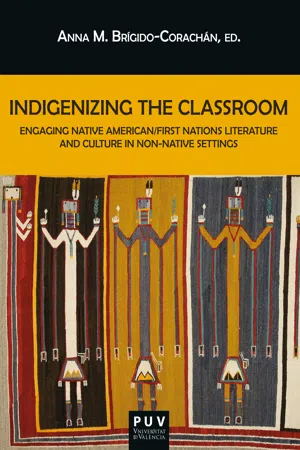
In the past four decades Native American/First Nations Literature has emerged as a literary and academic field and it is now read, taught, and theorized in many educational settings outside the United States and Canada. Native American and First Nations authors have also broadened their themes and readership by exploring transnational contexts and foreign realities, and through translation into major and minor languages, thus establishing creative networks with other literary communities around the world. However, when their texts are taught abroad, the perpetuation of Indian stereotypes, mystifications, and misconceptions is still a major issue that non-Native readers, students, and teachers continue to struggle with. To counter such distorted representations and neo/colonialist readings, this book presents a strategic selection of critical case studies that set specific texts within cross-cultural contexts wherein Native-based methodologies and key concepts are placed at the center of the reading practice. The challenging role of teachers and researchers as potential intermediaries and responsible disseminators of what Gayatri C. Spivak calls "transnational literacy" as well as the reception of Native North American works, contexts, and themes by international readers thus becomes a primary focus of attention. This volume provides a set of critical analyses and practical resources that may enable teachers outside the United States and Canada to incorporate Native American/First Nations literature and related cultural and historical texts into their teaching practices and current research interests in a creative, decolonizing, and responsible manner.
eBook - ePub
Indigenizing the Classroom
Engaging Native American/First Nations Literature and Culture in Non-native Settings
AAVV,
- 204 pages
- English
- ePUB (mobile friendly)
- Available on iOS & Android
eBook - ePub
Indigenizing the Classroom
Engaging Native American/First Nations Literature and Culture in Non-native Settings
AAVV,
About this book
Trusted by 375,005 students
Access to over 1.5 million titles for a fair monthly price.
Study more efficiently using our study tools.
Information
Topic
LiteraturaSubtopic
Ensayos literariosIdentity (and Other) Lessons:
Creative Writing in the Classroom
as a Door into the Poetry of Ralph Salisbury
Creative Writing in the Classroom
as a Door into the Poetry of Ralph Salisbury
Ingrid Wendt
My goal here is to provide teachers and intermediaries working at the secondary and university levels, with materials—a handful of poems by Cherokee-Irish-English-American, pacifist, and environmentalist writer Ralph Salisbury—and teaching suggestions to aid in their efforts to change students’ stereotyped ideas and misconceptions of contemporary Native Americans.
Though Salisbury, whose primary tribal identity was Cherokee, authored three books of short fiction and a prize-winning book-length autobiography, this paper will focus exclusively on poems selected from his 11 books of poetry. The selections, which appear at the end of the article, are short, accessible, and lend themselves well to class discussion. Their themes are wide-ranging, from the personal to the global, and give evidence of Salisbury’s stance (to quote scholar Arnold Krupat) as a “Cherokee Humanist and Indigenous Cosmopolitan.”
The subject matter and themes in these selected poems recur throughout Salisbury’s entire oeuvre. Some poems even do double or triple or quadruple duty. They can be categorized in the following ways:
1) cultural misunderstandings and personal confusions of mixed-raced identity (“Sometimes Likely,” “With the Rain and the Sun,” “Medicine Meeting, Hoopa,” “An American-Indian Success Story in India”);
2) a commitment to preventing his “Vanishing American” heritage, along with his people’s history of genocide and oppression, from being totally erased (“Swimming in the Morning News,” “Medicine-Meeting, Hoopa, 1994,” “Respecting Uktena,”);
3) Salisbury’s sense of kinship with indigenous people around the world (“A Coastal Temple Ruin, 1992,” “Medicine-Meeting, Hoopa, 1994” “With the Wind and the Sun”);
4) the cyclical nature of peace and war, plus the lingering trauma of war’s aftermath, as experienced by himself, by family members, and by total strangers (“For Robert Wessels,” “Old German Woman, Some Wars,” “My Brother’s Poem: Vietnamese War, 1969,” “With the Wind and the Sun”);
5) Salisbury’s pacifist stance and his condemnation of United States imperialism as the force that drove his country into the Vietnam War and that still drives US military engagement in the Middle East (“My Brother’s Poem: Vietnamese W, 1969,” “My Country Again Threatening Aggression,” “Swimming in the Morning News”);
6) Salisbury’s compassion for all victims of all wars—civilians and combatants—on both sides (“My Brother’s Poem: Vietnamese War, 1969,” “For Robert Wessels,” “Old German Woman, Some Wars”);
7) his environmentalism
8) his belief in the sacred oneness and interconnectedness of all creation (“Awakened by Cell Phone,” “Around the Sun, the Alaskan Oil-Spill,” “Respecting Uktena”);
9) Salisbury’s belief in the fusion of Past and Future time, within each Present moment (“A Genesis,” “Awakened by Cell Phone,” “Around the Sun, the Alaskan Oil-Spill,” “Swimming in the Morning News”); and
10) his wish “to save” whatever was in his power to save, be it immediate—girls drowning or someone falling from a tram—be it historical or long term. He believed his destiny in life was, through his writings of protest and affirmation, to save the sacred earth from destruction by nuclear warfare and/or the human greed that has led to today’s existential climate crisis. (“Swimming in the Morning News,” “A Coastal Temple Ruin, 1991,” “Old German Woman, Some Wars,” “Medicine-Meeting, Hoopa, 1994,” “Around the Sun, the Alaskan Oil-Spill”).
More than once Salisbury declared that his life and his writing were dedicated to the Tribe of the World, the Human Tribe. “Though I have lived and worked among the intelligentsia of many nations, my writing comes from having lived as a questing, mixed-race, working-class individual in a violent world, and my work is offered to the spirit of human goodness, which unites all people in the eternal struggle against evil, a struggle to prevail against global extinction” (Wendt “The Vitruvian Man” 143).
I will discuss six Salisbury poems: three that that focus on his mixed-race identity and three that focus on his stance as an environmental activist, condemning what he saw as the root cause of the climate crisis: greed. But first, I will also describe, in detail, a classroom approach that can be used to teach the other poems in this paper. Its purpose is to help teachers help their students to gain not only a better understanding of Salisbury’s work, as it stands alone, but also of its universality: of the possible parallels between the poet’s views and experiences, and their own.
Readers will also find, at the end of this article, a condensed bibliography and abbreviated biographical information about Ralph Salisbury, who is still, even after his death in 2017, widely acclaimed throughout North American literary and university circles, both within the world of Native American publishing, and beyond.
THE SEVEN BASIC STEPS: A CLASSROOM STRATEGY USING POEMS AS SPRINGBOARDS FOR WRITING
The Philosophy
After many years of teaching poetry writing in hundreds of elementary through graduate school classrooms, across the US, as well as in Germany, Italy, and Spain; having been a 3-time Fulbright professor at the Universities of Frankfurt/Main and Freiburg, Germany; and having taught classes in undergraduate poetry writing as well as classes for future and practicing ESL teachers on how to teach poetry writing in the classroom, I summarize my basic approach as a sequence of seven steps, which I give farther below (see also Wendt Starting With Little Things).
As an “aside,” I have noticed, while teaching in Europe, a resistance among some educators to the idea that poetry writing can be taught. (Perhaps they forget the centuries-old tradition of the painter’s apprentice.) The talent for writing is inborn, they say. If it is genuine, they say, talent will emerge, on its own. If the talent is not there, forget it. My reply has been that most healthy young people can ride a bicycle, with just a bit of help. Not all of them, however, have the will, the drive, the physique, and the love of cycling needed to become world-class champions. Knowing this, would we withhold instructions that might give all young people access to cycling for the sake of pleasure and/or cutting carbon emissions?

Ralph Salisbury
My philosophy is that within each student lies a vast, untapped reservoir of creativity. With just a few suggestions, a few instructions, students can experience just a bit of the pleasure of writing something like poetry and feel more secure in their own creativity. The bonus? They are also learning about the poems we use as examples, about the subjects and themes under discussion.
In-Class Writing Activity: One Central Ground Rule
One of my own mentors, the great American poet William Stafford, is famously known for his cure for writers’ block. When he gets stuck, he said, he just lowers his standards. He didn’t mean his standards didn’t rise again, during the revision process. But we are not planning to revise right now. Students can do this later, on their own, if they wish.
Central to the success of any and all in-class writing activities, is the understanding that first drafts/experiments can’t happen when impulses are not followed, when the mind is not allowed to wander, when pre-editing happens in the middle of a sentence or before, when students let perfectionism get in the way of creation, or if they worry about merit, or teacher expectations, or grades, or peer pressure.
So, adapting Stafford’s practice to the classroom, I tell the students: “Avoid writer’s block: lower your standards! Take what comes, follow what Stafford called ‘the golden thread.’ Let the mind wander. This is sometimes called ‘free association’ or ‘stream of consciousness’.”
Convincing students they can do this is, of course, easier said than done.
I’ve Learned:
• to say we’ll be doing a writing “experiment” or “exercise,” or “activity,” especially if I sense that students think that writing poetry is only for special people, or if they seem to be intimidated or afraid of failure.
• to use the terms “draft” or “first draft.”
• to say, “What we write may or may not look like a poem; no worries.”
• to set a time limit: 10 or 15 minutes, no more.
• to say, “If English is not your first language, write in your native tongue; translate later, if you wish. Or if you wish to write in English, insert a word in your native tongue, if you’re not sure of the translation.”
• to say, “Write down whatever comes to your head. Even if the words that pop to mind aren’t inspiring, get them out of your head and onto the page, so you’re free to move on. Other things will follow, and one of them might be worth keeping.” There’s something about hand movement that gets the creative juices flowing.
• to say, “No rhyming unless it’s impossible to avoid.”
• to say, “So it’s messy, so what? This is brainstorming. Cross out your mistakes. Erasing takes time.”
• “If you don’t know how to spell a word, circle it. Please do not lose time by looking it up.”
• to say, “You won’t be graded, but everyone needs to do this writing, for the experiment to work, and I need to give your credit. Your names must be on your work, and your writing needs to be turned when it’s done.”
• to say, “You may, however, in the eyes of the class, remain anonymous.”
The Practice
The following sequence of seven steps is geared to a classroom period of 1½ hours. It might be necessa...
Table of contents
- Cover
- Halftitle
- Title
- Copyright
- Contents
- Acknowledgement
- Reframing Our Pedagogical Practice. Teaching Native American/First Nations Literature and Culture through Indigenous-centered Methodologie
- Pedagogies of Language Sovereignt
- Addressing Matters of Concern in Native American Literatures: Place Matter
- Buffalo Man: Human-Animal Transformations in American Indian Fiction and Its Reception by Polish University Student
- An Interdisciplinary Approach to Teaching Pocahonta
- ‘With them was my home’: The Politics of Native Space in A Narrative of the Life of Mrs. Mary Jemison
- Teaching Native American Literature in Argentin
- Native American Children’s Literature in the English Language Education Classroo
- Indigenizing Afroperipheralism in Wayde Compton’s The Outer Harbour
- Identity (and Other) Lessons: Creative Writing in the Classroom as a Door into the Poetry of Ralph Salisbur
Frequently asked questions
Yes, you can cancel anytime from the Subscription tab in your account settings on the Perlego website. Your subscription will stay active until the end of your current billing period. Learn how to cancel your subscription
No, books cannot be downloaded as external files, such as PDFs, for use outside of Perlego. However, you can download books within the Perlego app for offline reading on mobile or tablet. Learn how to download books offline
Perlego offers two plans: Essential and Complete
- Essential is ideal for learners and professionals who enjoy exploring a wide range of subjects. Access the Essential Library with 800,000+ trusted titles and best-sellers across business, personal growth, and the humanities. Includes unlimited reading time and Standard Read Aloud voice.
- Complete: Perfect for advanced learners and researchers needing full, unrestricted access. Unlock 1.5M+ books across hundreds of subjects, including academic and specialized titles. The Complete Plan also includes advanced features like Premium Read Aloud and Research Assistant.
We are an online textbook subscription service, where you can get access to an entire online library for less than the price of a single book per month. With over 1.5 million books across 990+ topics, we’ve got you covered! Learn about our mission
Look out for the read-aloud symbol on your next book to see if you can listen to it. The read-aloud tool reads text aloud for you, highlighting the text as it is being read. You can pause it, speed it up and slow it down. Learn more about Read Aloud
Yes! You can use the Perlego app on both iOS and Android devices to read anytime, anywhere — even offline. Perfect for commutes or when you’re on the go.
Please note we cannot support devices running on iOS 13 and Android 7 or earlier. Learn more about using the app
Please note we cannot support devices running on iOS 13 and Android 7 or earlier. Learn more about using the app
Yes, you can access Indigenizing the Classroom by AAVV in PDF and/or ePUB format, as well as other popular books in Literatura & Ensayos literarios. We have over 1.5 million books available in our catalogue for you to explore.