Biotechnology in the Modern Medicinal System
eBook - ePub

Biotechnology in the Modern Medicinal System

Advances in Gene Therapy, Immunotherapy, and Targeted Drug Delivery

  1. 240 pages
  2. English
  3. ePUB (mobile friendly)
  4. Available on iOS & Android
eBook - ePub

Biotechnology in the Modern Medicinal System

Advances in Gene Therapy, Immunotherapy, and Targeted Drug Delivery

About this book

Biotechnology in the Modern Medicinal System: Advances in Gene Therapy, Immunotherapy, and Targeted Drug Delivery presents an informative picture of the state-of-the-art research and development of actionable knowledge in medical biotechnology, specifically involving gene therapy, immunotherapy, and targeted drug delivery systems. The book includes novel approaches for therapy of various ailments and the real-world challenges and complexities of the current drug delivery methodologies and techniques.

The volume helps to bridge the gap between academic research and real-time clinical applications and the needs of medical biotechnology methods. This edited book also provides a detailed application of medical biotechnology in drug discovery and the treatment of various deadly diseases.

Chapters discuss targeted drug delivery to specific sites to avoid possible entry to non-targeted sites, minimizing adverse effects. The volume provides information about the roles of alternative routes of drug targeting, like intranasal and transdermal, resulting in improving patient compliance. Targeted drug delivery is explored for several health issues, such as neurodegenerative disorders, cancer, malaria, and hemoglobin disorders. Also considered is the role of genes in various genetic diseases and gene therapy, and immunogene therapy as alternative approaches to conventional cancer therapy.

Finally, the book investigates the important role of computers in biotechnology to accelerate research and development in the modern medicinal field for better and optimum results. Studies show that significant improvement has been observed in the development of a faster and less invasive diagnostic system for the treatment of diseases by utilizing both artificial intelligence (AI) and biotechnology.

This valuable volume provides a wealth of information that will be valuable to scientists and researchers, faculty, and students.

Trusted by 375,005 students

Access to over 1.5 million titles for a fair monthly price.

Study more efficiently using our study tools.

Information

Year
2021
Print ISBN
9781771889728
eBook ISBN
9781000290592

CHAPTER 1Role of Naturally Occurring Lead Compounds as Potential Drug Targets against Malaria

NEHA KAPOOR1* and SOMA M. GHORAI2
1Department of Chemistry, Hindu College, University of Delhi, Delhi 110007, India
2Department of Zoology, Hindu College, University of Delhi, Delhi 110007, India
*Corresponding author. E-mail: [email protected]

ABSTRACT

This chapter overviews the diversity of natural products (NPs) obtained from telluric plants, marine-, and microorganisms in the treatment of variety of communicable and noncommunicable diseases. A historical perspective is being given to the readers about the discovery and use of various NPs as lead compounds for the synthesis of various drugs. Screening of natural resources to generate new lead compounds has been possible due to their enormous structural diversity and medicinal significance. Generation of many lead compounds with different structural analogs having fewer side effects and more pharmacological activity can be obtained by molecular modifications of their functional groups. Among others, much has been acknowledged about lead compounds that hold the promise as potential drug targets against almost all the vector-borne diseases. However, this chapter is restricted to document those lead compounds that are used in the management of malaria, a mosquito-borne disease. A wide range of compounds resulting from natural product sources such as endoperoxide, isonitrile derivatives, alkaloids, and nonalkaloid derivatives (terpenes, flavinoids, quinones, phenols, polyethers, and peptides) have been found to have promise as antimalarials. Such lead compounds as antimalarials with unique functional groups and chemical backbones holds key to future drug synthesis against Plasmodium parasites.

1.1 HISTORICAL PERSPECTIVE

Every era had seen successive development of use of natural products (NPs) to benefit societies and is passed on to another with improvement in its effectiveness through generations. Approximately, 5000 years ago, medicinal plants’ were the first candidates to be used and the early evidences have been found on a Sumerian clay slab from Nagpur. The inscriptions mentioned about 250 various plants and 12 recipes for drug preparation from plants like poppy, henbane, and mandrake (Kelly, 2009). The Chinese Emperor Shen Nung was the first to have documented a book called Pen T’Sao, circa 2500 BC, which defines 365 drugs from dried parts of medicinal plants including Rhei rhisoma, Theae folium, camphor, the great yellow gentian, podophyllum, ginseng, cinnamon bark, jimson weed, and ephedra (Wiart, 2006; Petrovska, 2012). Likewise, ancient Indian Vedas including the Charaka and Samhitas, which dates back to 1000 BC, recognized 341 medicinal plants and 516 drugs of the Indian Ayurvedic system (Dev, 1999; Kapoor, 2017). Many plant extracts of pomegranate, castor oil plant, senna, aloe, onion, fig, willow, coriander, juniper, common centaury, and so on have been mentioned along with garlic, a collection of 700 plant species used for therapeutics in Ebers Papyrus, circa 1550 BC (Tucakov, 1964). Talmud, the holy book of Jews, refers to the use of aromatic plants as incense or myrtle (Dimitrova, 1999). Homer’s epics, The Iliad and The Odysseys (ca. 800 BC), also mentions use of 63 plant species as pharmacotherapeutic agents (Toplak Galle, 2005). Greek scholars such as Herodotus and Pythagoras (500 BC) mentioned about the therapeutic values of garlic, castor oil, mustard, and cabbage. Hippocrates (459–370 BC) categorized nearly 300 medicinal plants conferring to their functional effects. Common centaury (Centaurium umbellatum Gilib.) and wormwood were administered against fever; garlic was used against intestine parasites; opium, deadly nightshade, mandrake, and henbane were consumed as narcotics; haselwort and fragrant hellebore were considered emetics; oak and pomegranate as astringents; while sea onion, parsley, celery, garlic, and asparagus were used as diuretics (Bojadzievski, 1992; Gorunovic and Lukic, 2001). Theophrast (371–287 BC), also known as the “Father of Botany,” was given due credit for cataloging more than 500 medicinal plants (Bazala, 1943; Nikolovski, 1995). The era from 23 to 79 AD was distinguished by two important contemporaries in pharmacy, Dioscorides (77 AD) and Pliny the Elder (23–79 AD). Both were credited to have traveled and documented more than 1000 medicinal plants (Tucakov, 1990; Toplak Galle, 2005). Galen (131–200 AD), a Roman physician, familiarized numerous new plants as remedial drugs which Dioscorides had not described, for example, Uvae ursi folium is used as an uroantiseptic and a mild diuretic. Some plants were used as insecticides, namely, Veratrum album, Alium sativum, Urtica dioica, Cucumis sativus, Achilea millefolium, Lavandula officinalis, Artemisia maritime L., and Sambuci flos (Bojadzievski, 1992) and by the seventh century, Ocimum basilicum, Rosmarinus officinalis, Iris germanica, and Mentha viridis were being used in cosmetics.
In the middle ages, particularly between 16th and 18th centuries, monasteries and churches took over the skills of healing and cultivation of medicinal plants, thereby; preparation of drugs were mostly restricted to a few handful of plants like sage, mint, anise, savory, tansy, and Greek seed (Tucakov, 1990). The silk route trade relations introduced the Arabs to numerous new plants in pharmacotherapy, mostly from India, and they used deadly nightshade, aloe, coffee, henbane, ginger, saffron, strychnos, pepper, curcuma, rheum, cinnamon, senna, and so forth. The European physicians consulted the Arab works, for instance; De Re Medica by John Mesue (850 AD), Canon Medicinae by Avicenna (980–1037), and Liber Magnae Collectionis Simplicum Alimentorum Et Medicamentorum by Ibn Baitar (1197–1248), in which over 1000 medicinal plants were documented (Tucakov, 1965). Though traditional people still used medicinal plants primarily as simple forms; the demand for compound drugs was increasing. During these period, simple pharmaceutical preparations by infusions, decoctions, and macerations using medicinal plants was also introduced and the compound drugs mainly contained of medicinal plants, rare animals, and minerals (Bojadzievski, 1992; Toplak Galle, 2005). Meanwhile, the great expedition by Marco Polo (1254–1324) and by Vasco dè Gama (1498) helped Europe develop rich cultivation of new medicinal plants like Cinchona, Cacao, Ipecacuanha, Ratanhia, Jalapa, Podophylum, Lobelia, Vanilla, Senega, tobacco, Mate, red pepper, as well as quinine bark Cinchona succirubra.
Early 19th century was marked by the beginning of scientific pharmacy. The earliest report of chemistry of NP was heralded by the work of Friedrich Wilhelm. With improved knowledge of chemistry and pharmacy; discovery, characterization, and isolation of lead compounds from the medicinal plants were available. Alkaloids were isolated from poppy (1806), ipecacuanha (1817), strychnos (1817), quinine (1820), pomegranate (1878), and other plants. Adam Serturner (1803), a German pharmacist, was known to sequester morphine from opium poppy (Papaver somniferum) (Huxtable and Schwarz, 2001). Glycosides, tannins, saponosides, etheric oils, vitamins, hormones, and so on, were also characterized and substantiated (Dervendzi, 1992).
An impediment was observed in the use of medicinal plants as drugs in the late 19th and early 20th centuries, owing to shortcomings incurred during the process of drying of medicinal plants. Moreover, synthetic preparations of alkaloids and glycosides were being used in therapeutics. Much effort was devoted to study the cultivation of medicinal plants which ascertained numerous forgotten plants like Aconitum, Hyosciamus, Punica granatum, Stramonium, Filix mas, Secale cornutum, Opium, Colchicum, Styrax, Ricinus, with more stabilization methods being proposed, especi...
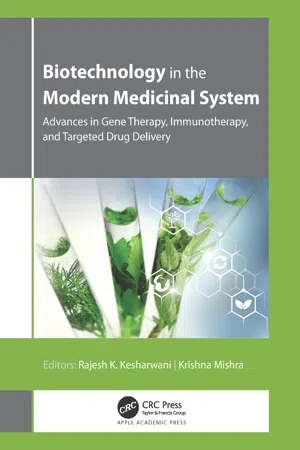
Table of contents

  1. Cover Page
  2. Half-Title Page
  3. Title Page
  4. Copyright Page
  5. About the Author
  6. Table of Contents
  7. Contributors
  8. Abbreviations
  9. Foreword
  10. Preface
  11. 1. Role of Naturally Occurring Lead Compounds as Potential Drug Targets against Malaria
  12. 2. Targeted Drug Delivery
  13. 3. Targeted Delivery of Biopharmaceuticals for Neurodegenerative Disorders
  14. 4. Genes in Genetic Disease
  15. 5. Current Perspectives and Trends in Gene Therapy and Their Clinical Trials
  16. 6. Immunogene Therapy in Cancer
  17. 7. Gene Therapy for Hemoglobin Disorders
  18. 8. Artificial Intelligence and Biotechnology: The Golden Age of Medical Research
  19. Index

Frequently asked questions

Yes, you can cancel anytime from the Subscription tab in your account settings on the Perlego website. Your subscription will stay active until the end of your current billing period. Learn how to cancel your subscription
No, books cannot be downloaded as external files, such as PDFs, for use outside of Perlego. However, you can download books within the Perlego app for offline reading on mobile or tablet. Learn how to download books offline
Perlego offers two plans: Essential and Complete
  • Essential is ideal for learners and professionals who enjoy exploring a wide range of subjects. Access the Essential Library with 800,000+ trusted titles and best-sellers across business, personal growth, and the humanities. Includes unlimited reading time and Standard Read Aloud voice.
  • Complete: Perfect for advanced learners and researchers needing full, unrestricted access. Unlock 1.5M+ books across hundreds of subjects, including academic and specialized titles. The Complete Plan also includes advanced features like Premium Read Aloud and Research Assistant.
Both plans are available with monthly, semester, or annual billing cycles.
We are an online textbook subscription service, where you can get access to an entire online library for less than the price of a single book per month. With over 1.5 million books across 990+ topics, we’ve got you covered! Learn about our mission
Look out for the read-aloud symbol on your next book to see if you can listen to it. The read-aloud tool reads text aloud for you, highlighting the text as it is being read. You can pause it, speed it up and slow it down. Learn more about Read Aloud
Yes! You can use the Perlego app on both iOS and Android devices to read anytime, anywhere — even offline. Perfect for commutes or when you’re on the go.
Please note we cannot support devices running on iOS 13 and Android 7 or earlier. Learn more about using the app
Yes, you can access Biotechnology in the Modern Medicinal System by Rajesh K. Kesharwani,Krishna Misra in PDF and/or ePUB format, as well as other popular books in Medicine & Biotechnology in Medicine. We have over 1.5 million books available in our catalogue for you to explore.