Focusing on the cutting-edge applications of AI cognitive computing from neuromorphic to quantum cognition as applied to AI business analytics, this new volume explores AI's importance in managing cognitive processes along with ontological modeling concepts for venturing into new business frontiers. The volume presents a selection of significant new accomplishments in the areas of AI cognitive computing ranging from neurocognition perception and decision-making in the human brain—combining neurocognitive techniques and effective computing—to basic facial recognition computing models. Topics include:
Agent neurocomputing techniques for facial expression recognition
Computing haptic motion and ontology epistemic
Characterizations of morph schemas for visual analytics
Learning and perceptive computing
Functional and structural neuroimaging modeling
Observed links between facial recognition and affective emotional processes
Interaction of cognitive and emotional processes during social decision-making
Neurocognitive processing of emotional facial expressions in individuals
Neurocognitive affective system for emotive robot androids
Executive surveys indicate that cognitive adoption is very important in business strategy for success and to remain competitive. Employing cognitive-based processes provides the way to get the right information in the right hands at the right time, which is the key to winning in the digital era and to driving business value that emphasizes competitive differentiation. Several chapters of the volume address the goal of using cognitive technology to improve search capabilities, to provide personalized customer service in business and in health and wellness, and to create better workflow management. Key features:
Looks at the newest frontiers on very popular AI and analytics topics
Discusses new techniques for visual analytics and data filtering
Shows how AI and cognitive science merges with quantum neurocognitive computing
Presents ontology models with ontology preservation data filtering techniques
Provides a cross-transposition on AI and digitizations for business model innovations
Artificial Intelligence and Computing Logic: Cognitive Technology for AI Business Analytics is a valuable resource that informs businesses and other enterprises the value of artificial intelligence and computing logic applications.
CHAPTER 1 FUNDAMENTAL NOTIONS AND APPLICATIONS OF SYMBIOTIC RECURSIVE PULSATIVE SYSTEMS
MARTA FRANOVA and YVES KODRATOFF
Advanced Researcher CNRS, Laboratoire de Recherche en Informatique, Rue René Thom, 91190 Gif sur Yvette, France
ABSTRACT
Developing and using symbiotic recursive pulsative systems (SRPS) is a source of innovation in various domains requiring to handle evolutive improvement, prevention, and control. However, the history of human thinking shows that the transmission of acquired results failed in most important human achievements due to a lack of a suitable presentation of fundamental notions behind the construction and the understanding of these systems.
The fundamental notions of SRPS are systemic symbiosis, recursion, and pulsation. In this chapter, we present them with the goal to underline that the use of standard modular and synergic methods is not appropriate for managing the transmission of knowledge needed for understanding SRPS. To this purpose, we shall divide management’s approaches into two basic categories. The Newtonian approach is suitable to manage modular systems. Cartesian Intuitionism is suitable to deal with SRPS. They are different, and thus they are complementary and not competitive to each other. A concrete example of the SRPS application will be given.
1.1 INTRODUCTION
New technologies of measurements in the physical world and new computational technologies allow Science to go further than it was imaginable a few decades ago. Such an advancement requires a focus on improvement, prevention, and control. This focus is not new in human thinking. However, the notions of improvement, prevention, and control are used even now in somewhat fuzzy versions. Indeed, so far, there has been no systemic paradigm that would provide a coherent and useful systemic presentation of these notions. In the past, these notions were present rather implicitly in philosophical systems. Nowadays, they are present in the same way in management techniques, or they are considered more-less separately in various scientific projects.
In the early eighties, we started to work on a technological vision that will be present in Section 1.7. Since there were no suitable available tools to start with, we have followed Descartes’ method. We have had interesting and useful results from the start. Throughout our advancement, we have realized that, due to handling systemic recursion, our interpretation of Descartes’ method differs from usual scientific or philosophical interpretations. The three keywords for these differences are symbiosis, recursion, and pulsation. It will be shown that they are directly inherent to a coherent systemic paradigm of improvement, prevention, and control.
Modern Science and philosophy consider synergy and modularity instead of symbiosis, non-recursive complexities instead of recursion and constant change or mutations instead of pulsation. While these modern Science notions are extremely useful and relevant for many real-world applications, they cannot replace symbiosis, recursion, and pulsation without destructive consequences. This means that the approaches of these two groups of notions are complementary and non-competitive.
For convenience, we shall call the first group the one containing the notions:
Symbiosis;
Recursion;
Pulsation.
And second group that of containing the notions:
Synergy, modularity;
Non-recursive complexities;
Change, mutations.
We shall present below reasons for naming Cartesian Intuitionism a systemic paradigm based on the first group and Newtonian approach a systemic paradigm based on the second group of notions. We shall call symbiotic recursive pulsative systems (SRPS) the systemic nucleus of Cartesian Intuitionism
We shall give below a systemic description of the first group notions as well as a presentation of a coherent and useful model for improvement, prevention, and control. It will be shown that the management of Cartesian Intuitionism projects significantly differs from Newtonian ones.
The chapter is organized as follows: Section 1.2 specifies the notion of symbiosis as understood in this chapter. Section 1.3 introduces recursion as a way of representing action, control, and prevention. It explains what we mean by systemic recursion. Section 1.4 introduces the notion of oscillation as a representation of a one-level creation process used in pulsation presented in Section 1.5. Section 1.6 presents a motivation for the introduction of systemic difference between the Newtonian approach and the Cartesian Intuitionism. It will become clear why the latter expression is used to describe the systemic Science relevant to SRPS. Section 1.7 presents a technological vision for which handling SRPS is relevant.
1.2 SYMBIOSIS-REPRESENTATION OF ‘VITAL INTERDEPENDENCE’
Symbiosis is a particular composition. In this section, we shall define of symbiosis as used in this chapter. We shall also compare symbiosis to another kind of composition, namely synergy and fusion. We shall start with an intuitive description before going into more formal details.
By symbiosis, we understand a composition of two or several parts that is separation-sensitive. This means that a separation of one or several parts leads to extinction or irrecoverable mutilation of the whole and all the involved parts.
In contrast to this, by synergy, we understand a composition of parts that is not separation-sensitive. Sometimes, synergy is also called modular composition.
In the case of fusion, the resulting composition is homogenous. It does not allow to recognize the involved parts, they are blended, such as in a fusion of metals. We shall now give several examples.
1.2.1 PICTORIAL SYMBIOSIS
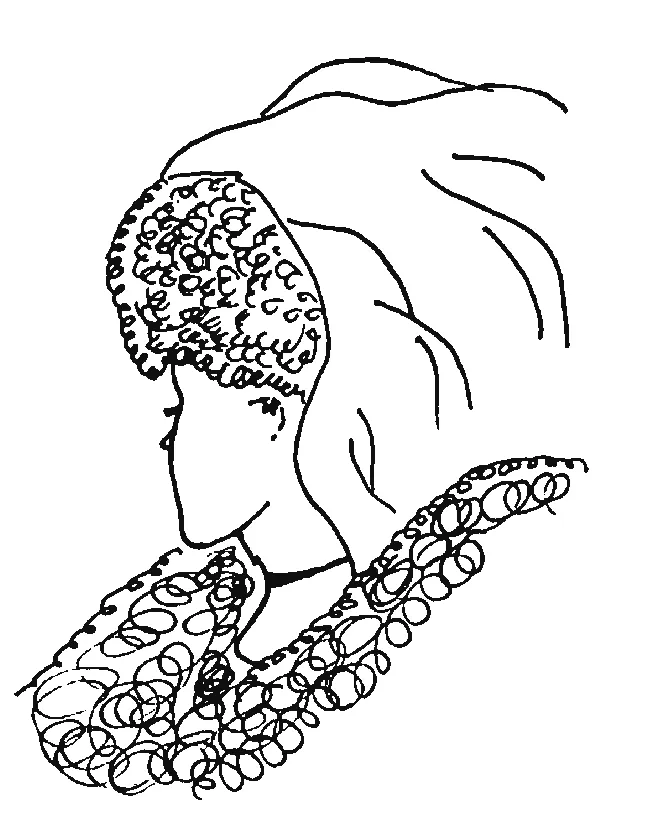
A similar picture is known as E.G. Boring’s version of one of the ‘Devinettes d’Epinal.’ Different overlapping features show either a young
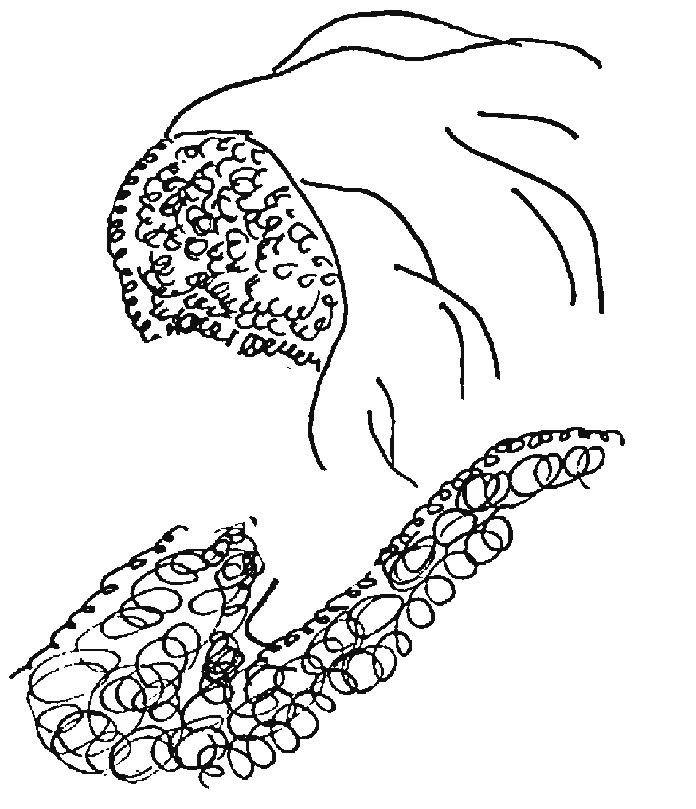
Let us consider our imitation of the well-known puzzle-like picture of ‘two women in one (see, for instance, Weisstein (2021) (Figure 1.1). or an old woman. The important point is that the features necessary to see the young or the old woman are common to both visions, say for example, their ‘little chin versus big nose’ or their ‘necklace versus lips’ features. If we withdraw these common features common to different interpretations, the women disappear, only leaving their common coat and a decorative feather in their hair (Figure 1.2).
FIGURE1.1 Old-young lady illusion.
FIGURE1.2 A mutilated version of old-young lady illusion.
This defines a symbiotic pictorial occurrence of both women, that is, there exists a subset of features (here, almost all of them, but this not necessary) such that deleting them from one occurrence induces an unrecoverable loss in both occurrences.
1.2.2 REPRESENTATIONAL SYMBIOSIS
A careful study of definitions of Euclid’s geometry objects shows that these definitions are symbiotic. This means that eliminating even one notion would either render meaningless the resulting system (i.e., extinction of the resulting system) or the meaning of the resulting system would be completely different (i.e., irrecoverable mutilation).
It should be noted here that the example of Euclid’s geometry illustrates well the fact that the constituents of a symbiotic system need to be handled as symbiotic in the construction process of such a system. However, after its successful final creation, the use of these notions may, in some cases, be modular. For instance, when we use the notion of point while working in Euclid’s geometry, we do not need to be aware of the symbiotic dependence of this notion on other notions of the same geometry. However, such awareness was necessary for Euclid when he created this geometry.
1.2.3 INTENTIONAL SYMBIOSIS
As far as intentional symbiosis is concerned, we consider it exclusively in relation to human artificial creations. The detection of intentional in nature processes is out of the scope of this chapter.
We could perceive a slight glimpse of intentional symbiosis in all the above, rather static, examples. Even though present, a rather procedural character of intentional symbiosis was not mentioned. In the next section, we shall give an example of the construction of Ackermann’s function, where such an intention will be easily describable and thus comprehensible.
In the following part, we shall give further examples of symbiosis in relation to recursion and pulsation. The above examples and descriptions make meaningful the following definition.
➣ Definition 1.2.3.1: Symbiosis: By symbiosis, we understand a composition of two or several parts which is separation sensitive.
1.3 RECURSION-REPRESENTATION OF ACTION, CONTROL, AND PREVENTION
This section is not intended as an introduction to mathematical recursion. It is intended only as a presentation of a minimal, but sufficient basis for understanding systemic recursion for SRPS.
Mathematical and computational recursion handle recursion from formal or programs efficiency points of view (see Gries, 1981; Kleene, 1980). Recursion, in these cases, is a known tool and not a science. In contrast to this, systemic recursion is a science of know-how for creating recursive systems that are useful for real-world applications in various domains. We shall point out the mai...
Table of contents
Cover Page
Half-Title Page
Title Page
Copyright Page
About the Editor
Table of Contents
Contributors
Abbreviations
Preface
1. Fundamental Notions and Applications of Symbiotic Recursive Pulsative Systems
2. Cognitive Computing: Quo Vadis?
3. Digital Transformations Imperatives: Predictive Goal Processes For Business Model Innovation
4. Toward a Quantum Theory of Cognitive Affect from Poe to Robotic Helpers: Newton, Arousal, and Covalent Bonding
5. AI Predictive Digital Analytics: A Model Computing Basis
6. Effect of Digitization on Business Model Innovation
7. AI Process Description Algebras and Ontology Preservation Techniques
Index
Trusted by 375,005 students
Access to over 1.5 million titles for a fair monthly price.
Study more efficiently using our study tools.
Frequently asked questions
Yes, you can cancel anytime from the Subscription tab in your account settings on the Perlego website. Your subscription will stay active until the end of your current billing period. Learn how to cancel your subscription
No, books cannot be downloaded as external files, such as PDFs, for use outside of Perlego. However, you can download books within the Perlego app for offline reading on mobile or tablet. Learn how to download books offline
Perlego offers two plans: Essential and Complete
Essential is ideal for learners and professionals who enjoy exploring a wide range of subjects. Access the Essential Library with 800,000+ trusted titles and best-sellers across business, personal growth, and the humanities. Includes unlimited reading time and Standard Read Aloud voice.
Complete: Perfect for advanced learners and researchers needing full, unrestricted access. Unlock 1.5M+ books across hundreds of subjects, including academic and specialized titles. The Complete Plan also includes advanced features like Premium Read Aloud and Research Assistant.
Both plans are available with monthly, semester, or annual billing cycles.
We are an online textbook subscription service, where you can get access to an entire online library for less than the price of a single book per month. With over 1.5 million books across 990+ topics, we’ve got you covered! Learn about our mission
Look out for the read-aloud symbol on your next book to see if you can listen to it. The read-aloud tool reads text aloud for you, highlighting the text as it is being read. You can pause it, speed it up and slow it down. Learn more about Read Aloud
Yes! You can use the Perlego app on both iOS and Android devices to read anytime, anywhere — even offline. Perfect for commutes or when you’re on the go. Please note we cannot support devices running on iOS 13 and Android 7 or earlier. Learn more about using the app
Yes, you can access Artificial Intelligence and Computing Logic by Cyrus F. Nourani in PDF and/or ePUB format, as well as other popular books in Betriebswirtschaft & Verwaltung. We have over 1.5 million books available in our catalogue for you to explore.