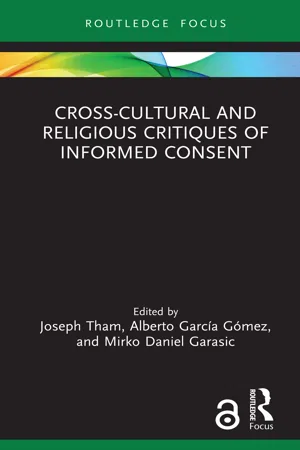
This book explores the challenges of informed consent in medical intervention and research ethics, considering the global reality of multiculturalism and religious diversity. Even though informed consent is a gold standard in research ethics, its theoretical foundation is based on the conception of individual subjects making autonomous decisions. There is a need to reconsider autonomy as relational—where family members, community and religious leaders can play an important part in the consent process. The volume re-evaluates informed consent in multicultural contexts and features perspectives from Buddhism, Confucianism, Hinduism, Christianity, Judaism and Islam. It is valuable reading for scholars interested in bioethics, healthcare ethics, research ethics, comparative religions, theology, human rights, law and sociology.
eBook - ePub
Cross-Cultural and Religious Critiques of Informed Consent
- 132 pages
- English
- ePUB (mobile friendly)
- Available on iOS & Android
eBook - ePub
Cross-Cultural and Religious Critiques of Informed Consent
About this book
Information
Part I
Multiculturalism and relational autonomy
1
Ethical issues concerning informed consent in translational/clinical research and vaccination
DOI: 10.4324/9781003213215-3
Improving the health literacy of patients in relation to medical practices and research is essential for upholding the principle of respect for autonomy—that is, respecting the patient’s ability to make self-governed choices regarding medical interventions or research participation that reflects the patient’s beliefs and values.
This report1 provides a full review of informed consent challenges (i.e. ethical gaps, barriers and priority needs) that are unique to certain vulnerable groups, namely, preadolescents, adolescents, and pregnant women, with a specific emphasis on how neurobioethical, multicultural and interreligious variables should be taken into account when assessing the appropriateness of the current documents relying on the notion of informed consent. In exploring how we are to improve the process of obtaining informed consent, we will also highlight the relevance of bias and privacy in the debate. The objective is to offer recommendations on how these gaps, barriers and challenges may be solved or avoided in the future.
There are two categories of challenges. The first category comprises challenges that are patient-centred, which prevent a research subject from fully comprehending the disclosed information. The second category comprises challenges that are process-centred, which are procedural barriers that prevent obtaining truly informed consent from prospective patients.
The types of recommendations explored for solving or avoiding these two forms of barriers in the context of research and vaccine administration include: 1) understanding more in depth the potential information derived from progress in neuroscience; 2) taking into account the role of religion and non-Western cultures in relation to a person-centred way of conceptualizing informed consent; 3) improving the readability and design of consent forms; 4) identifying the cultural and other bias of both the patient and the doctor/researcher; 5) evaluating the role of privacy in the collection of sensitive data connected to informed consent; 6) incorporating education-specific strategies to improve patients’ or participants’ understanding of consent information; 7) initiating discussion of meningitis, HPV or RSV immunization and clearly explaining the benefits of infection prevention through immunization; 8) inviting questions at every step of the consent process; 9) acknowledging and addressing discrimination based on age and gender; 10) obtaining consent from legal representatives (in the case of children or pregnant women limited by mental defects or disorders); 11) protecting the privacy of participants enrolled in vaccine-related research; 12) acknowledging patients’ or participants’ own experiences with meningitis, RSV and/or HPV infection; 13) implementing procedures to assess patients’ or participants’ capacity to consent; 14) supporting parenting strategies and lifestyle practices that reduce and reverse predisposing risk factors to meningitis, RSV and HPV infection; 15) adopting individualized approaches to promote health protective behaviours (tailoring the consent process to reduce concerns relating to vaccine cost, pain, safety, side effects, perceived appropriateness to lifestyle and/or need for multiple doses) and 16) implementing a dynamic informed consent model with participant control, accompanied by appropriate privacy safeguards.
A multicultural and interreligious perspective on informed consent
The UNESCO International Bioethics Committee stressed in more than one occasion that an individual has to be informed as much as possible on the outcomes of the procedure in which she is involved in:
The close connection between autonomy and responsibility supposes that consent be freely given by the person concerned, the clearest possible information be provided, his/her faculties of comprehension be intact, that he/she has been able to assess the consequences of participating in a research project and the development of the entire process, as well as fully understanding the advantages and disadvantages of possible alternatives, also in terms of treatment.2
Aside from this analysis, various cultural and social variables are to be considered when assessing the ethical validity of the informed consent process. Oftentimes, such considerations might impinge upon the monolithic, individual-centred version of autonomy that we tend to give for granted in the Western contexts, creating a space for new versions of vulnerability—in which the vulnerable population is represented by those individuals unable to see their attitude and perception of autonomy as sufficiently represented by current legislations. In some scenarios, for example, we could use “communal autonomy” or “relational autonomy,” a version of autonomy that sees the deliberation and the legitimacy of a decision to belong not only to a single person but rather the community to which one belongs (i.e. family). Often leaders of the community—nearly always family members—are those who make the decisions and their judgement is not questioned due to their age, expected wisdom and knowledge of the community’s internal dynamics in place.
Individual and relational autonomy
In line with what just described, the words of Joseph Tham and Marie Letendre are particularly relevant to understand more accurately how some of our standard ways of conceptualizing the discussion around informed consent might not be as given as expected.
Cultural norms specify behavior. ‘Honesty is an ideal value for most Americans, but it varies in strength as a real value for other cultures.’3 Honor is highly prized in the Japanese culture as is female purity in the Islamic world. Direct eye contact is avoided in several cultures, notably Asian and the Middle Eastern culture; the Navaho use silence to formulate their thoughts in order to give the most complete answer. Trust is given only to family members in the Gypsy culture. Masculine and feminine pronouns do not exist in Asian languages, and ‘yes’ does not always mean the affirmative since many cultures use the ‘yes’ as a way of avoiding an embarrassing ‘no’. This is just a short list of cultural variables that inform and form communication styles. A cross-cultural health care ethic combines the tenets of patient—family centered care with an understanding of the social and cultural influences that affect the quality of medical services and treatment. Developing sensitivity to different cultures can make health care programs and activities attractive and interesting for a broader population base. In contrast, a lack of cultural sensitivity can deter people from using health care services.4
Hence, not all documents that assume that focusing on the individual might be sufficiently sensitive towards how one person with a cultural, religious or identitarian background might want (or is capable) to express her views, values and desires if disconnected from her community. In accepting this reality, it is equally important to bear in mind, as Loredana Persampieri rightly stresses, that—though contemplated—relational autonomy has no effective role in the shaping of informed consent in official forms.5
Seeking consent from an individual is necessary, even if the community is consulted, but the actual value of the consent of such individual, once the community has given its approval or disapproval, often raises concern. Nevertheless, such reasons should not lead to the conclusion that cultural considerations pave the way to situations where, exceptionally, for members of some groups communal autonomy may override individual autonomy. Conversely, we should always bear in mind that “respect for cultural diversity and pluralism should not be used to infringe fundamental freedoms nor any of the principles set out in the Declaration.”6 In this perspective, the Italian National Bioethics Committee suggests an interpretation of the concept of autonomy in terms of “relational autonomy,” which may be better tailored to an intercultural approach aimed at accommodating the value of the community dimension in certain cultural settings (i.e. African tribes) and respect for the person.7
As the notion of informed consent relies on a set value of individual autonomy that not all cultures and approaches to life share, a patient’s cultural disposition and past experiences with medical healthcare professionals will have an impact on the amount of trust that they can have in a vaccines’ efficacy, for example. Although local culture may shape people’s perception over time, people are more likely to trust experts that share a similar background, tradition, religion and culture with them.8 When working with ethnic minority patients, it is important to note that comprehension may also transcend simply linguistic barriers. The conceptualization of illness and cultural bias both plays a role in the ways that information is presented and understood. Thus, it is important to understand the role that culture plays in obtaining informed consent.9 In particular, in multicultural societies, where a large portion of the society is made up of immigrants with varying cultural backgrounds, there may be differing attitudes regarding the role of physicians. Moreover, the quality of informed consent may be dependent on the relationship between a physician and their patient.
To improve the physician–patient relationship and for the consent gained to be effective, there has to be a partnership based on openness, trust and good communication between the two parties.10 Individual’s religious beliefs or related cultural values can lead to questions and concerns that health professionals, unfamiliar with the religion or culture, have not encountered before. It has been shown that culture (which can also include religious and spiritual backgrounds) can impact one’s vulnerability to infectious diseases. Rejecting treatments or prevention measures due to religious or cultural values is not a new phenomenon; there have been reports of vaccines-preventable outbreaks in r...
Table of contents
- Cover Page
- Half Title Page
- Series Page
- Title Page
- Copyright Page
- Contents Page
- List of contributors Page
- Introduction
- Part I Multiculturalism and relational autonomy
- Part II Religious perspectives on informed consent
- Index
Trusted by 375,005 students
Access to over 1.5 million titles for a fair monthly price.
Study more efficiently using our study tools.
Frequently asked questions
Yes, you can cancel anytime from the Subscription tab in your account settings on the Perlego website. Your subscription will stay active until the end of your current billing period. Learn how to cancel your subscription
No, books cannot be downloaded as external files, such as PDFs, for use outside of Perlego. However, you can download books within the Perlego app for offline reading on mobile or tablet. Learn how to download books offline
Perlego offers two plans: Essential and Complete
- Essential is ideal for learners and professionals who enjoy exploring a wide range of subjects. Access the Essential Library with 800,000+ trusted titles and best-sellers across business, personal growth, and the humanities. Includes unlimited reading time and Standard Read Aloud voice.
- Complete: Perfect for advanced learners and researchers needing full, unrestricted access. Unlock 1.5M+ books across hundreds of subjects, including academic and specialized titles. The Complete Plan also includes advanced features like Premium Read Aloud and Research Assistant.
We are an online textbook subscription service, where you can get access to an entire online library for less than the price of a single book per month. With over 1.5 million books across 990+ topics, we’ve got you covered! Learn about our mission
Look out for the read-aloud symbol on your next book to see if you can listen to it. The read-aloud tool reads text aloud for you, highlighting the text as it is being read. You can pause it, speed it up and slow it down. Learn more about Read Aloud
Yes! You can use the Perlego app on both iOS and Android devices to read anytime, anywhere — even offline. Perfect for commutes or when you’re on the go.
Please note we cannot support devices running on iOS 13 and Android 7 or earlier. Learn more about using the app
Please note we cannot support devices running on iOS 13 and Android 7 or earlier. Learn more about using the app
Yes, you can access Cross-Cultural and Religious Critiques of Informed Consent by Joseph Tham, Alberto García Gómez, Mirko Daniel Garasic, Joseph Tham,Alberto García Gómez,Mirko Daniel Garasic in PDF and/or ePUB format, as well as other popular books in Theology & Religion & Religion. We have over 1.5 million books available in our catalogue for you to explore.