This volume explores the philosophical and metaphysical manifestations of contemporary cinema. Starting with the hypothesis that movies provide an experience that is both a pathway into the thinking mechanisms of modern humans and into our collective psyche, this study focuses on the elements that form the "Romanian cinematic mind" as part of the European cinema-thinking.
While this book is based on specific case studies provided by recent productions in Romanian filmmaking, such as Proroca (2017) and Touch me Not (2018), it also contextualises the national cinema within the larger, European art of making movies. Offering close interpretations of the works of world-renowned directors like Cristi Puiu, Cristian Mungiu, Corneliu Porumboiu or more recently Adina Pintilie and Constantin Popescu, this book questions the "Romanianess" of their cinematic techniques, and places their philosophical roots both in a particular mode of thinking and within continental philosophy.
- 280 pages
- English
- ePUB (mobile friendly)
- Available on iOS & Android
eBook - ePub
About this book
Information
1
The Eternal Flickering of the Film-philosophies Quarrel
Films make us think, characters in movies philosophize, their stories are carriers of philosophical questions and problems, and cinema is even considered to be a new form of thinking. These statements appear axiomatic, as they are purported by many film philosophers, film critics, theorists, and filmmakers. An entirely new and autonomous academic field was promptly created around these presuppositions, consecrated with a generous label: “film-philosophy.” With innumerable publications, journals, articles, and books coming out at an astonishing rate, it would be impossible to deny that films can “do philosophy,” or at least that they can generate various forms of philosophizing. A myriad of titles tagged “The philosophy of …” are constantly published, placed in distinctive categories on library bookshelves. Upgraded versions of the same denomination, such as “Philosophers on film” or the various philosophers that forcibly took “to the movies,” become activated as soon as a new film production is in theaters. Once a movie is released, far-reaching explanations of its philosophical contents are already available, in-depth meanings of the special thinking residing within a genre are extracted, and revelations about the particular philosophies created by the moviemaker are uncovered. To the surprise of many moviegoers, who find out only in the bookstores what they were supposed to understand while watching the fascinating images quickly shimmering on the big screen, such books suggest a plethora of ideas, presumably preexisting in those films.
My approach is no different; thinking about how movies are thinking is the underlying premise of this work. As it happens when joining late the discussion in any field, the effort to elaborate a theoretical framework designed to explain features and manifestations previously interpreted, to give a clear interpretation of the thought processes outside the cinematic is an endeavor obstructed by the multiple competing paradigms already disputing priority and ascendency. An attempt to propose a set of explanations about the specific mode in which cinematic thinking happens outside the screen was encumbered by numerous assumptions generating more confusion than clarity. The following clarifications must be understood not as a summary of the major debates between film-philosophers, film scholars, and film critics, they are intended as a pretext for my own conceptual framework.
In no way am I assuming the Herculean task of summarizing the history of all the encroaching theoretical disputes proposed in this clogged matter. Although many attempts were made to bring balance between the various irreconcilable perspectives advanced by academics and cinephiles alike, there is no consensus on this subject among the theorists and amateurs of cinema. The sheer amount of works that take interest in the relationship between cinema and philosophy might seem overwhelming, as a constant flow of texts, manuals, and compendiums has already tackled similar issues. Comprehensive philosophy and film companions are available (Livingston and Plantinga 2009); reliable handbooks are making the key concepts intelligible for the use of students and film teachers (Carroll et. al 2019), with many more individual studies constantly printed adding to the overall knowledge. This avalanche of publications, which has created an autonomous field in philosophical studies, has brought conceptual controversies and terminological squabbles. There is no consensus about the jurisdiction of the discipline itself. For some authors (Wartenberg 2015) it has fully developed into a subfield of the philosophy of art, while for others (Shaw 2008) it should be placed within the field of aesthetics, or, in a less pretentious way, it is considered to be a component of film theory.
Disregarding the debate about the boundaries of film studies and the questioning of philosophical interpretations of movies residing outside the borders of cinema research, movies always represented an attractive topic, since even philosophers seem to enjoy “going to the movies” (Falzon 2002). Multiple interdisciplinary approaches to cinema were proposed in order to combine the two seemingly incompatible fields and in many contemporary philosophical debates movies are used as either first-hand illustrations or visual aids that can bring accessibility. In a reversible move, philosophy for film critics is an instrument providing credibility and the appearance of knowledgeability.
To make things worse, the confusing mixture of explanations is amplified by the riddles caused by systematically challenging previously staked explanations, with a constant exposure of contrasting explanations for the same phenomena. Since this is a common practice in the humanities, we should not worry much, but it does not help that any attempt to settle the long-standing debates about the nature of cinema or the philosophical dimensions of movies end up often as goose-egged chases. Such an effort seems doomed to fail from the start; yet, since the guns are out, why not give it a go?
Thus a critical overview of the most important approaches and perspectives involved in the film and philosophy polemic becomes imperative. Numerous approaches and answers to the problematic relationship between film and philosophy represent a conceptual face-off.
A Philosophical Standoff: The Banal, the Bold, and the Moderate
This philosophical standoff can be mapped like a Spaghetti Western scene, similar to the classic confrontation from The Good, the Bad and the Ugly (Figure 1.1). I am aware that this might look trivial as a reductionist vision of a complex debate. Using a cinematic cliché could bring menacing frowns from serious-minded scholars. I am only critically reacting to other film theorists (Livingston 2006) who entered a philosophical duel, reducing the debate to a dichotomy. Two contrasting perspectives are locked in a confrontation, the so-called “bold” versus the “moderate” propositions. My model is obviously a call-out, first and foremost because one must fly in the teeth of the label used by Livingston and the other participants in this “film querelle.” Although the Hong Kong-based philosophy professor later revised his own conceptualization, proposing an alternative wording in which he is opposing the “strong” and “modest” philosophical claims—himself supporting the latter—the blanket definition for all theories supporting the ability of films to create innovative philosophical contributions through the cinematic medium (Livingston 2009: 21) has stuck. As I will try to prove in the following explanations, the fact that Livingston and many others are placing authors like Jean Epstein, Gilles Deleuze, or Daniel Frampton in the same category is fallacious and misleading, adding to the confusion of this binary duel of concepts. None of the positions adopted by the participants in this philosophical stalemate can be counterbalanced, as various commentators, critics, and cinephiles simply cross the lines from one stance to another.
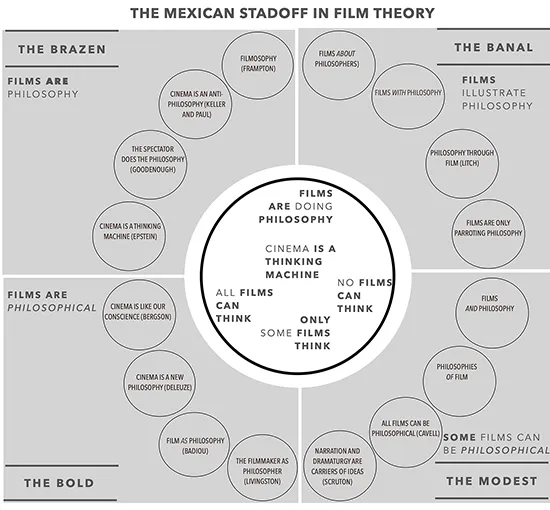
FIGURE 1.1 Schematic overview of the major opposing theories in film and philosophy studies.
The cinematic standoff is not unlike the famous Mexican face-off, as everybody is pointing his philosophical gun in someone’s direction. Like in a typical Mexican standoff, there are at least three irreconcilable perspectives, all facing each other and contesting the validity of their opponents. The three major hypotheses dominating contemporary discussions in film-philosophy can be summarized as such: (a) the conception of cinema as philosophical and/or capable of “doing” philosophy; (b) the refusal of the assumptions crediting cinema with a structural capacity to think or even to generate viable thoughts; and (c) the effort to identify some aspects in movies that have philosophical meanings, while admitting that not all films have the capacity to generate conceptual thoughts. For each of these approaches there are several subcategories, in turn impeding on the progress of other lines of questioning.
The protagonists of this intellectual combat taking place in the wastelands of cinema and philosophy have different names. The most common form of labeling is done by combining the two terms (film/philosophy) with different prepositions and conjunctions. The result is a complicated series of definitions, organizable alphabetically in the following series: about/and/as/at/in/is/on/through/with/without. These combinations are complicated by the fact that, as noted by John Mullarkey (2009), the field of film-philosophy is dominated by partisanships, and the conflictual nature of these positions is disputed fiercely. Various tags and denominations are rejected, criticized, and discharged as defective. A relative consensus in film theory is to settle with three basic modes of cinematic philosophy (Wartenberg 2011: 22): films illustrating philosophy, films conducting philosophical thought experiments, and films performing real experiments. Others (Mullarkey 2009: 13) describe similar forms in which philosophy can manifest: through film, of film, and as film. By using the same formula, Baracco (2017) identified four different approaches to film philosophy: the philosophies of film, philosophy through film, films about philosophy, film as philosophy. As previously elaborated by Goodenough (2005: 1–3), these definitions can cover the following basic reasons for a philosopher to “go to cinema”: to discover the philosophical dimensions of the movies (philosophy of film); to use the films as illustrations of already-existing philosophical topics (philosophy through film); to watch philosophical issues displayed in movies (films about philosophy); or to see how films are actually “doing” philosophy (film as philosophy).
While providing a similar taxonomy of instances in which film and philosophy can “meet” (Vaughan 2013), in fact the spectrum of prepositions which is extremely variegated can often lead to confusions due to their simplistic formulation. These “prepositional explanations,” which are designed to set apart different assertions and conceptual disagreements, sometimes accentuate the lack of clarity by producing more semantic misunderstandings. One example of the ways in which these definitions and conceptual divides are perpetuated is illustrated by Philipp Schmerheim, who also catalogued the various theses existing in the scholarly field of film and philosophy. Expressing a disagreement with the group of definitions and configurations belonging to the “through” category, Schmerheim (2017: 21–2) criticized Mullarkey’s definition of the philosophy “through” film. The German researcher considers that “through” should include the “philosophicality” of movies, while the Kingston University professor defines with “through” the films that are used as illustrations of philosophical ideas. This important discussion will be reappraised again later in another subchapter.
This is only one example of why I consider that the film about/and/as/at/in/is/on/through/with/without philosophy taxonomy must be reappraised by using proper nouns in definitions, which should take us the apparent handiness of prepositions, conjunctions, or adverbs usually associated in the field. When overlooking the terms coupled in this debate, I also consider it important to offer a couple of new and corrective concepts that are obligatory in order to clarify some of the critical misunderstandings that come from some limitative readings. A strident example is the interpretation of the famous Deleuzian formula: “The screen is the brain.” This utterance is quickly translatable with the constituent terms of our debate, where “screen” equals cinema (or film) and “the brain” equals thinking (or philosophy). Nevertheless, this apparently unproblematic definition is misused and its interpretations induce inaccurate understandings of the relationship between film and philosophy—the specific aspects of the discussion will also be clarified in a dedicated subchapter. The lack of agreement between the major theories and theoretical paradigms explaining the relationship between film and philosophy comes with a supplementary divergence from the various paradigms already existing in philosophy studies.
This being said, the taxonomy is unavoidable. We can draw the major divide along two opposing lines of arguments, each offering a basic classification and establishing a large categorical divide alongside two major questions: “Can films do philosophy?” and “What kind of thinking can films generate?” The answers are never easy and are complicated by the remarkable properties of cinema, given by the fact that a material reality, with physical consistency (actors, settings), is modified in such a way that the experience provided has no physical properties. Unlike painting, where the representation has a material manifestation and a clear intentional determination, the immaterial nature of the cinematic projection, which allowed the creation of a new mode of experiencing the material world for humanity, is highly problematic. The nature of the things that seem to exist only on screen coalesced with the material nature of the cinematic; as the film itself is “real,” the actions and emotions that are present in the world created by the movie, which exist autonomously in the minds of the viewer, are factors complicating any answers. Such internal contradictions have led many film theorists and film-philosophers to reach different conclusions about the epistemological, ontological, and metaphysical dimensions of the cinematic.
Positive–Negative Thinking: The Horizontal Models
One of the simplest and most functional representations we can use when dealing with the problems raised by the relationship between film and philosophy is to operate a positive–negative charge of the existing concepts—somewhat similar to the conventional description of polarized electrons. Such a schematic opposition is grouping films according to their philosophical “charge,” covering a large spectrum from the profoundly thoughtful to the quickly dismissable as a-philosophical. As illustrated by my rendition of the binary contradictions, the “polarized electrons” model in Figure 1.2 is a simplified drawing of the film-thinking debate. These opposing paradigms are thick-bedded along a horizontal divider, with major confrontational lines drawn in a binary fashion. This needs to be discussed more carefully, especially since many other authors who have engaged with the subject found it necessary to clarify these aspects in their own theoretical positioning while maintaining the oppositional line represented by two contradictory prepositions: “and” (philosophy) versus “as” (philosophy/philosophical).
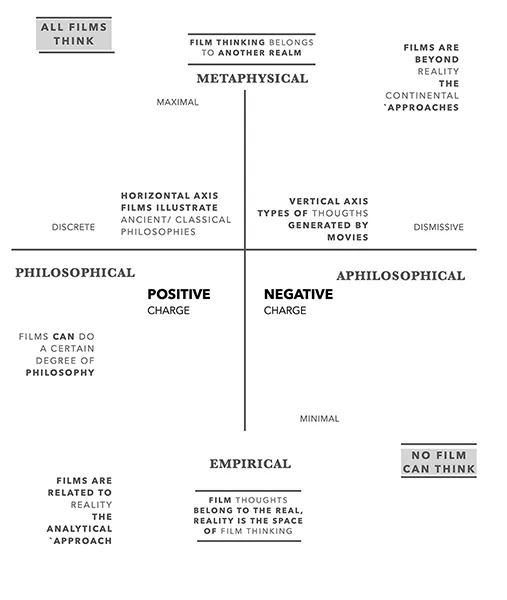
FIGURE 1.2 The polarized electron model, a schematic representation of the contradictory definitions of the relationship between film and thinking.
The elementary principle of the horizontal model accepts a corresponding tension existing between two major philosophical positions, each occupying one end of the conceptual rift. The negative end of the spectrum is dominated by philosophers and theorists who deny any possible contribution of movies to philosophical knowledge. The negatively charged side of the film-philosophy electron is substantiating the claim that “films cannot think.” On the opposing side are positioned those authors and thinkers who submit the arguments based on the premise that cinema has the capacity to be philosophical. Here, in the overcharged or the “radical” versions, those films can even innovate philosophy. Their catchphrase is “all films can think.” The philosophical refuseniks, opposed by the film-philosophy zealots, can concede no possible mollification between their positions. Either films have no contribution to the creation of ideas, or cinema can revolutionize traditional philosophy. In the middle are the philosophical appeasers, who try to find a midway in the debate. I would submit later another opinion that a post-metaphysical and a non-philosophical component of cinema thinking must be taken into consideration, exemplified by the Romanian cinema examples analyzed in the following chapters.
The abrupt claim that cinema displays an intrinsic incapacity to provide any philosophical concepts or innovative solutions is based on the idea that the medium itself is incapable of philosophical investigations. Here also we can find a divide, as one line of argument considers the fact that a visual medium cannot provide the same results as a text-based medium, while the other views cinema as a debased form of communication. One side of the horizontal, at the negatively charged end, provides two different types of subsequent explanations, which can be categorized as either disconnective or dismissive. The dismissive view completely disregards any possible contributions of cinema to philosophy, while the disconnective approach concedes to some extent that Ideas can be integrated into films, when they are separated from the medium itself. Films are not able to “do philosophy” because cinema simply cannot philosophize; yet, movies can contain debased forms of thinking. When contesting the philosophical properties of cinema, the main assertion is that films lack the necessary language and tools to produce philosophical content. The philosophical refuseniks have an important argument to deny the “film as philosophy” contention—the cinematic apparatus is not designed as a reason-inducing environment or instrument.
At the other end are positioned the supporters of the positive perspective. While the so-called film as philosophy paradigm is antithetical to the dismissive attitude of the refuseniks, the domain is also diversified and various divergent opinions collide inside the general scheme of those supporting the idea that films “can do philosophy.” One zealot group comprises the filmolatrical claims, suggesting that the cinematic machine is profoundly philosophical by its very nature. Corresponding to the film is philosophy formula; filmolatry offers more than a radical version of the film as philosophising assumption. The contention is that the “old” forms of philosophy are obsolete and that cinema is rejuvenating the mode in which humanity is thinking. Other explanations fall into a more nuanced category, similar to the film and philosophy model. Films are companions or illustrations of existing ideas; they are ideal carriers of philosophical concepts, providing an environment in which thoughts can be easily cultivated and disseminated.
Because of all the differences in opinions, I considered that a better definition for this group of propositions would be to label them as the discrete explanations. As they are not simply opposing counterarguments of the disconnection theories, here too we can identify a separate set of arguments. One can be described as the cogent interpretations, applicable to all those who consider a partial philosophical relevance in cinema. Only some films have the power to generate philosophical ideas. Another is ascribing the entire cinematic medium with the ability to philosophize and to create innovative concepts, which is the autonomous perspective. By stating the obvious contradiction, that films can think, there are various degrees of philosophical abilities that cinema can display. This set of interpretations is further complicated by its own sort of ineluctable predicaments—to be detailed in a dedicated subchapter. It would suffice to say that the discrete category is split between three explanatory functions. One claims that there is an intrinsic function of the philosophical, residing inside the cinematic; another is searching for mean...
Table of contents
- Cover
- Halftitle Page
- Title Page
- Dedication Page
- Contents
- List of Illustrations
- Acknowledgments
- Introduction
- 1 The Eternal Flickering of the Film-philosophies Quarrel
- 2 Offscreen Cinema: The Aesthetics of the Non-cinematic
- 3 This Is Not a Film You Are Watching: A Visceral-Conceptual Response
- 4 A Magical Mystical Tour into the Romanian Cinematic Mind
- Epilogue: Rear-view Glances into the Post-metaphysical Cinema
- Bibliography
- Index
- Imprint
Trusted by 375,005 students
Access to over 1.5 million titles for a fair monthly price.
Study more efficiently using our study tools.
Frequently asked questions
Yes, you can cancel anytime from the Subscription tab in your account settings on the Perlego website. Your subscription will stay active until the end of your current billing period. Learn how to cancel your subscription
No, books cannot be downloaded as external files, such as PDFs, for use outside of Perlego. However, you can download books within the Perlego app for offline reading on mobile or tablet. Learn how to download books offline
Perlego offers two plans: Essential and Complete
- Essential is ideal for learners and professionals who enjoy exploring a wide range of subjects. Access the Essential Library with 800,000+ trusted titles and best-sellers across business, personal growth, and the humanities. Includes unlimited reading time and Standard Read Aloud voice.
- Complete: Perfect for advanced learners and researchers needing full, unrestricted access. Unlock 1.5M+ books across hundreds of subjects, including academic and specialized titles. The Complete Plan also includes advanced features like Premium Read Aloud and Research Assistant.
We are an online textbook subscription service, where you can get access to an entire online library for less than the price of a single book per month. With over 1.5 million books across 990+ topics, we’ve got you covered! Learn about our mission
Look out for the read-aloud symbol on your next book to see if you can listen to it. The read-aloud tool reads text aloud for you, highlighting the text as it is being read. You can pause it, speed it up and slow it down. Learn more about Read Aloud
Yes! You can use the Perlego app on both iOS and Android devices to read anytime, anywhere — even offline. Perfect for commutes or when you’re on the go.
Please note we cannot support devices running on iOS 13 and Android 7 or earlier. Learn more about using the app
Please note we cannot support devices running on iOS 13 and Android 7 or earlier. Learn more about using the app
Yes, you can access Romanian Cinema by Doru Pop in PDF and/or ePUB format, as well as other popular books in Media & Performing Arts & Film & Video. We have over 1.5 million books available in our catalogue for you to explore.