This volume tackles the role of smell, under-explored in relation to the other senses, in the modern rejection, reappraisal and idealisation of antiquity. Among the senses olfaction in particular has often been overlooked in classical reception studies due to its evanescent nature, which makes this sense difficult to apprehend in its past instantiations. And yet, the smells associated with a given figure or social group convey a rich imagery which in turn connotes specific values: perfumes, scents and foul odours both reflect and mould the ways in which a society thinks or acts. Smells also help to distinguish between male and female, citizens and strangers, and play an important role during rituals.
The Smells and Senses of Antiquity in the Modern Imagination focuses on the representation of ancient smells - both enticing and repugnant - in the visual and performative arts from the late 18th century up to the 21st century. The individual contributions explore painting, sculpture, literature and film, but also theatrical performance, museum exhibitions, advertising, television series, historical reenactment and graphic novels, which have all played a part in reshaping modern audiences' perceptions and experiences of the antique.
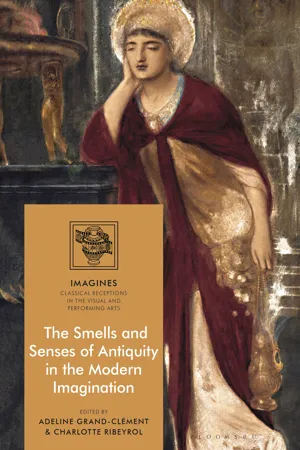
eBook - ePub
The Smells and Senses of Antiquity in the Modern Imagination
- 288 pages
- English
- ePUB (mobile friendly)
- Available on iOS & Android
eBook - ePub
The Smells and Senses of Antiquity in the Modern Imagination
About this book
Information
PART I
WHAT SMELL IS THE SACRED? THE SENSORIALITY OF ANTIQUE RITUALS
CHAPTER 1
‘UNGUENT FROM A CARVEN JAR’: ODOUR AND PERFUME IN ARTHUR MACHEN’S THE HILL OF DREAMS (1907)
Catherine Maxwell
‘Why doesn’t some scientific man stop wasting his time over a lot of useless rubbish and discover a way of bottling the odour of the past?’ So muses Ambrose Meyrick, the protagonist of Arthur Machen’s novel, The Secret Glory, published in 1922.1 This chapter deals specifically with the smell of Antiquity as imagined by another of Machen’s heroes, Lucian Taylor, who appears in his earlier novel The Hill of Dreams, first published as a serial in 1904 and then in book form in 1907. But, before exploring The Hill of Dreams and its vision of odorous Antiquity, it is necessary to say a few prefatory words about its author, a figure still unfamiliar to many readers.
Born and brought up in Wales, Arthur Machen (1863–1947) moved to London as a young man in the 1880s to start his writing career. The author of many short stories and essays, he worked early on in his career as a translator from the French, translating the Heptameron of Marguerite de Navarre, the fantastic tales of Béroalde de Verville and the Memoirs of Casanova. He later supported himself chiefly through his journalism, although, for a short period, he also took small supporting roles as a touring actor. In the 1890s he started to produce the supernatural fiction for which he is now best known, his most celebrated work being the novella The Great God Pan (1894), a horror story in which the pagan spirit of Pan returns to disturb and terrorize the present through the agency of a mysterious, beautiful but depraved woman called Helen Vaughan. Until recently, Machen was something of a niche taste, chiefly read by a small group of fans or by devotees of Gothic fiction, although lately he has gained a larger audience with academic articles appearing on him and his stories appearing in university courses on Gothic or fin-de-siècle literature. The year 2018 saw the publication of two annotated editions of his works, the first a selection of stories edited by Aaron Worth and published by Oxford University Press, the second a collection titled Decadent and Occult Works, edited by Dennis Denisoff for the MHRA series The Jewelled Tortoise. This collection, in addition to containing various short stories and non-fictional writings, contains the first annotated edition of The Hill of Dreams.2
Although Machen is now claimed as a decadent writer, we have a somewhat sketchy sense of his contact with the aesthetic and decadent literature of his day. From his autobiography we know he conceived an admiration for Swinburne’s poetry in 1880 after obtaining an edition of Songs before Sunrise (1871) and can assume that he then went on to read the earlier and more famous Poems and Ballads (1866), because the representative Swinburne poem he quotes, ‘The Hymn to Proserpine’, is actually from that collection.3 As recently shown in my Scents and Sensibility: Perfume in Victorian Literary Culture (2017), Swinburne, proud of his olfactory powers, sets the trend for scented decadence. His influential Poems and Ballads, his most perfumed collection, contains its own apprehensions of scented Antiquity in poems such as ‘Laus Veneris’, which explores the reappearance of the Roman goddess Venus in medieval times and her seduction of the Christian knight Tannhauser.4
Swinburne’s verse encouraged the seventeen-year-old Machen to write poetry including Eleusinia (1881), his first publication, a poem about the Eleusinian mysteries of Demeter and Persephone, which he said was inspired by the account provided by Sir William Smith’s Dictionary of Greek and Roman Antiquities.5 According to the critic Gwilym Games, Smith’s is the standard Victorian dictionary on the classical world, with the Eleusinian entry written by ‘the renowned expatriate German scholar Dr Leonard Schmitz’.6 Nonetheless we can assume that Machen would also have known Swinburne’s early poems in Poems and Ballads (1866), which honour Demeter or her daughter – ‘The Hymn to Proserpine’, ‘The Garden of Proserpine’ and ‘At Eleusis’, a monologue spoken by Demeter herself.7 Certainly, and perhaps more importantly, Swinburne’s awareness of perfume, especially when presented synaesthetically, finds its way into Eleusinia. In Swinburne’s ‘Laus Veneris’, Venus’ ‘beds are full of perfume and sad sounds’; in his ‘At Eleusis’, Demeter’s loss of her daughter is soothed by the prayers and offerings made in her honour: ‘all grace of scent and sound / In ear and nostril perfecting my praise’.8 Such olfactory/aural combinations surely inform the following synaesthetic lines in Machen’s poem that describe the procession of the Eleusinian celebrants from Athens to Eleusis:
The sweet soft scent of roses fills the air
With silent music, even as a dream
The lilies anguish and the censers stream.
Sweet sounds and scents are mingled everywhere…9
Machen may also have been encouraged in his subject matter by the vogue for Victorian paintings depicting classical subjects. He mentions that one of his earliest poems had been inspired by Harmony, a painting with a medieval subject shown in the Royal Academy Exhibition, supposedly in 1880 but actually in 1877, though subsequently acquired by the Academy as a permanent exhibit.10 It appears that Machen saw this painting for himself at the Academy in 1880.11 It is likely then that he saw Lawrence Alma-Tadema’s classically-inspired painting Spring Festival (On the Road to the Temple of Ceres), also displayed at the Royal Academy in 1880, though he might have seen a reproduction of it in a magazine, newspaper or shop window.12
Alma-Tadema’s picture depicts a celebratory procession of flower-crowned women revellers who dance their way towards the temple of the goddess Ceres (who doubles for Demeter in the Roman pantheon). Though Alma-Tadema portrays a Roman rather than a Greek festival, he illustrates the contemporary interest in depicting pagan antique rites and spectacles. A much later but more precise visual analogue for Mach...
Table of contents
- Cover
- Half-title Page
- Series Page
- Title Page
- Contents
- List of Illustrations
- List of Colour Plates
- Notes on Contributors
- Acknowledgements
- Introduction: The Fragrant and the Foul: What did Antiquity Smell Like?
- Part I What Smell is the Sacred? The Sensoriality of Antique Rituals
- 1 ‘Unguent from a Carven Jar’: Odour and Perfume in Arthur Machen’s The Hill of Dreams (1907)
- 2 Incense and Perfume for Isis: The Sensory Reconstruction of the Isiac Ritual in Pompeii in Visual Art
- Part II Gendered Smells and Bodies
- 3 From Gorgons to Goop: Scent Therapy and the Smell of Transformation in Antiquity and the Holistic Health Movement
- 4 The Smell of Marble: The Warmth and Sensuality of Twenty-first-Century Classical Bodies
- Part III Sensing Otherness from Canvas to Screen
- 5 Sensing the Past: Sensory Stimuli in Nineteenth-Century Depictions of Roman Baths
- 6 Evoking Empathy: Smell in the Twenty-first-Century Reception of Antiquity
- Part IV Recreating the Fragrance(s) of the Past
- 7 Archiving the Intangible: Preserving Smells, Historic Perfumes and Other Ways of Approaching the Scented Past
- 8 The ‘Persistence’ of an Ancient Perfume: The Rose of Paestum
- 9 The Fragrance of Ancient Kyphi: An Experimental Workshop
- Part V Re-enacting the Fragrance(s) of the Past
- 10 ‘Balsama et crocum per gradus theatri fluere iussit’ (HA Hadr. 19.5): The Contemporary Reception of Smells and Senses in the Roman Theatre
- 11 Incense on the Grass: A Strongly Perfumed Libation Bearers (1999)
- 12 ‘Untarnished Experiences?’ Re-enactors and Their Appraisal of Smell as Gateway into the Ancient World
- Envoi ‘Scratch and Sniff’: Recovering and Rediscovering Roman Aromas
- Index
- Plates
- Copyright
Trusted by 375,005 students
Access to over 1.5 million titles for a fair monthly price.
Study more efficiently using our study tools.
Frequently asked questions
Yes, you can cancel anytime from the Subscription tab in your account settings on the Perlego website. Your subscription will stay active until the end of your current billing period. Learn how to cancel your subscription
No, books cannot be downloaded as external files, such as PDFs, for use outside of Perlego. However, you can download books within the Perlego app for offline reading on mobile or tablet. Learn how to download books offline
Perlego offers two plans: Essential and Complete
- Essential is ideal for learners and professionals who enjoy exploring a wide range of subjects. Access the Essential Library with 800,000+ trusted titles and best-sellers across business, personal growth, and the humanities. Includes unlimited reading time and Standard Read Aloud voice.
- Complete: Perfect for advanced learners and researchers needing full, unrestricted access. Unlock 1.5M+ books across hundreds of subjects, including academic and specialized titles. The Complete Plan also includes advanced features like Premium Read Aloud and Research Assistant.
We are an online textbook subscription service, where you can get access to an entire online library for less than the price of a single book per month. With over 1.5 million books across 990+ topics, we’ve got you covered! Learn about our mission
Look out for the read-aloud symbol on your next book to see if you can listen to it. The read-aloud tool reads text aloud for you, highlighting the text as it is being read. You can pause it, speed it up and slow it down. Learn more about Read Aloud
Yes! You can use the Perlego app on both iOS and Android devices to read anytime, anywhere — even offline. Perfect for commutes or when you’re on the go.
Please note we cannot support devices running on iOS 13 and Android 7 or earlier. Learn more about using the app
Please note we cannot support devices running on iOS 13 and Android 7 or earlier. Learn more about using the app
Yes, you can access The Smells and Senses of Antiquity in the Modern Imagination by Adeline Grand-Clément, Charlotte Ribeyrol, Adeline Grand-Clément,Charlotte Ribeyrol in PDF and/or ePUB format, as well as other popular books in History & History of Art. We have over 1.5 million books available in our catalogue for you to explore.