What is law? What is it for? How should judges decide novel cases when the statutes and earlier decisions provide no clear answer? Do judges make up new law in such cases, or is there some higher law in which they discover the correct answer? Must everyone always obey the law? If not, when is a citizen morally free to disobey?
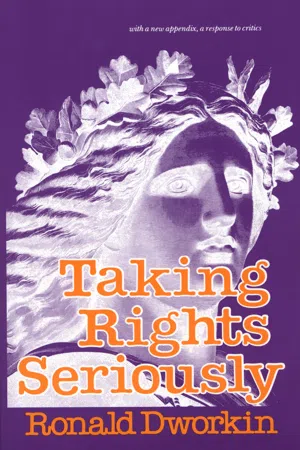
A renowned philosopher enters the debate surrounding these questions. Clearly and forcefully, Ronald Dworkin argues against the "ruling" theory in Anglo-American law—legal positivism and economic utilitarianism—and asserts that individuals have legal rights beyond those explicitly laid down and that they have political and moral rights against the state that are prior to the welfare of the majority.
Mr. Dworkin criticizes in detail the legal positivists' theory of legal rights, particularly H. L. A. Hart's well-known version of it. He then develops a new theory of adjudication, and applies it to the central and politically important issue of cases in which the Supreme Court interprets and applies the Constitution. Through an analysis of John Rawls's theory of justice, he argues that fundamental among political rights is the right of each individual to the equal respect and concern of those who govern him. He offers a theory of compliance with the law designed not simply to answer theoretical questions about civil disobedience, but to function as a guide for citizens and officials. Finally, Professor Dworkin considers the right to liberty, often thought to rival and even preempt the fundamental right to equality. He argues that distinct individual liberties do exist, but that they derive, not from some abstract right to liberty as such, but from the right to equal concern and respect itself. He thus denies that liberty and equality are conflicting ideals.
Ronald Dworkin's theory of law and the moral conception of individual rights that underlies it have already made him one of the most influential philosophers working in this area. This is the first publication of these ideas in book form.
- 371 pages
- English
- ePUB (mobile friendly)
- Available on iOS & Android
eBook - ePub
About this book
Information
Publisher
Harvard University PressYear
2018Print ISBN
9780674867116
9780674867109
eBook ISBN
9780674237322
Topic
PhilosophySubtopic
Law Theory & PracticeTable of contents
- Cover
- Title
- Copyright
- Contents
- Introduction
- 1. Jurisprudence
- 2. The Model of Rules I
- 3. The Model of Rules II
- 4. Hard Cases
- 5. Constitutional Cases
- 6. Justice and Rights
- 7. Taking Rights Seriously
- 8. Civil Disobedience
- 9. Reverse Discrimination
- 10. Liberty and Moralism
- 11. Liberty and Liberalism
- 12. What Rights Do We Have?
- 13. Can Rights be Controversial?
- Appendix: A Reply to Critics
- Index
Trusted by 375,005 students
Access to over 1.5 million titles for a fair monthly price.
Study more efficiently using our study tools.
Frequently asked questions
Yes, you can cancel anytime from the Subscription tab in your account settings on the Perlego website. Your subscription will stay active until the end of your current billing period. Learn how to cancel your subscription
No, books cannot be downloaded as external files, such as PDFs, for use outside of Perlego. However, you can download books within the Perlego app for offline reading on mobile or tablet. Learn how to download books offline
Perlego offers two plans: Essential and Complete
- Essential is ideal for learners and professionals who enjoy exploring a wide range of subjects. Access the Essential Library with 800,000+ trusted titles and best-sellers across business, personal growth, and the humanities. Includes unlimited reading time and Standard Read Aloud voice.
- Complete: Perfect for advanced learners and researchers needing full, unrestricted access. Unlock 1.5M+ books across hundreds of subjects, including academic and specialized titles. The Complete Plan also includes advanced features like Premium Read Aloud and Research Assistant.
We are an online textbook subscription service, where you can get access to an entire online library for less than the price of a single book per month. With over 1.5 million books across 990+ topics, we’ve got you covered! Learn about our mission
Look out for the read-aloud symbol on your next book to see if you can listen to it. The read-aloud tool reads text aloud for you, highlighting the text as it is being read. You can pause it, speed it up and slow it down. Learn more about Read Aloud
Yes! You can use the Perlego app on both iOS and Android devices to read anytime, anywhere — even offline. Perfect for commutes or when you’re on the go.
Please note we cannot support devices running on iOS 13 and Android 7 or earlier. Learn more about using the app
Please note we cannot support devices running on iOS 13 and Android 7 or earlier. Learn more about using the app
Yes, you can access Taking Rights Seriously by Ronald Dworkin in PDF and/or ePUB format, as well as other popular books in Philosophy & Law Theory & Practice. We have over 1.5 million books available in our catalogue for you to explore.