eBook - ePub

About this book

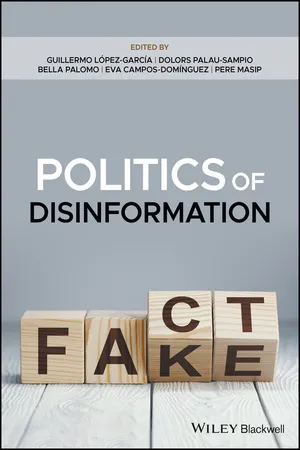
POLITICS OF DISINFORMATION

Discover a comprehensive exploration of the underlying theories of disinformation, and their impact, from leading voices in the field

Politics of Disinformation delivers a thorough discussion of the overwhelming problem of modern fake news in the political arena. The book reviews fundamental theoretical concepts of disinformation and analyzes the impact of new techniques of misinformation and the dissemination of false information in the public space. A group of distinguished authors provide case studies throughout the text to illustrate the effect of disinformation all around the world; including, but not limited to Europe, the Middle East, and South America.

The chapters include examination of topics such as the rise of populism, the increasing political influence of social networks, the use of fact checking to combat fake news and echo chambers, and comparative analyses of how disinformation affects conservatives and liberals. A final case study examines all of these factors as they relate to the recent Spanish election of 2019 and how they affected the results. This book also includes:

  • A thorough introduction to the politics of disinformation and the relationship between disinformation and populism
  • An exploration of the democratic implications of networked persona construction and the likely reaction to disinformation by future journalists
  • Discussions of the third person effect and fake news in Spain, as well as perceptions, views, and definitions of fake news among Israeli conservatives and liberals
  • A treatment of disinformation in campaigns in France, Brazil, and Spain

Perfect for use as a reference book for students and scholars of political communication and political science, Politics of Disinformation will also earn a place in the libraries of practicing journalists and students of journalism and media studies, as well as those studying or working in communications.

Trusted by 375,005 students

Access to over 1.5 million titles for a fair monthly price.

Study more efficiently using our study tools.

Information

Year
2021
Print ISBN
9781119743231
Edition
1
eBook ISBN
9781119743316

Part I
Theoretical Approaches to Disinformation

1
Disinformation Matters
Analyzing the Academic Production

Nereida Cea, Bella Palomo
University of Málaga,Spain

Introduction

The experts predict that in 2022 the citizens of developed countries will be consuming more disinformation than genuine news, because lies are 70% more likely to go viral and be retweeted in comparison with verified information (Vosoughi et al. 2018). It is estimated that 115 fabricated stories favoring Donald Trump were shared on Facebook a total of 30 million times during the 2016 US presidential election (Allcott and Gentzkow 2017). This figure confirms the impact attained by isolated content, disseminated on alternative rather than traditional news channels. This is shaping a dangerous news diet that can generate distrust toward the media and damage the democratic quality of society by encouraging civic apathy, destabilization, chaos (Waisbord 2018), a reduction of pluralism, and a strengthening of polarized communities in which fake news and conspiracy theories are freely propagated. Specialized approaches also warn of a decline of scientific culture in the age of fake news, threatening the scientific and economic progress of Western countries (Elías 2019).
Audiences are conscious of the ambiguity, lack of control, and weakness that accompany the hybrid media system in which such practices have come to maturity. This is why one of their main concerns is the manipulation of journalistic news stories to serve political or economic interests, as the Reuters Institute Digital News Report testified in 2018. This panorama explains why disinformation has become the principal challenge and concern in communication in the twenty-first century, and why its transmedia and cross-border dimension requires public policies and specific training in order to limit its spread.
The scientific community has reacted actively, since academic attention can contribute to sustainable digital development by designing solutions that lead to an innovative society that is also reflexive, responsible, and secure, in the context of an unprecedented transformation in communication patterns. This chapter confirms that studies linked to disinformation have become a fertile and priority line of research. This intensity of production respects the proposal made by the High Level Group on Fake News and Online Information of the European Commission to formulate continuous investigation on the issue in order to evaluate the measures adopted by the different actors.
Mapping recent developments in the scholarship on fake news and misinformation has previously been undertaken in the sphere of health (Wang et al. 2019), selectively in the area of communication (Jankowski 2018; Tandoc et al. 2018), and by applying an interdisciplinary approach that involved disciplines like psychology, economics, and political science as well as communication (Ha et al. 2019), analyzing investigations registered on the databases of Web of Science, Scopus, Google Scholar, and Pubmed. The novelty of the present chapter lies in the breadth of the sample used, since previous review articles had examined between 2 and 142 journal articles.

Methodological Approach

Forty years after the publication of the first articles indexed in Web of Science related to disinformation, it seems timely to construct an x-ray of its presence in academic research in order to objectively set out the scope achieved. To this end a mixed methodology is applied, which combines bibliographical with bibliometric analysis to gather qualitative and quantitative data, enabling the volume and impact of scientific publications to be measured.
This chapter therefore aims to analyze the scientific production on disinformation issues published in journals indexed in the Web of Science Core Collection (WoS) without any temporal restriction, that is, from 1900 until August 2020. The sample was put together on the basis of articles housed in the Social Sciences Citation Index (SSCI) database, which is the most relevant and pertinent index for the area of Communication. Following the analysis of the conceptual articles related to disinformation (Wardle 2017, 2018; Tandoc et al. 2018), a list of terms used for the consultation was designed. The following search string was applied:
(disinformation* OR misinformation* OR “misleading information*” OR “manipulated new*” OR “fake new*” OR “fact* check*” OR “false content*” OR “false new*” OR “post-truth” OR “verification tool*” OR “verif* process*” OR “information* disorder*” OR “hybrid media system”).
This search was conducted on the titles, abstracts, and keywords of the articles published by all SSCI publications, without considering book reviews or proceedings. Initially, 536 references were localized in the general category of Social Sciences, and this list was subjected to a bibliometric analysis referring to the following indicators: temporal evolution, authorship, affiliation, language, country of production, journal, and most-cited articles.
A codifier examined all the articles in full, eliminated reiterations, and for the content analysis selected only those empirical investigations whose pivotal issue was disinformation, obtaining a final sample of 434 articles. In addition, a deductive codebook was implemented, and labels created manually on Zotero were applied in order to classify and categorize the information. In this second phase the registered variables belonged to the following categories: (i) theme; (ii) subtheme; (iii) platform analyzed; (iv) methodological focus; and (v) tools employed. The thematic classification used a standard taxonomy proposed by the International Communication Association (ICA), which establishes 24 sections within the Communica...

Table of contents

  1. Cover
  2. Title page
  3. Copyright
  4. Dedication
  5. Table of Contents
  6. Part I Theoretical Approaches to Disinformation
  7. Part II Disinformation in Politics
  8. Part III Fact-checking in Polítics
  9. Part IV The Effects of Disinformation on Everyday Life
  10. About the Authors
  11. Index
  12. End User License Agreement

Frequently asked questions

Yes, you can cancel anytime from the Subscription tab in your account settings on the Perlego website. Your subscription will stay active until the end of your current billing period. Learn how to cancel your subscription
No, books cannot be downloaded as external files, such as PDFs, for use outside of Perlego. However, you can download books within the Perlego app for offline reading on mobile or tablet. Learn how to download books offline
Perlego offers two plans: Essential and Complete
  • Essential is ideal for learners and professionals who enjoy exploring a wide range of subjects. Access the Essential Library with 800,000+ trusted titles and best-sellers across business, personal growth, and the humanities. Includes unlimited reading time and Standard Read Aloud voice.
  • Complete: Perfect for advanced learners and researchers needing full, unrestricted access. Unlock 1.5M+ books across hundreds of subjects, including academic and specialized titles. The Complete Plan also includes advanced features like Premium Read Aloud and Research Assistant.
Both plans are available with monthly, semester, or annual billing cycles.
We are an online textbook subscription service, where you can get access to an entire online library for less than the price of a single book per month. With over 1.5 million books across 990+ topics, we’ve got you covered! Learn about our mission
Look out for the read-aloud symbol on your next book to see if you can listen to it. The read-aloud tool reads text aloud for you, highlighting the text as it is being read. You can pause it, speed it up and slow it down. Learn more about Read Aloud
Yes! You can use the Perlego app on both iOS and Android devices to read anytime, anywhere — even offline. Perfect for commutes or when you’re on the go.
Please note we cannot support devices running on iOS 13 and Android 7 or earlier. Learn more about using the app
Yes, you can access Politics of Disinformation by Guillermo Lopez-Garcia, Dolors Palau-Sampio, Bella Palomo, Eva Campos-Dominguez, Pere Masip, Guillermo Lopez-Garcia,Dolors Palau-Sampio,Bella Palomo,Eva Campos-Dominguez,Pere Masip,Eva Campos-Dominguez, Guillermo Lopez-Garcia, Dolors Palau-Sampio, Bella Palomo, Eva Campos-Dominguez, Pere Masip in PDF and/or ePUB format, as well as other popular books in Politics & International Relations & Civics & Citizenship. We have over 1.5 million books available in our catalogue for you to explore.