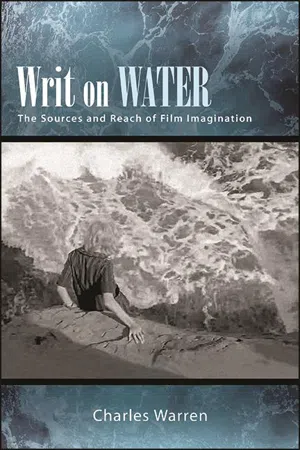
A powerful and original statement on the nature of film and the intimate relation of "film imagination" to our lives as human beings in the world.
This eloquent book draws on the author's responses to a wide range of extraordinary films-"long takes" on Altman's Nashville, Godard's Hail Mary, Makavejev's WR: Mysteries of the Organism, and von Sternberg's Blonde Venus, as well as "short takes" on films by Jean Rouch, Chris Marker, Chantal Akerman, Ross McElwee, Michelangelo Antonioni, Michael Haneke, and Jean-Pierre and Luc Dardenne. Charles Warren's masterful close readings blend profound philosophical reflections with a treasure trove of literary and artistic references to place film, in its relations to other arts, as one of the greatest aesthetic forms. Collectively, these essays offer an original and powerful statement on the nature of film and the intimate relation of what the author calls "film imagination" to our lives as human beings in the world. This important and much-needed book is no less than a celebration and affirmation of the very discipline of film criticism. One is left with one's appetite for film refreshed.
WHEN I WAS GROWING UP in eastern North Carolina, Tennessee was very decidedly the West. It was far away and difficult of access, over high mountains. There seemed to be more space there than in the East, and people seemed to live a simpler, purer, more honest life than ours. Tennessee was farming, but there was room for cultivation of the self. One could make oneself comfortable as one saw fit. People raised fine show horses. One could be religious, or drink. One could pursue learning—this was the country of John Crowe Ransom and Allen Tate, who with other poets and critics fostered a significant literary and intellectual culture at the University of the South in Sewanee, Tennessee, and at Vanderbilt University in Nashville. A young Robert Lowell left Harvard to move south and study with these people.
Nashville was a big and raucous city (bigger than any in North Carolina). But it was still a part of the Tennessee life. The city was dominated by sights like the Andrew Jackson plantation house—the Hermitage—and the imitation Parthenon, situated in a grassy flat area with trees looming about—tacky perhaps, but known for what it was, lived with and just enjoyed, not too much staked on it.
At the beginning of F. Scott Fitzgerald’s novel The Last Tycoon, easterners traveling west to Hollywood stop in Nashville and visit the Jackson house:
We drove for a long time over a bright level countryside, just a road and a tree and a shack and a tree, and then suddenly along a winding twist of woodland … somewhere we passed a negro driving three cows ahead of him, and they mooed as he scatted them to the side of the road … presently the taxi turned down a long lane fragrant with honeysuckle and narcissus, and stopped beside the great grey hulk of the Andrew Jackson house … The Hermitage looked like a nice big white box, but a little lonely and vacated still after a hundred years. We walked back to the car. Only after we had gotten in and Mr. Schwartz had surprisingly shut the door on us did we realize he didn’t intend to come along … I kept thinking of him all the way back to the airport—trying to fit him into that early hour and into that landscape … Manny Schwartz and Andrew Jackson—it was hard to say them in the same sentence. (11–16)
The stop in Nashville and visit to the Hermitage seem steps in a ritual for those who are movie-bound. The crossing of Nashville and Hollywood will come back here.
The city of Nashville seemed to us those years ago to give scope to Tennesseans’ desires to shop; to hobnob, those who had money, with lots of others who had money; to dine out well; to see shows—all of this without making people into city folk like those of any other city. They were still Tennesseans, with the accent and smile and honest look in the eye.
My family was involved in a minor way in the showing of Tennessee Walking Horses, an activity which had spread from Tennessee to other southern states (these horses figure in Altman’s film: the Haven Hamilton character [Henry Gibson] is said to raise them, and he makes a joke about the maverick, roving political candidate’s name, Walker, being the same as that of the horse). My friends and I, once we were fairly independent teenagers, sought to spend as much time as we could in Tennessee, to stable and show our horses there and to live the life. Tennesseans understood these horses, and trained and showed them with effectiveness and grace. The one-night horse show in every country town brought out an audience of connoisseurs. I am happy to adopt the terms of D. H. Lawrence in Studies in Classic American Literature and say we went West to “get away” (15)—away from a world, back in North Carolina, that seemed a little degenerate, a little as if having given up, not alive to life’s purposes as they might be. And we went to submit ourselves to, to be taken over by, “It”—to live a life answering to our sense of discovering our deepest selves, what mattered most.
And the music. My friends and I were not devotees of country music. In Tennessee we were aware that most people knew and more or less liked this music—had listened to the Grand Ole Opry on the radio growing up, if they did not listen still. Yet we could see that the music was not pervasive. It was all right to be a Tennessean and like other music, or not particularly any music. At times I listened to Roy Acuff or Hank Williams or one of the more modern stars like Tammy Wynette, and I admitted that this was a real art, fed by the soul and beautifully crafted, unlike anything else. One knew that it was commercial—that one reason Nashville existed was to process and sell the music, and to allow the stars a place for their mansions. Plenty of dull and trivial music was sold. One heard of the stars’ divorces, wild living, and breakdowns. The music was a genuine creation, but sullied in its commerce and in the way some people lived its life.
Tennessee was a West for us. It admitted of human imperfection (and I have not mentioned the sins of the horse world). But it held the possibility of a plain life that was aristocratic—self-cultivating—for anyone who would embrace it, something like the Nebraska of Willa Cather, where every experience, dramatic or workaday or small-scale—walking down a ditch between fields, for example—had about it a sense of magic, of ritual—being an enactment of the transformative. And Tennessee had its own art—that special music and the show horses.
I came to Robert Altman’s Nashville (1975) in the course of time, and here was the romance world of my adolescent years, portrayed—it seemed at first—as a chaos of idiocy and viciousness. The music is made fun of. The people are variously gullible, self-deluding, hypocritical, demented with lust. The city looks silly with its strutting drum majorettes, bouffant hairdos, Opryland, and the wretched Parthenon. And yet the film is exhilarating—and it was so to me on my first viewing of it—with its wide-screen exploration of the life of a city (forget that it is a city one knows); with its inventiveness as spectacle; with its grand—critical—conception of America in the microcosm of the music business here. The people may be pathetic or condemnable, but what performances! And how interesting the people become, after all, as one thinks about them and explores them on re-viewings of the film. One comes to feel a good deal for them. And the music, if made fun of, is fascinating to hear and see performed, always in the eye of Altman’s wondering and very much alive camera.
I believe anyone looking at the film has to deal with the double experience of a shock at the critical portrayal of life and an exhilaration at the rendering of it all as a film. One may be prepared to be a snob about country music, Nashville, or the South (like the Michael Murphy or Geraldine Chaplin characters in the film). But this film makes it clear that it has to do with human beings in general, with America, with life itself (consider its great concern with death). One has to face a take on these bigger things. I wonder whether my own experience of romantic memories being affronted by this film may not stand for the experience of any viewer, who will bring a grasp of life to this film, or any other, and have it met by the unexpected.
I am outraged at this film and yet I enjoy something like an enormous vitality in it. I am delighted at the sheer event of it. In trying to account for this work that can do one thing seemingly in spite of doing another, I would like to call on D. H. Lawrence’s idea of creativity, as developed in Psychoanalysis and the Unconscious and Fantasia of the Unconscious and in the essays of the Phoenix volumes. Creativity is the entirely new and absolutely unaccountable that always, on and on, wells up in life, the going ahead that is in no way repetition or recurrence, except in a Kierkegaardian or Nietzschean sense of repetition that goes beyond repetition or transforms what is repeated or recurs. In art the creative burns us free from any predispositions we may have had about the subject matter or the form. Altman’s film in its creativity, I want to say, turns its elements of the recognizable world, along with problems we may have about the attitude Altman takes to this world, into a wholly new area, a world of film. This film world presents its own new challenge as to the attitude to be taken to it. Perhaps Nashville in working this change gives its own direction to a power of film that operates always, in any film. Stanley Cavell suggests in The World Viewed that the individual film, if pondered, will reveal something of the medium of film as it always is.
But what is a world of film? T. S. Eliot wrote, in a moment of pique over the concept of art as a “criticism of life,” that “no phrase can sound more frigid to anyone who has felt the full surprise and elevation of a new experience of poetry” (Sacred Wood ix). It has been a besetting difficulty to reconcile our sense that we ought to acknowledge art as a criticism of life—as being about life, and having a position toward life to promote—with our sense that art rushes us beyond the area where we have to think in such terms—life in the world, interpretation of the world, and so on. F. R. Leavis faces this problem in his essay on Swift. Swift can look juvenile (not Leavis’s word) in unremitting negativity about the world. But by his writing’s resourcefulness, its effect of surprise that goes on and on, a new energy is put into play. There is an energy, as we read, that we can only direct back disruptively toward ourselves in our situation in the world. Finally we are forced to question ourselves and our world most deeply. With Swift’s writing—as opposed to his imputable views—we are brought to face a mind, with its regard of the world, unlike anything we could have supposed a mind to be. This happens with Nashville, and with much other film.
The substantial beginning of Nashville is an episode in a recording studio. This is just after a parody television commercial for a record anthology of country hits, and a brief scene showing the emergence of the Walker political van, driving off down a Nashville street. The parody television commercial might precede various sorts of film. It is a thing of so odd a tone. It dazzles us for a few minutes, announcing the film as “Robert Altman’s Nashville” and running through the cast with a lot of fast promotional talk and shifting still images and bits of songs. We know that what is to follow will have a measure of irony and comedy. Chiefly, we wonder where we are.
We might think the film has begun with the shot of the street, with the traveling van spouting its message. Here is a real street, and things are beginning to happen as they will in a film. But this is interrupted after so little. Strains of the beginning of a song intrude on the soundtrack, and there is a cut to the studio.
With this recording studio we feel we are being allowed to enter a privileged world—the place where artists work, an underworld or world of those who are more than human, a place curiosity would love to have a look. Altman calls on the power the camera has held since Lumière and Méliès, Griffith and Murnau, to show us something marvelous, perhaps real, that we are exhilarated to see.
The studio is a dark cave, or womb. (The cave/womb will come back in my discussion of Blonde Venus [1932].) Here the camera moves slowly, ritualistically, past spectators and musicians, with interesting objects continually emerging, the lighting carefully set for the effects of color and bright areas and shadow on film. We see dials, control boards, musical instruments, a projector creating a rectangle of bright red light, and more. The accompaniment of music—Haven Hamilton’s “Two Hundred Years”—superficially silly (“We must be doin’ somethin’ right to last two hundred years”), but at a deeper level truly eerie, with drum rolls and a chorus singing nonsense syllables and particles of words and sentences—everything works to make us feel we are being taken into a mystery. Haven’s song means to comment on the upcoming American bicentennial (1976), as does, in a different way, Altman’s film as a whole. Now credit titles begin to appear, “Associate Producers …” and so on, and these titles come and go at intervals well into this long scene.
One deep interest of the studio scene, something that helps to give it its weightedness like the images of a dream, is the suggestion that all this may be a film studio. It may be a “stand-in” for one, to use a term Haven uses later in the film. The singing artists here are conspicuously brightly lit in their glass booths, and they are the objects of a train of vision on the part of others in the room, seated in rows and watching. The glass screens before the artists suggest the projection screens it is the destiny of film artists to come to live in.
The cumbersome equipment and the effort at coordination are like what our impression is of the working of a film studio. Shortly into the scene Geraldine Chaplin drifts across the room, Opal from the BBC, as she repeatedly introduces herself, here wanting to join the spectators in the room, watching Haven record his song. Chaplin’s face and presence eerily suggest her father, as if that Hollywood giant, Charlie Chaplin, gives his blessing to this film as a continuation of Hollywood’s serious critical comedy—Capra, Lubitsch, Chaplin himself. In a way, Nashville is a successor to The Gold Rush (1925, about American ambition); Modern Times (1936, about the maddening pressures of work, taking in political tensions); and Monsieur Verdoux (1947, about the violence at the heart of things).
We may begin to reflect that this film is all about a city of productions and “stars” (the word is stressed in the film) and people wanting to break in, and so on. Nashville is a “stand-in” for Hollywood, perhaps. What we may be seeing in this studio episode is the place that generates the films, or this film—the source of creation. A cave or womb suggests a woman at the origin of all this. The fact that credit titles begin to appear, and not cast credits but production credits, might seem to underscore the idea that we are getting a suggestion of this film’s scene of production.
The recording studio episode announces the film, literally in the titles, and more richly if we see the scene as a film studio. In this announcing, the episode links with the opening parody television commercial, which announces the film literally in the voiceover and in written names for the cast, and figuratively in the still images of people that are turned clockwise on a wheel—the spool of film, a wheel of fortune of a sort. The television commercial and studio sequences declare that what we are seeing is a film: life deadened in order to come into new life, like the still images rotated in the commercial, and something born mysteriously in the dark—whether we think of the film studio or the cinema hall with its spectators.
With the shot of the street and the political van, here is a real street, I have said. One of the major impressions of Nashville as a whole is that we are getting something like a documentary of the city, or at least of the music world here. There are those frames so full of activity, and so much on the soundtrack, and the seemingly random movement among so many lives and stories. There are many natural settings. And here in the van sequence at the start is our first taste of all this. Further, the political theme is begun. The candidate is offering himself and telling us we are all involved in politics. But suddenly it is interrupted. We are removed to the studio scene that proclaims that we are watching a film. Is politics, is reality, film? The van the camera follows first emerges from a dark indoors, like the studio, and the overhead lettering NASHVILLE on the garage has been dissolved from the graphics of the television commercial. The music that wells up with the van, which might be radio music or conventional film scoring, is shown to be the product of the studio scene that follows. The little look at a Nashville street looks more and more to be the product of the two self-admittedly filmic sequences that surround it. What is the world? What is film? The quality of randomness of movement from scene to scene is very important to our sense of the documentation of a world we can believe in, in Altman as in Renoir. But even randomness is subverted, so to speak, in these first three sequences of Nashville. The television commercial sequence [1] and the political van sequence [2] feel uncertain in significance as they go by. But sequence [3], the recording studio, reveals their meaning, and makes it clear that [1] and [2] were put there to serve the interest of [3]. [1] and [2] are seen to have their full existence only as they stand in relation to [3], which underscores the power of film. These three sequences are each very different from the others—in material, in look—and there remains absolutely a randomness in moving from one to the next. But now we have to think of randomness differently. It can accord with things standing in relation to one another. This is a lesson of this film and of Altman in general, and perhaps a lesson Altman offers about all film,...
Table of contents
Cover
Title
Copyright
Contents
Introduction
Long Takes
Short Takes
Postscript: The Integrity of Film
Notes
Works Cited
Index
Back Cover
Trusted by 375,005 students
Access to over 1.5 million titles for a fair monthly price.
Study more efficiently using our study tools.
Frequently asked questions
Yes, you can cancel anytime from the Subscription tab in your account settings on the Perlego website. Your subscription will stay active until the end of your current billing period. Learn how to cancel your subscription
No, books cannot be downloaded as external files, such as PDFs, for use outside of Perlego. However, you can download books within the Perlego app for offline reading on mobile or tablet. Learn how to download books offline
Perlego offers two plans: Essential and Complete
Essential is ideal for learners and professionals who enjoy exploring a wide range of subjects. Access the Essential Library with 800,000+ trusted titles and best-sellers across business, personal growth, and the humanities. Includes unlimited reading time and Standard Read Aloud voice.
Complete: Perfect for advanced learners and researchers needing full, unrestricted access. Unlock 1.5M+ books across hundreds of subjects, including academic and specialized titles. The Complete Plan also includes advanced features like Premium Read Aloud and Research Assistant.
Both plans are available with monthly, semester, or annual billing cycles.
We are an online textbook subscription service, where you can get access to an entire online library for less than the price of a single book per month. With over 1.5 million books across 990+ topics, we’ve got you covered! Learn about our mission
Look out for the read-aloud symbol on your next book to see if you can listen to it. The read-aloud tool reads text aloud for you, highlighting the text as it is being read. You can pause it, speed it up and slow it down. Learn more about Read Aloud
Yes! You can use the Perlego app on both iOS and Android devices to read anytime, anywhere — even offline. Perfect for commutes or when you’re on the go. Please note we cannot support devices running on iOS 13 and Android 7 or earlier. Learn more about using the app
Yes, you can access Writ on Water by Charles Warren in PDF and/or ePUB format, as well as other popular books in Media & Performing Arts & Film & Video. We have over 1.5 million books available in our catalogue for you to explore.