Compares life today in the German Black Forest with Thoreau's experiences at Walden Pond.
Finalist for the 2022 Foreword INDIES Book of the Year Award in the Essay Category
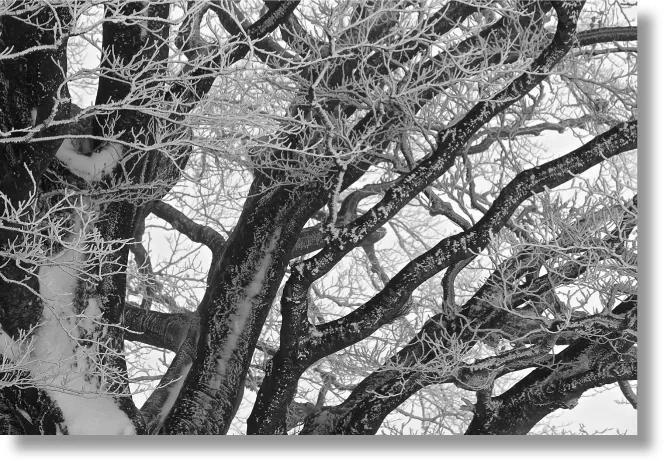
A Black Forest Walden is a work of philosophical reflection, nature description, and sly humor. In brief chapters, or aphorisms, the American philosopher David Farrell Krell recounts his experiences in a cabin located in the mountains of southern Germany's Black Forest, where he has lived for several decades. Insofar as Krell compares his experiences with those of Henry David Thoreau, who serves as both inspiration and irritation, the book could be described as a critical commentary on Thoreau's Walden. Yet it equally reads as a rigorous yet playful and profoundly literary manifestation of where and how the mind wanders. Hence, the "Marlonbrando" of the subtitle is not the late actor but a feral cat who frequents the cabin and comes to be an important interlocutor, as if playing the role of analyst to the author. The subjects Krell treats are wide-ranging: the changing seasons, environmental issues, romantic love, parent-child relations, European versus American "values," higher education, artistic creativity, solitude, and the contrast between lifestyles in a quiet Black Forest village and in a noisy contemporary United States. Forty-one black-and-white photographs taken by the author accompany and enliven the text.
Trusted by 375,005 students
Access to over 1.5 million titles for a fair monthly price.
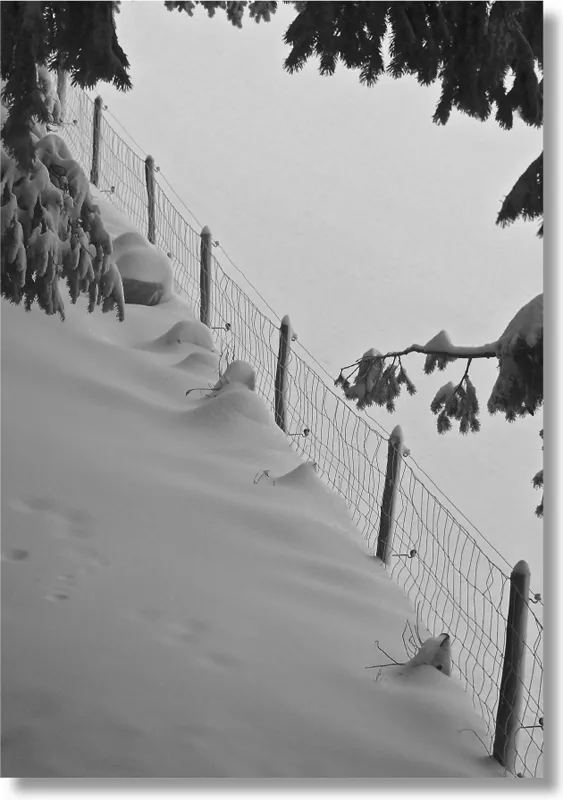
It happens over and over again throughout the winter, so why does it always surprise me? The evening, all windstorm, soon passes over into a night of rainfall. Droplets dance on the metal roof of the cabin—lightly, on their toes, and I doze; heavily, foot stomping, and I stir. Then silence. I sleep. In the morning, a lambent white light fills the bedroom of the cabin. The mirror affixed to the door of the old cupboard at the head of my bed tells me what I already know. I rise and gaze out the window at Douglas the Fir. His branches strain under the weight of white. The fields stretching up to Schauinsland Mountain blaze white-hot with cold. It’s always the same feeling that accompanies the first overwhelming glimpse of snowfall at the cabin, the feeling of having been hoodwinked during the night, the sense that I should have known what the night—that inexpressibly beautiful creature—was up to, or down to. The Snow Queen of Kurosawa’s Dreams has once again suffocated me softly in the night, and once again I awake in paradise.
2
The colors of snow; or, where beauty is
When Monet and Pissarro paint snow, it is all roses and bluebells with an orange aura and a crimson afterglow—every color but white. Of course, white isn’t a color at all, but, as we learned in school, it is all the colors spun around on a disc. That spinning disc is rarely encountered out there in the world, to be sure, but painted snow teaches us the lesson anyway. Herman Melville calls white “the colorless all-color,” and so it is, even at night, under a moon.
Years ago, I arrived at the cabin with a lover. We were jet lagged and could not sleep during the night. We sensed, then saw, in the moonlight outside the cabin window that snow had fallen. We got up, dressed, and stepped out the cabin door into two feet of snow. It was four o’clock in the morning. The waxing moon was only half full, but it lit up the blanketed valley. We walked, or trudged, in silence over Edward’s Heights until dawn. In the black of night, under moonlight, the snow crystals glittered violet and green—amethyst and sapphire—with each laborious step of ours. With each turn of the head or inclination of the back and shoulders, the snow scintillated in alternating flashes of green and purple, purple and green, each more brilliant than the last. It was as though not white but purple-green was the all-color. A flashing round dance of vert and violet seemed to capture the entire spectrum of colors, including ultraviolet and infrared. The philosopher Friedrich Joseph Schelling calls the unity of violet and green “supreme splendor,” and we believed him. We returned to the cabin, cooked a big breakfast, made love, slept away the day, and woke to another night of moonlit snow. We discovered that lag can also make a life.
Since then, I have walked over Edward’s Heights under snow and moonlight many times, searching for amethyst and sapphire but finding only diamonds. On these later occasions, I was alone. That was how I learned that vert and violet had been effluences of her eyes, and that beauty is in the eye of the beholder’s beloved.
3
In the still of the night
If recently you’ve been living in a city, your first night in the cabin can be disconcerting, no matter how happy you are to get there. (You get there by taking a tram through Freiburg from the railway station to the southern outskirts of town, catching a bus up to the most remote village—the bus leaves once every hour till nightfall—then walking up the steepest hill on the horizon off to your right, Barley Stalk Hill, about a ninety-minute walk.)
Disconcerting first of all because of the chill in the walls. Whether winter or summer, the cabin walls are cold and damp long after you light your first fire. In winter, it will take you three days’ and nights’ worth of fires to rout that chill, even if the forester has come early on the day of your arrival (he has a key) and lit a fire for you. In summer, the chill will be banished more quickly once you light your fire and open all the windows and the door. Disconcerting in the second place because even after your bed is warm on that first night (ah, the featherbed! we will have to come back to this little touch of heaven!) so that you drift off into a grateful and gratifying sleep, you will be roused in the middle of the night by something else—the stillness.
Absolute silence is like noise: you can hear it. You wake up and you listen to it. You rise and fall on its waves, its periods and cadences. It fills your ears like the chirpings of tinnitus, and you wonder at it. You do not hear the man in the moon breathing, because he does not breathe. Yet in the silence you sense him looking at you, and you feel his pull on the seas and the blood. The stillness is palpable. Sometimes it is so disquieting that you have to rise and go outside to see if it is real, or if the cabin has become a pyramid. Once outside, you feel the winter wind or summer breeze, and more important, you hear it in the trees. After a while the silence abates, goes quiet. You can go back to bed now.
Back in Chicago or New York City, the drunken brawl outside your window has to escalate to beer bottle smashing or a gunfire exchange before you hear it. Here, the stillness of the night escalates without police or ambulance sirens, without cries and whispers or sound and fury, and it has all the time in the world to wait until you hearken to it. You will.
4
The snowplow
The roar of a motor at night—what can it be but the destroyer of sleep? It is true that whenever the salt-strewing snowplow comes bellowing up the switchback asphalt road of the Möhlin Valley, all the way up to the parking lot that is located several hundred meters south and east of the cabin, I wake up. Sleep is suspended, at least for a few moments, until the plow clears the parking area of snow, turns, and heads back down the road. Yet I am always delighted, no matter how heavy with sleep my head may be. I open my eyes to the brilliant headlights lighting up the forest pines and the spinning orange warning lights whose beams turn up periodically in the mirror. They are like searchlights in the sky near an airport or the beam of the outermost lighthouse. Nothing makes me feel more secure or gives me more hope for the day to come, not because I have anywhere to go, but simply because of the company. Depending on the timing of the snow or ice storm, the truck may come chugging by at one or three or five o’clock in the morning: the drivers do not sleep all winter long, no hibernation for them. It isn’t that I’m grateful for their work. For years now, I have been hoping to be snowed in for weeks at a time, to be like Jack in that high Colorado hotel laboring diligently over his book, all work and no play. And every year the undaunted, unstoppable snowplow frustrates my hope. I should be growling. Yet there is something reassuring about the deep hum of the engine and the scrape of the plow, as there is about a lonesome freight train’s whistle in the night. There is a world out there, a world of workers and wanderers, and it sings to me like Woody Guthrie or Pete Seeger, “Go to sleep, you weary hobo, let the towns drift slowly by.” So I turn and scrunch the featherbed tight around my shoulder and know that there is a world in here too. And mine is appreciably warmer.
5
Ice wings
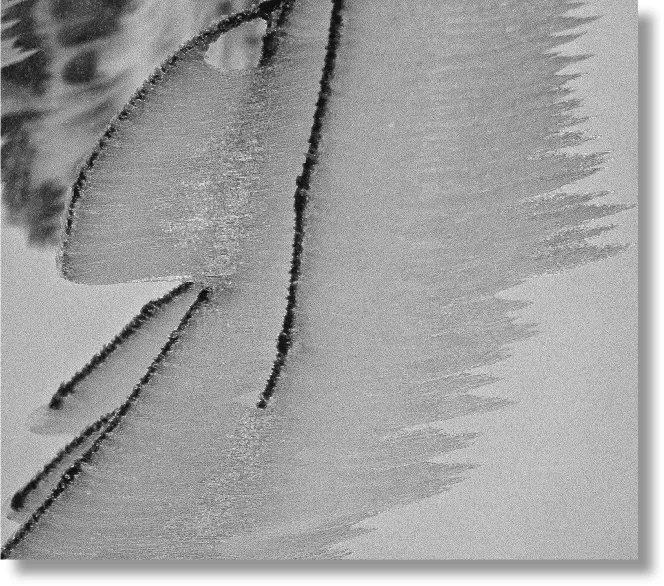
“Many of the phenomena of Winter are suggestive of an inexpressible tenderness and fragile delicacy. We are accustomed to hear this king described as a rude and boisterous tyrant; but with the gentleness of a lover he adorns the tresses of Summer.” So says Henry David Thoreau (W 234), and he is right. If the dense fog lasts through the night and Boreas the north wind blows lightly but steadily till dawn, each twig and tine of the leafless birch on the meadow above the cabin forms along its entire length a wing of transparent ice an inch or more in width. By morning, the tree is an enormous white bird or, when the wind blows, a musical instrument. The poet Georg Trakl calls these ice wings crystalline angels.
There is a clearing near the edge of the forest on Barley Stalk Hill. Stinging nettles flourish there in summer, growing chest high in the rich soil. The very sight of them on a summer morning sets the skin to tingling. In winter, the tall stalks are stripped of their nettlesome leaves. The ice wings construct an enchanting heaven out of their little hell; they are swaying seraphim rather than stinging satans. A few meters farther on, huge boughs of pine and fir dip under the weight of ice wings grown so close together—crowding every needle and branch—that they form something like tufts of thick white wool, a warm mantle of ice, winter fur for winter firs—but back to that solitary birch on the meadow.
When the March sun burns off the frozen fog, usually by mid-afternoon, the wings take flight, an Icarus of ice, and plunge to the ground. A silhouette of shattered wings, shards of iced fog, spreads across the matted brown grass beneath the tree. Within half an hour every wing has fallen, the music is stilled, and the naked birch grows taciturn once again. It wants to bud leaves, not ice wings. I scoop up some jagged fragments of ice and hold their freeze, albeit only for a melting moment. I notice that the wings are ribbed, as though for tensile strength, testifying to the long and patient labors of the night fog. But did any effort at all go into these formations? One tree would have taken you and me years of work to transform. So much effort! No effort at all for nature. The fragments chill my palm, then swell to one great tear that rolls across my lifeline, uncertain of the cause of its weeping. Toil? Time? Warmth? Transient beauty?
6
The Storm Beech
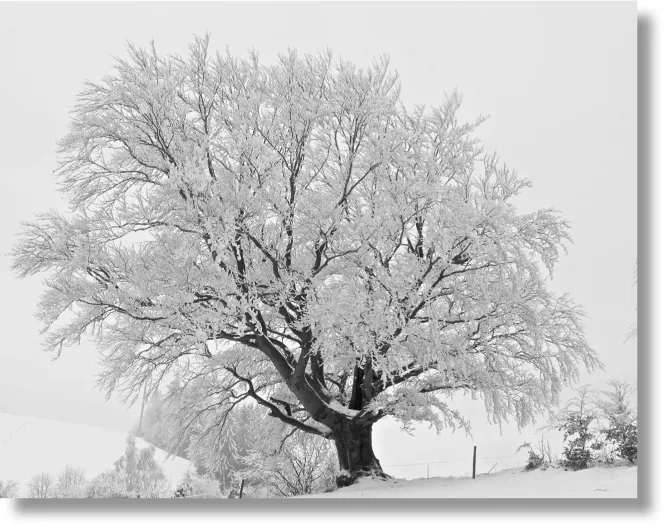
The enormous tree, my most august neighbor, dominates the hill and the sky of the pasture above the cabin. In fact, the sky stretches over the Storm Beech like a tarpaulin, gray in winter, blue in summer; the beech’s roots gather together the earth, frozen and brown in winter, green and gay with wildflowers in summer. It is called the Storm Beech because the south wind has shaped it for a century or two, twisting and bending its boughs so that they incline toward the northeast like the myriad needles of numberless compasses. “No tree has so fair a bole and so handsome an instep as the beech,” says Thoreau in an unpublished text cited by Ralph Waldo Emerson (SW 428). On every fair summer evening, I sit on that instep—one of the many insteps, which are the thick gray roots almost entirely exposed to the light and air. Onto one of the neighboring insteps, one that happens to be flattened and scarred, I place my wine cup. The blood of the grape is sometimes red, sometimes pale yellow-green, and I toast the setting sun after it has toasted me during the day. I lay back in the arms of the tree and study—through gnarled branches and a riot of green leaves—the brilliant sky. The great beech has soaked up so much caloric during the day that it now communicates it to me: if I am able to write tomorrow, it will be thanks to the energy transfer from tree to me.
One of the locals told me many years ago about the arboreal energy of the Storm Beech, but I was skeptical at the time and merely laughed: old wives’ tales. As I toast the sun now, I do not forget to salute the Storm Beech, which extends over me its protecting boughs and leaves and subtends me with its earth-embracing root system. I may be dendritically drunk. Or perhaps I have gone a bit mad, tetched by numerous old wives and their stories? Am I altogether a beechnut?
7
The Moon and Venus
I had to catch the first bus to Freiburg on a December morning and so had to leave the cabin at five o’clock, long before daylight. The chilly sky blinked with iced stars. The waning moon showed but a sliver, even though I could easily make out the shadowy circle or corona of the entire sphere. It was like an eclipse of the sun, with the curved arc of the celestial body startlingly clear, as though backlit. Below the moon was the brightest satellite I had ever seen, huge and silver and seemingly unmoving. It could not have been a manmade satellite, yet I had never seen the likes of it before. Had the calendar put us closer to Christmas, I would have thought of Bethlehem, Hallmark, and Monty Python. A friend later told me it was Saturn, vast enough on its own, yet appearing even larger because of its rings. No earthling could make out the rings, of course, but I was witness to a massive, unified, argentine light in...
Table of contents
Cover
Title
Copyright
Contents
Preface
1. Silent snowfall
2. The colors of snow; or, where beauty is
3. In the still of the night
4. The snowplow
5. Ice wings
6. The Storm Beech
7. The Moon and Venus
8. The cabin; or, plucking the raisins
9. The past has not passed
10. Neighbors
11. But where’s the pond?
12. River of fog
13. My “office”
14. Conversations with Marlon Brando?
15. Ice wings, Part Two
16. Douglas the Fir
17. Aurora
18. Freaks of nature; or, lighting fires and mourning the woods
19. H.D. in bed
20. Maudlin and bathetic
21. Add your dreams, and not just the sexy ones!
22. Tell Marlonbrando your dreams, honey, and everything will be all right
23. Neighbors, Part Two: Herr S.W.
24. The darkness of the woods
25. Monarchs in December
26. The limits of description
27. The limits of knowledge
28. Black and white
29. Fool’s spring
30. A reflection on consumer society; or, a Romantic has his uses
31. The deserving poor
32. A succession of beautiful days
33. Neighbors, Part Three: Wolfgang
34. La pensée du jour
35. The smartphone in high mountains
36. The new adventures of Pinocchio
37. News of the world
38. On the difference between European and American “values”
39. Tell Marlonbrando your dreams, honey, and everything will be all right, Part Two
40. On the degeneration of poetry to chemistry
41. Platonism and Puritanism keep us on our spiritual toes
42. Neighbors, Part Four: Frau S.M.
43. Let’s (not!) do lunch
44. The perfect universe
45. Autarchy; or, fatties beware!
46. Woodchuck Heaven
47. Mudslide Man
48. Knowing beans
49. Tell Marlonbrando your dreams, honey, and everything will be all right, Part Three
50. Moving mountains
51. Obscene spring
52. On jealousy and brutalization
53. The bowlegged larch
54. Speculative gardening
55. Former inhabitants
56. The two corners of Melville’s smile
57. Thaw and Thor
58. Former inhabitants, Part Two
59. Taking the arm of an elm tree
60. Thoreau’s serviceable body
61. On loneliness; or, snap out of it!
62. The work of mourning
63. A cautionary note
64. Hurry up, please, it’s time
65. Return to sender
66. Former inhabitants, Part Three
67. A snippet on schnapps
68. Tell Marlonbrando your dreams, honey, and everything will be all right, Part Four
69. Doubling up
70. My little chickadee!
71. Home Entertainment Center
72. Neighbors, Part Five: Rüdiger
73. The forlorn pair of shoes
74. The forlorn BMW
75. Kids
76. Henry’s mom and dad
77. More work of mourning
78. Tell Marlonbrando your dreams, honey, and everything will be all right, Part Five
79. Old people
80. About that blackbird
81. Former inhabitants, Part Four: The lover suspended in the rafters
82. On doing good
83. Organized religion
84. Tell Marlonbrando your dreams, honey, and everything will be all right, Part Six
85. Living in the present
86. Out of doors
87. Bronchitis? Pneumonia?
88. Day, season, and year
89. The bloody truth about trees
90. The head monkey at Paris
91. On the gift-giving vice
92. Losing the whole world
93. Knowing when to break up
94. Accentuate the negative
95. Prejudice
96. How to become just friends
97. Faithless fidelity
98. Advice to the lovelorn
99. Books
100. Former inhabitants … of color … at Walden Pond
101. Crooked genius, crooked rules
102. Art is not yet weaned
103. Life is not yet weaned
104. Problematic praxis
105. The Copernican Revolution?
106. New beech leaves
107. God bless the American Igel; or, true patriotism
108. One more angel story, the last one, I promise
109. Creationism
110. Capital punishment
111. May fog
112. Thoreau’s model farm
113. The water works
114. There is nothing inorganic
115. The ashes of once living things
116. The katzenjammer of birds
117. The wolf spider
118. A morning hike
119. Music of the rain
120. Tell Marlonbrando your dreams, honey, and everything will be all right, Part Seven
121. Save your hay
122. A day’s journey
123. Dream and catastrophe; or, the politics of archaeology
124. And then the sky fell
125. Still more work
126. Life stammers on
127. Pinions
128. The logic of error; or, a modest disquisition on the synthesis of being, time, and truth
129. Tell Marlonbrando your dreams, honey, and everything will be all right, Part Eight and Last
130. Cabin smells
131. Desperately sad
132. Self-confidence
133. Polonius
134. Sea of fog
135. Sunworshiper fog
136. Weather can be extraordinarily precise
137. The man in the moon
138. Breaking News: Marlonbrando confesses all!
139. Extra-vagance
140. September mood
141. Periwinkle and ivy
142. To see and say it all
143. Marlonbrando sees the light
144. The power of the past tense
145. From the mountains of Saint Ulrich to the prairies of Chicagoland?
146. Life is at bottom indestructibly powerful and pleasurable
Notes
List of Illustrations
Back Cover
Frequently asked questions
Yes, you can cancel anytime from the Subscription tab in your account settings on the Perlego website. Your subscription will stay active until the end of your current billing period. Learn how to cancel your subscription
No, books cannot be downloaded as external files, such as PDFs, for use outside of Perlego. However, you can download books within the Perlego app for offline reading on mobile or tablet. Learn how to download books offline
Perlego offers two plans: Essential and Complete
Essential is ideal for learners and professionals who enjoy exploring a wide range of subjects. Access the Essential Library with 800,000+ trusted titles and best-sellers across business, personal growth, and the humanities. Includes unlimited reading time and Standard Read Aloud voice.
Complete: Perfect for advanced learners and researchers needing full, unrestricted access. Unlock 1.5M+ books across hundreds of subjects, including academic and specialized titles. The Complete Plan also includes advanced features like Premium Read Aloud and Research Assistant.
Both plans are available with monthly, semester, or annual billing cycles.
We are an online textbook subscription service, where you can get access to an entire online library for less than the price of a single book per month. With over 1.5 million books across 990+ topics, we’ve got you covered! Learn about our mission
Look out for the read-aloud symbol on your next book to see if you can listen to it. The read-aloud tool reads text aloud for you, highlighting the text as it is being read. You can pause it, speed it up and slow it down. Learn more about Read Aloud
Yes! You can use the Perlego app on both iOS and Android devices to read anytime, anywhere — even offline. Perfect for commutes or when you’re on the go. Please note we cannot support devices running on iOS 13 and Android 7 or earlier. Learn more about using the app
Yes, you can access A Black Forest Walden by David Farrell Krell in PDF and/or ePUB format, as well as other popular books in Philosophy & Philosopher Biographies. We have over 1.5 million books available in our catalogue for you to explore.