![]()
PART ONE:
LANDS OF MAKE-BELIEVE
The place is somewhere near the trail that led from the Rancho El Rodeo de Las Aguas to Rancho del Sausal Redondo. The haciendas were rich. The walled gardens were afire with poinsettia by day and scented with tuberose at twilight. There were great ladies, pale, dark-eyed señoritas, and gay blades, and great dignity of family. It was the land of such as the Picos, the De La Guerras, the Verdugos, and the Carillos. It was a realm of romance. And there was melodrama, too, and such flitting flames of violence as that charming bandit, Don Tiburcio Vasquez.
Now it has a crisp Yankee name—Culver City—and across those acres spread the studios of M-G-M. So again the land is drenched with romance and drama and splendors, a world of make-believe, the like of which the most spend-thrifty of the old grandees could not have dreamed, nodding over his oporto in the patio shade of palm and vine.
—Motion Picture Herald,
June 24, 1944
MISTER CULVER AND THE MOVIES
—”Paper Moon,”
music by Harold Arlen,
lyrics by E. Y. Harburg and Billy Rose
The land where our story takes place was first occupied by a loose confederacy of Native American peoples, the Gabrieliños, approximately 10,000 years ago. Very little is known of these mysterious people, whose lives and culture have vanished into the Santa Ana winds. Even their very name is lost to us, “Gabrielmos” being an appellation given to the locals by the Spanish because of their proximity to the nearby Mission San Gabriel.
The acreage that concerns us became part of two, vast early Spanish homesteads: Rancho La Ballona, controlled by the Machado family, and its southerly neighbor, Rancho Rincon de los Bueyes, operated by the Higuera clan. The resourceful Machados in particular managed to retain control of their 14,000-acre hacienda through the rise and fall of both the Spanish and Mexican regimes, and even after California was admitted into the Union in 1850.
The man to whom the city surrounding the future MGM studios owes its name was born in Nebraska in 1880. Harry C. Culver was an entrepreneur who followed his instincts west in 1910. Within five years, he had laid out the community of Culver City, California, and formed an investment company to attract local merchants. His diligence was rewarded in 1914 when the citizenry in his little community rejected annexation into greater Los Angeles and supported Culver City’s official incorporation in 1917.
Culver fretted over his shiny new township like the diligent father that he was. He sponsored picnics and fairs and baby contests. He placed ads in local papers extolling the virtues of his little community. Most importantly, he encouraged local industries—including motion picture companies—to come to Culver City.
The majority of these rather disreputable little operations were already based up the road in neighboring Hollywood. Unlike the original, conservative, temperate citizens of that community—settled by a strict prohibitionist from Kansas—Culver tolerated, even encouraged the “movies,” as early filmmakers were then called. He befriended producer Thomas Ince, and fast-talked the fast-talking “movie” into building a new studio in Culver City on 16 vacant acres in August of 1915.
Ince had partnered with fellow moviemakers D. W. Griffith and Mack Sennett to secure financing for a dream studio that, unlike other film lots of the era, was to be both functional and, at least from the outside, aesthetically pleasing. The three-story administration building, with its Corinthian-columned entrance, rose just as the dirt road in front was pretentiously christened “Washington Boulevard.”
The sign proclaiming the place “Triangle Studios” seemed both a nod to the three partners, as well as to the physical shape of the studio, which formed a triangular arrow pointing northeast in a direct line towards Hollywood. Oddly enough, the current studio property, after nearly 90 years of growth and contractions, now forms a similar triangle.
By the spring of 1916, the little studio had taken shape with an administration building, commissary, producers and writers buildings, wardrobe, dressing rooms fronting Washington Boulevard, and six glass stages for silent film production. In March, the Ince/Triangle studios were officially inaugurated with such stars as actor-director William S. Hart, actress Bessie Barriscale, and Charles Ray in attendance.
For three years, Triangle was a dominant force in the film industry, producing a string of prestige pictures and gaining exclusive bookings to thousands of motion picture theatres at higher-than-usual ticket prices. But the union was as doomed as the Gabrielinos. A combination of internal management disagreements, and the painful financial losses incurred by Griffith’s Intolerance (1916) caused the group to break up in 1918.
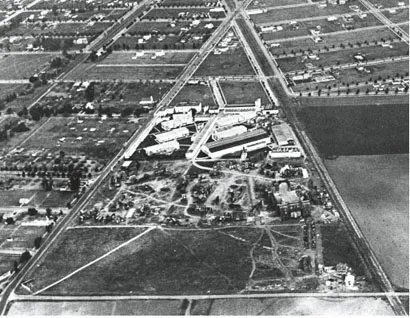
An aerial view of the property in the early 1920s.
The next tenant was Goldwyn Pictures, which purchased the studio facilities for $325,000 in October of 1918. This time, the studio’s name was actually an anagram created by combining the names of part ners Samuel Goldfish and Edgar Selwyn. “If we had jumbled them the other way around it would have been called ‘Selfish Pictures,’” Goldfish used to quip. To the surprise of no one, he subsequently adopted the name Samuel Goldwyn as his own.
Goldwyn shared Ince’s vision of the industry as both an art and a science. He took an interest in his studio’s physical operation, and construction continued on crafts buildings and in technical departments. For $50,000, he added 23 additional acres to the studio, expanded the administration building to a total of 15,324 square feet, and extended the studio’s impressive exterior wall almost a half mile along Washington Boulevard. Inside, a lawn was planted near the front of the lot, bringing these new buildings and the six glass soundstages together into a cohesive campus for the first time. Exterior sets were constructed as needed on the western end of the lot, which faced Overland Avenue. A Los Angeles Times article on July 25, 1923, used the phrase “back lot” (the quotation marks and word spacing are the paper’s) for one of the first times in print to describe this...