For over fifty years, the American Film Institute has flourished as one of America's great cultural entities. Its graduates, faculty, supporters, and trustees have included such acclaimed individuals as Steven Spielberg, Maya Angelou, Gregory Peck, Meryl Streep, Les Moonves, Patty Jenkins, David Lynch, Jane Fonda, Edward James Olmos, Shonda Rhimes, James L. Brooks, Michael Nesmith, Sir Howard Stringer, and many other respected leaders in the worlds of film, television, digital media, and philanthropy.
Written in a unique memoir style, Becoming AFI: 50 Years Inside the American Film Institute offers a candid look at how this remarkable organization has brought together aspiring filmmakers, outstanding educators, and visionary artists. The book details AFI's journey to becoming the foremost national champion for moving images as a vibrant art form and a critical component of America's cultural history.
AFI's story is chronicled through in-depth essays written by those who have been involved in its adventures, growth, and successes: from its early years under George Stevens Jr.'s direction at the legendary Greystone mansion and the Kennedy Center in Washington, DC; through its period of incredible growth, under Jean Picker Firstenberg's guidance, as an influential cultural institution at its landmark Hollywood campus; to its continued years of excellence under Bob Gazzale's dynamic leadership.
Becoming AFI provides an insightful, behind-the-scenes look at how AFI—with passionate determination—overcame the hurdles of advancing technology, political shifts, and new audience dynamics to turn its aspirations into a substantial and highly successful organization. A tireless advocate of moving images as one of America's most popular art forms, AFI is maturing into one of the world's most respected educational and cultural institutions.
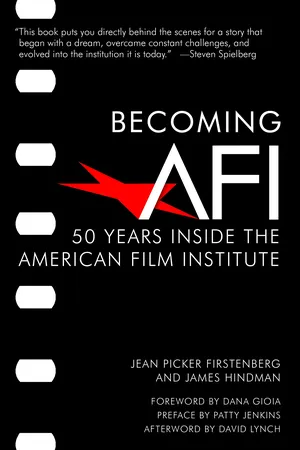
eBook - ePub
Becoming AFI
50 Years Inside the American Film Institute
- 496 pages
- English
- ePUB (mobile friendly)
- Available on iOS & Android
eBook - ePub
About this book
CHAPTER 1
THE LAUNCH
To Begin at the Beginning
JEAN PICKER FIRSTENBERG
What does reaching fifty mean? Numbers mark our lives, from childhood to adulthood. By fifty, we have been around more than half the average life expectancy—a real milestone. And it is the same for an entity that was created fifty years ago.
Looking back, what was our country like? Sociologist Todd Gitlin called the 1960s “years of hope, days of rage.” It was a decade of enormous change, creativity, upheaval, and accomplishment in American life. College campuses erupted with anger at the Vietnam War. The Women’s Movement arrived, again. Three American leaders were assassinated.
President Lyndon Johnson’s Great Society initiatives, announced mid-decade, promised federal support of the arts and humanities, which also galvanized support from the private sector. This set in motion a cultural agenda that reshaped the landscape, literally and figuratively. In 1965, he signed the legislation that planted the seed for AFI. That was the same year that civil rights protesters marched from Selma to Montgomery, the Beatles played Shea Stadium, Bob Dylan went electric, The Sound of Music dominated the Oscars, the Mustang became Ford’s best launch since the Model A, and Sandy Koufax pitched a perfect game.
President Johnson’s 1965 declaration that “we will create an American Film Institute” was bold. For the first time in U.S. history, federal funding was dedicated to supporting a broader cultural agenda that included film, and this simple declaration signaled a new recognition of motion pictures as an art. But as we all know, many good ideas from the 1960s did not survive. It turns out that the strongest institutions unfold over time. Fifty years later, scholars suggest that long-form storytelling with moving images is now viewed as the literature of the twenty-first century. Indeed, on the day Bob Dylan’s Nobel Prize for Literature was announced in 2016, Dana Gioia, who was chair of the National Endowment for the Arts from 2003 to 2009 and now serves as Poet Laureate of the State of California, commented to me: “We’ve been waiting for an American to win this again for some years. Will Martin Scorsese be next?”
In 1967, AFI was launched and, over the decades, it found its footing as a voice of enduring quality and artistic standards. What started with a concept was followed by formal documentation including a corporate charter, bylaws, and board members who led the way through growing pains into adolescence and adulthood. Enduring and thriving for fifty years is remarkable. Even more remarkable is an institution that continues to evolve and renew itself.
This book tells the story of AFI as it reaches that fiftieth anniversary. It is not a historic recitation in the academic sense; rather, it is a personal memoir from several of us who were there, primarily during the middle three decades, but with a perspective that honors the remarkable first decade-plus and delights in the achievements of the fifth decade.
Fifty years ago, George Stevens Jr., at thirty-five, was asked to lead this new creation. He had never been a CEO before. While everyone knew he was talented, no one could have predicted what a brilliant writer and producer he would become, nor what an astute political competitor he would be. George’s life and career have been devoted to the arts, arts institutions, and telling stories worth telling.
When I succeeded him in 1980, at forty-three, I had never been a CEO either. But I also had a promising background, with useful educational and political experiences. I, too, was passionate about the cause. Both George and I brought our knowledge and instincts to bear on a new idea that had no models and no road-maps. Our life experiences, personal tendencies, and professional inclinations took us to places no one had ever been before.
Late in 2007, I was succeeded by Bob Gazzale, then forty-two, who also had never been a CEO. As a devoted film historian with brilliant writing, producing, and entrepreneurial skills, he has taken AFI through some precarious economic circumstances with grace and tenacity. And now, thanks to Bob, the AFI is strong at fifty.
This book brings us through to AFI’s fiftieth anniversary in 2017, by looking at the original goals, the programs that have prospered, the programs we wished had succeeded, and the programs that have passed the test of time. I joined AFI in 1980 as director and CEO. That same year, James Hindman started as a consultant for AFI in DC before moving to Los Angeles, where, within a decade, he became AFI’s deputy director and COO, and then co-director, COO, and provost of the AFI Conservatory. In all, we worked together for twenty-four years.
When he and I started thinking about the AFI at fifty, we wondered what story we could tell. And over several years writing this book, we found our voices and, gratefully, the voices of several colleagues. Over time, we found a story that makes us proud, because I know that we—as well as George and Bob—cared about every project we conceptualized and every activity we planned. Reality often had to balance our emotional energy and, in telling this history, we have not avoided the hard moments over the decades. I can also attest that we have always felt honored to support the moving image artists whose insights and genius have contributed to so much culturally, and whose visions and voices are essential to our nation and our world.
First Steps
The elaborate tale of how the National Endowment for the Arts was itself initially established and how it, in turn, established the AFI is quite complex. The first National Council on the Arts, appointed by President Johnson in 1965, was chaired by the respected theatrical producer Roger Stevens, who went on to chair the AFI board briefly before becoming the founding chair of the Board of Trustees of the John F. Kennedy Center for the Performing Arts when it opened in 1971. The council included three artists of the film world: actress Elizabeth Ashley, acclaimed director George Stevens, and distinguished actor Gregory Peck. (Among the first council were artists from many disciplines, as well as heads of the leading cultural institutions in the nation.) The council immediately allocated $91,000 for the Stanford Research Institute (SRI) to advise the endowment on how to organize an American Film Institute. Two years after the endowment itself was organized, the NEA accepted the SRI report.
A young George Stevens Jr. was asked to lead the new American Film Institute. He had come to Washington, DC, in 1961 to head up the Motion Picture and Television Service for the U.S. Information Agency, led by Edward R. Murrow during the Kennedy Administration. Stevens’s division produced 300 documentaries a year and distributed them to more than 110 countries. NEA chairman Roger Stevens worked with George Stevens Jr. on the purpose and structure of the new American Film Institute. Then there was the question of funding. The NEA committed $1.3 million each year for three years for the soon-to-be AFI—if a matching grant could be confirmed. In fact, in the 1960s, the Ford Foundation, a very strong NEA partner at the time, had become the largest private entity making grants to the arts in the U.S. It is probably fair to say that, because of Ford Foundation vice president McNeil Lowry’s leadership, the AFI launch was actually made possible. George Stevens and Roger Stevens met with Lowry and described the concept for a film training center in Los Angeles. As a result, Ford then matched the NEA’s $1.3 million (over three years), funds that had been pledged even before AFI was legally incorporated. The Stanford Report clearly stated that “an advanced study center should be established in or near Los Angeles to take advantage of the major resources of the theatrical motion picture industry concentrated there.” Thus, AFI was to have a bicoastal identity from its inception.

“The first National Council on the Arts was stellar. It was comprised of Agnes de Mille, Leonard Bernstein, Isaac Stern, John Steinbeck, Yamasaki the architect, David Smith the sculptor, my father, and Gregory Peck. It was this blazing assembly of real artists. And they knew what to do about grants. They gave grants to dance companies, symphony orchestras, and playwrights. But as we said at the time, you can’t give a grant to Warner Bros. So the question became, how do you develop film within the endowment idea?”
—GEORGE STEVENS JR.,
writer, producer, and AFI founding director
The third angel in the birth of the AFI was the indomitable Jack Valenti, who had moved from LBJ’s White House across the street to run the Motion Picture Association of America, and who corralled the major studios to provide a $1.3 million match over three years that got AFI underway. In addition, Roger Stevens wrote to George Stevens Jr. in February 1967 that further funding would be forthcoming if things proceeded as expected, with $350,000 more in fiscal year 1968. He also believed that AFI should receive ten percent of the NEA budget on an annual basis. Unfortunately, neither would come to pass.
The Context for an American Film Institute
James Hindman
Fifty years ago, the American Film Institute emerged from a unique confluence of cultural and political energies at a particular moment in American history. While the U.S. had never subscribed enthusiastically to government support for the arts, early attempts in the 1930s New Deal to help artists survive the Great Depression yielded such remarkable results as the Federal Theatre Project, Federal Writers Project, and Federal Art Project. Congressional discomfort and the war effort ended these experiments but left memories and a belief in the ideal of government support for the arts as a public good.
Postwar European cultural reconstruction was the source of interesting models for public art as a national identity builder, especially through the support of major flagship institutions like museums, orchestras, and performing arts centers. Under President Kennedy’s triumphalist New Frontier, supporting the arts directly was seen as a natural part of the agenda for developing a mature America, holding its own with the European nations it had rescued.
At the same time, interest in movies as more than ubiquitous popular entertainment began to grow. Sparked by the importing of brilliant international art films in major media centers like New York City, Boston, and Washington, DC, renowned critics like Andrew Sarris and Pauline Kael gradually promoted a new image of movies as cinema—art with profound insight into the world’s cultures and the human spirit. The arcane processes that brought films to the screen were fascinating and of growing interest to a movie-infatuated public. The French obsession with auteurisme, authorship in movies (nevertheless truly a collaborative art) focused on the director, suggesting that he (not many “she’s” out there) could achieve the status of a film artist—and even America might have a few of these remarkable creatures, like John Ford and Orson Welles.
How to study this phenomenon? How to recognize movies and cinema as real art? How to have access to the best examples? How to preserve them, like great paintings? How to prepare the best and brightest for careers here?
According to Deborah Jae Alexander’s 2010 dissertation, “A History of the American Film Institute,” as far back as 1935, a call came from American educators to support the use of film as a learning device for students, leading to a proposal for a so-called American Film Institute to garner government support of film in the classroom. And in the summer 1961 issue of Film Quarterly, Los Angeles editor Colin Young joined critics and educators to explore the possibility of establishing a national organization dedicated to film. “An American Film Institute: A Proposal” set out his concept of the goals and opportunities for such an institution, based on government-supported film institute models in Britain and Sweden. Support existed among major film critics and a small group of academics, but it wasn’t until 1965, when the U.S. government took up its mantle as the nation’s primary art patron, that the American Film Institute came into real focus.
The minutes from those first AFI board meetings create a fascinating look into the challenge of starting a national institution from square one. Founding trustee Arnold Picker (my uncle) alone took on the challenge to raise the required $1.3 million in matching funds by AFI and reported on that progress at every meeting. Valenti worked with his member companies at the MPAA while Arnold reached into the wider filmmaking community to companies like Eastman Kodak, Technicolor, Deluxe Labs, Consolidated Film Industries (Sid Solow), and exhibitors like Sherrill Corwin and Michael Forman and their National Association of Theatre Owners (NATO). Arnold also enlisted the support of Charles Benton, lawyers, the guilds, and his close friend and leading Hollywood agent Charles Feldman. (When Feldman fell ill and passed away in 1968, Arnold raised ...
Table of contents
- Cover
- Title Page
- Copyright
- Dedication
- Contents
- Foreword
- Preface
- Introduction
- Authors’ Note
- Chapter 1: The Launch
- Chapter 2: Next Steps
- Chapter 3: Training the Next Generation
- Chapter 4: Women in Charge
- Chapter 5: Film Preservation
- Chapter 6: Exhibition
- Chapter 7: Technology’s Influence
- Chapter 8: Developing a Public Vision
- Chapter 9: Financial Realities
- Chapter 10: Major Moments
- Chapter 11: Leadership
- Chapter 12: Today’s AFI
- Chapter 13: Themes and Lessons
- Afterword
- Appendix
- Acknowledgments
- About the Authors and Contributors
- Quote Citations
- Photo Credits
- Index
Trusted by 375,005 students
Access to over 1.5 million titles for a fair monthly price.
Study more efficiently using our study tools.
Information
Publisher
Santa Monica PressYear
2017Print ISBN
9781595800947
Subtopic
Film & VideoeBook ISBN
9781595807946
Frequently asked questions
Yes, you can cancel anytime from the Subscription tab in your account settings on the Perlego website. Your subscription will stay active until the end of your current billing period. Learn how to cancel your subscription
No, books cannot be downloaded as external files, such as PDFs, for use outside of Perlego. However, you can download books within the Perlego app for offline reading on mobile or tablet. Learn how to download books offline
Perlego offers two plans: Essential and Complete
- Essential is ideal for learners and professionals who enjoy exploring a wide range of subjects. Access the Essential Library with 800,000+ trusted titles and best-sellers across business, personal growth, and the humanities. Includes unlimited reading time and Standard Read Aloud voice.
- Complete: Perfect for advanced learners and researchers needing full, unrestricted access. Unlock 1.5M+ books across hundreds of subjects, including academic and specialized titles. The Complete Plan also includes advanced features like Premium Read Aloud and Research Assistant.
We are an online textbook subscription service, where you can get access to an entire online library for less than the price of a single book per month. With over 1.5 million books across 990+ topics, we’ve got you covered! Learn about our mission
Look out for the read-aloud symbol on your next book to see if you can listen to it. The read-aloud tool reads text aloud for you, highlighting the text as it is being read. You can pause it, speed it up and slow it down. Learn more about Read Aloud
Yes! You can use the Perlego app on both iOS and Android devices to read anytime, anywhere — even offline. Perfect for commutes or when you’re on the go.
Please note we cannot support devices running on iOS 13 and Android 7 or earlier. Learn more about using the app
Please note we cannot support devices running on iOS 13 and Android 7 or earlier. Learn more about using the app
Yes, you can access Becoming AFI by Jean Picker Firstenberg,James Hindman in PDF and/or ePUB format, as well as other popular books in Media & Performing Arts & Film & Video. We have over 1.5 million books available in our catalogue for you to explore.