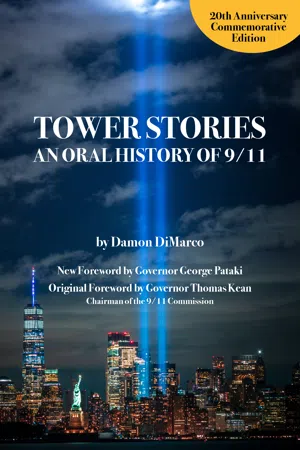
Damon DiMarco's Tower Stories: An Oral History of 9/11 (20th Anniversary Commemorative Edition), eternally preserves a monumental tragedy in American history through the voices of the people who were in New York City on that fateful day. At the same time, the individuals featured in the book speak to the myriad ways by which Americans rose to meet the challenges presented by 9/11, and celebrates the many heroes that are found within its pages.
In the tradition of Studs Terkel, DiMarco's literary time capsule includes a wide variety of viewpoints, including: The small group of people who miraculously made it safely down from the 89th floor of Tower 1, the New York Times reporter who desperately fought her way through the fleeing crowds to get back into Lower Manhattan, the paramedic who set up a triage area 200 yards from the base of the Towers before they collapsed, and the bereaved citizens of New York City who struggled to get on with their lives in the days and months following the tragic event, among dozens of others.
The original edition of Tower Stories was one of the best-selling and most critically acclaimed books on 9/11 ever published, and for this 20th Anniversary Commemorative Edition, DiMarco has conducted additional interviews that offer a contemporary perspective on the 9/11 tragedy. The individuals DiMarco interviewed for the new edition include:
• Alice Greenwald (President and CEO of the 9/11 Memorial & Museum)
• Father Jim Martin (New York Times bestselling author)
• Tom Haddad (survivor of the 89th floor, Tower 1)
• Stephen Adly Guirgis (Pulitzer Prize-winning playwright).
The 20th Anniversary Commemorative Edition of DiMarco's moving oral history preserves all of the voices from the original edition for generations to come, while offering new insights that benefit from twenty years of reflection on the world-shattering event.
The voices in Tower Stories are in turn haunting and heartbreaking, always emotional, yet ultimately heroic. It's no wonder that MSNBC called Tower Stories "Arguably the most successful attempt at capturing the enormity of the events of 9/11," while Publishers Weekly wrote that "DiMarco's contribution to the memory of that horrific day is enormous; the testimonies collected here form a one-of-a-kind account."
Nick Gerstle, twenty-four, worked for Verizon as a construction technician and splicer.50 On September 11, he saw a rare opportunity to make a very important contribution.
I WAS AT WORK in Brooklyn when we heard about the attacks over the radio. Our foreman called us up and told us to go to one of our COs—the central offices where huge computer networks handle the telephone switching. There are dozens of COs around the city—that’s how the telephone network is built in New York. Cables connect your home or business to central offices, then the central offices connect to other central offices, like tentacles of nerve fiber going in and out of a massive brain.
When I pulled into our central office, I asked my foreman if there was any kind of volunteer effort being organized within our company. He said, “It’s too early, it just happened a few hours ago. Watch the TV, and if they need you for the Red Cross, you can volunteer that way.”
Well, that wasn’t enough for me.
I just went down there. I didn’t know if the trains would still run to the Trade Center or if I’d even be allowed to help. But my company’s certified me every year in CPR and first aid—that’s one of the things that motivated me to act. And I’m a pretty big guy. I knew they’d need people who were used to working with their hands and could move things, especially people with the knowledge that I have and the training Verizon provided me. Even if they had me just handing out cups of water, I’d have still done it to make a difference.
I took the N/R subway and had to change trains a couple times to make it into Manhattan. The train ran above ground into the city as we headed in from Brooklyn, and as we went over the bridge, we could see the smoke billowing out from the Towers. It was horrifying. People were looking at it in awe and crying. Mothers were crying because they knew their families—their kin—were in the buildings.
The first stop that let off in the city was Canal Street. As soon as I got out, I got a sense that nothing was as it was supposed to be. Basically, it was like Lower Manhattan had turned into some kind of war zone. From Canal Street down to the Trade Center, I had to find “holes” in the police barricades where I could convince authorities to say, “You can go through with that pass.”
I kept showing my ID and telling them I was first-aid certified. Some cops would let me through, some wouldn’t. If they wouldn’t let me past, I’d walk a block away and try another police officer. Like that, I worked my way closer and closer downtown.
Finally, I made it to a temporary triage center by a college near the Brooklyn Bridge. When I went in, there was no power, just emergency workers who’d gotten injured. I asked for gloves and the people in charge gave me a little mask—not the type that would stop anything serious, but it still helped.
I knew that in order for me to go into the zone, I needed protective gear. I scrounged around and picked up a firefighter jacket from a Burger King down on Church Street near the Trade Center; someone had made it into, like, a temporary rescue center headquarters. I also got some heavy-duty gloves. I needed all this because otherwise, I just had the shirt on my back.
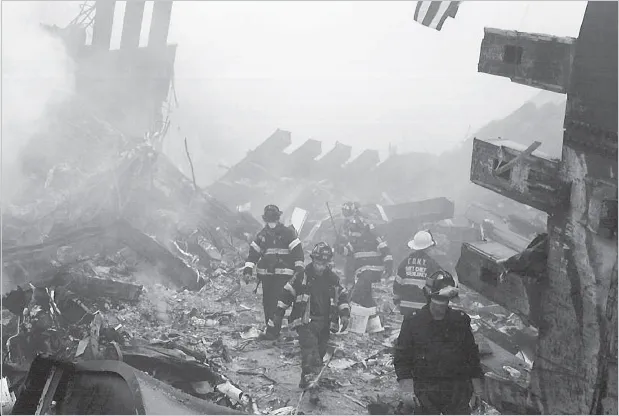
As I walked down Church Street … I can’t even begin to describe it. Three inches of layered soot on the street. The surrounding area was wet from fire hoses. It was like the war zone you see in that film Terminator 2.
There I was on Church Street, waiting with hundreds of firefighters and a small group of volunteers. There were marines standing next to us; they were suiting up and getting ready to go into the debris field.
The area wasn’t organized at all. It wasn’t like someone was in charge and giving orders, like, “You, you, and you! Go there!” It was more like, “Okay … hell. I’m going in.” Whatever you could find, whoever you could get to go in with you, you just did it.
I remember some of the guys who were preparing to go in. There was a volunteer fireman from Maryland who told me he’d heard what had happened, put a siren on his car, and driven from Maryland to New York in an hour and a half. That trip usually takes four hours, so I gotta imagine he was doing a hundred miles an hour the whole way.
I remember another volunteer, a Hispanic guy from Long Island. He didn’t go into the rubble with us, he knew his fire company was responding and he was going to wait for his equipment to arrive.
Half an hour later, when I finally got into the debris myself, I found that group of marines again and linked up with them. This was a good thing. They needed all the help they could get, because they’d found two Port Authority cops who were trapped fifteen feet under the rubble.
You could see one cop’s hand sticking out of the debris. The hand was alive and wiggling. The cop called up to us and said that his partner was down there with him and wasn’t doing so well.
“I kept showing my ID and telling them I was first-aid certified. Some cops would let me through, some wouldn’t. If they wouldn’t let me past, I’d walk a block away and try another police officer. Like that, I worked my way closer and closer downtown.”
There were three marines with me, and we tried talking to them. “Hey guys. Don’t worry.”
I remember one of the marines saying, “By this time tomorrow, you’ll be somewhere on a beach, sipping a drink.”
We started digging. We didn’t have any tools, so we used our hands to dig away at the rubble.
I looked down into the hole at the two men and said, “Anybody order pizza?” I was trying to lighten up the mood, you know?
I’m glad I had the fireman’s jacket and gloves. Some parts of the rubble were very hot. Some of the I-beams sticking up out of the rubble were glowing, even. I was scared but at the same time, there was so much camaraderie you didn’t feel the fear. We were right there on the rubble, under it sometimes, and we heard these guys saying, “Don’t let us die! Please! Don’t let us die!” That keeps you motivated.
And I thought while I was working, don’t worry, guys, I’m right down here with you. I won’t let you go, because if you go, we all go.
Like I said, the hole those cops were in went down about fifteen feet. It was a small hole with a huge I-beam sitting on top, holding up the concrete and rubble so it wouldn’t collapse in on them. We formed a line from the rubble pile to the street and began bringing tools in. It was an unbelievable landscape, you gotta picture it. Amidst the smoke and rubble and darkness, flickers of light from fires all around.
When the professionals finally arrived, I told them I was a volunteer, and they ordered me out. They said they needed space to get the trained emergency personnel in. I said, “Okay, I’ll go,” but I stayed next to the hole.
Then I started to feel nauseous. I couldn’t breathe. I suddenly felt like I was only able to use 50 percent of my lungs. It was around twelve o’clock noon.
A fire lieutenant asked me if I was fine. I said, “Yeah. Yeah.” But ten or fifteen minutes later, he saw me again. This time I was gasping for air, down on one knee, and he said, “Hey guy. You gotta get out of here.”
I wanted to stay there as long as I could, but I’m glad he told me to go.
The core fires under the colossal pile of debris left on the World Trade Center site by the Towers’ collapse would burn for more than five months. The intense heat of this inferno resisted any attempts by firefighting crews to extinguish it.
When I was evacuated, they still didn’t have the two cops out. They were just starting to bring them up.
I started stumbling out of the rubble, gasping for air. I swear to you, I couldn’t fill my lungs. If it wasn’t for the line of firefighters giving me air from their oxygen tanks on two occasions, I don’t think I would have made it back out of the debris field.
It was a long way back; the rubble was a mammoth field of smoking hills. The hole where the cops were was in the middle of the Trade Center area. And all the way out, I had to jump over fallen I-beams and climb over things. If it wasn’t for the thick gloves they gave me, my hands would have been burned. You had to be careful not to step in holes, too, because you didn’t know what was down there. A lot of times, I looked down and all I saw was glowing red fires.
The firemen’s air tanks were so heavy, and I was so weak that I dropped it the second time I was being given oxygen. I was so exhausted.
There was one last hill before me. When I got to the apex of it, I could see firemen below moving everywhere. It was like looking down from a plane and seeing these little ants. And it was a great feeling when I saw it. Home free. Almost.
Once I got down the hill, they had gurneys ready. Firemen helped me, giving me their shoulders to lean on. I collapsed on the gurney and two doctors started working on me as they hustled the gurney out at about fifteen miles per hour, heading toward a triage area.
I was exhausted, but I was amazed. I’m a pretty heavy guy. At times, they had to lift me up to get me over the debris, but they did it. They moved me like I weighed nothing.
I checked into the hospital later on, and that’s when I heard about those two cops on the TV news. They got them out just fine and man, that felt good to hear.
At the hospital, I was treated for smoke inhalation. Apparently, I’d burned my lungs and throat pretty badly. They gave me some steroids to reduce the swelling.
They’d torn my shirt off when I was admitted, and I needed a new one before they’d let me out. I didn’t want to wait, but they told me, “No, no. You have to wait.”
I said, “Okay,” and sat down for forty minutes.
They finally gave me a clean shirt and I was about to leave when Mayor Giuliani walked in. One of his aides saw my fireman’s jacket and said, “Wait right here. Mayor Giuliani wants to see you.”
The mayor’d come to con...
Table of contents
Cover
Title Page
Copyright
Dedication
Contents
Foreword
Original Foreword
Introduction
Timeline of Events for September 11, 2001
Map
At the Towers
Outside the Towers
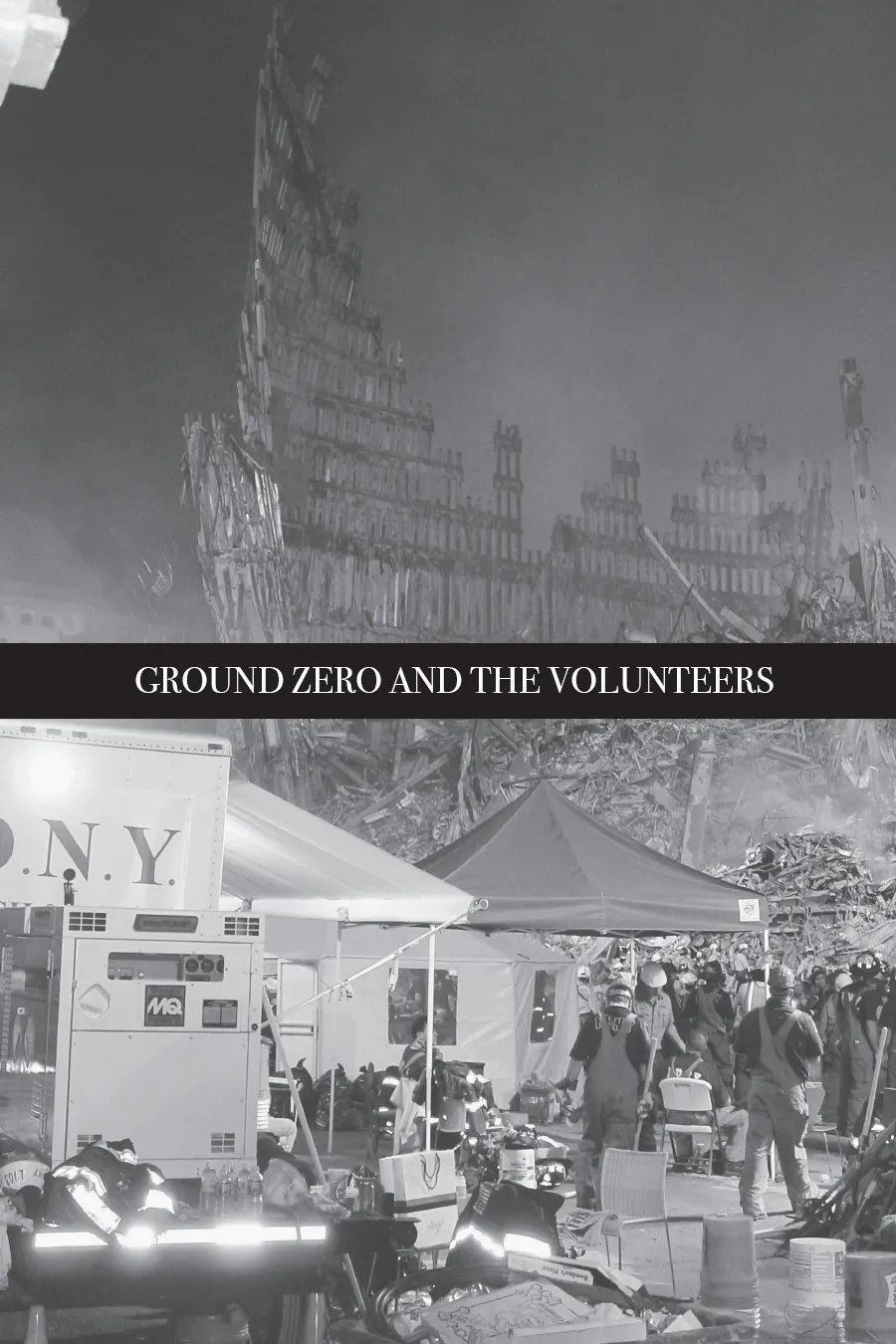
Ground Zero and the Volunteers
The Aftermath
Retrospectives
Contributing Photographers
With Thanks To
Trusted by 375,005 students
Access to over 1.5 million titles for a fair monthly price.
Study more efficiently using our study tools.
Frequently asked questions
Yes, you can cancel anytime from the Subscription tab in your account settings on the Perlego website. Your subscription will stay active until the end of your current billing period. Learn how to cancel your subscription
No, books cannot be downloaded as external files, such as PDFs, for use outside of Perlego. However, you can download books within the Perlego app for offline reading on mobile or tablet. Learn how to download books offline
Perlego offers two plans: Essential and Complete
Essential is ideal for learners and professionals who enjoy exploring a wide range of subjects. Access the Essential Library with 800,000+ trusted titles and best-sellers across business, personal growth, and the humanities. Includes unlimited reading time and Standard Read Aloud voice.
Complete: Perfect for advanced learners and researchers needing full, unrestricted access. Unlock 1.5M+ books across hundreds of subjects, including academic and specialized titles. The Complete Plan also includes advanced features like Premium Read Aloud and Research Assistant.
Both plans are available with monthly, semester, or annual billing cycles.
We are an online textbook subscription service, where you can get access to an entire online library for less than the price of a single book per month. With over 1.5 million books across 990+ topics, we’ve got you covered! Learn about our mission
Look out for the read-aloud symbol on your next book to see if you can listen to it. The read-aloud tool reads text aloud for you, highlighting the text as it is being read. You can pause it, speed it up and slow it down. Learn more about Read Aloud
Yes! You can use the Perlego app on both iOS and Android devices to read anytime, anywhere — even offline. Perfect for commutes or when you’re on the go. Please note we cannot support devices running on iOS 13 and Android 7 or earlier. Learn more about using the app
Yes, you can access Tower Stories: An Oral History of 9/11 (20th Anniversary Commemorative Edition) by Damon DiMarco in PDF and/or ePUB format, as well as other popular books in History & North American History. We have over 1.5 million books available in our catalogue for you to explore.