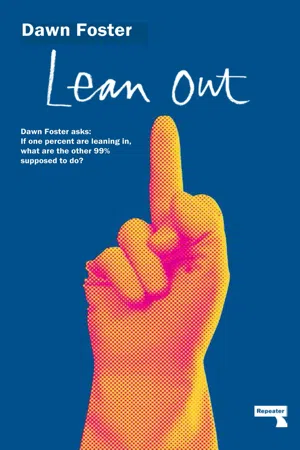
In her powerful debut work Lean Out, acclaimed journalist Dawn Foster unpicks how the purportedly feminist message of Sandberg's book neatly exempts patriarchy, capitalism and business from any responsibility for changing the position of women in contemporary culture. It looks at the rise of a corporate '1% feminism', and at how feminism has been defanged and depoliticised at a time when women have borne the brunt of the financial crash and the gap between rich and poor is widening faster than ever. Surveying business, media, culture and politics, Foster asks whether this 'trickledown' feminism offers any material gain for women collectively, or acts as mere window-dressing PR for the corporations who caused the financial crash. She concludes that 'leaning out' of the corporate model is a more effective way of securing change than leaning in.
eBook - ePub
Lean Out
About this book
Information
CHAPTER 1
Leaning In
Not too long ago, hearing the word “viral”, whether in a film or a doctor’s surgery, would cause a certain amount of alarm. Viruses in films invariably signal a cataclysmic, dystopian scenario, a hitherto unknown incurable disease that threatens the entire existence of the human race around the globe. When a doctor, removing the blood-pressure strap from your arm, informs you that you have a viral rather than bacterial infection, you know you have to sit it out and attempt to take the edge off the symptoms, rather than being sent off with a pack of antibiotics that will cure you in a few days.
It’s strange then that the term has changed so swiftly to a broadly positive term for a story, meme, or video clip that becomes wildly, uncontrollably popular online very quickly. The fascination with what “goes viral” is down to the unpredictability of the internet, and by extension the unpredictability of human beings. Advertisers and media agencies try, and usually fail, to replicate the style of videos and articles that go viral. Newspapers and websites rush to either write or respond to viral content in an attempt to siphon off some of the web traffic.
One such viral success was, perhaps counterintuitively, a short lecture on women in the workplace. Lean In began as a TED talk, delivered in December 2011 by Facebook’s Chief Operating Officer Sheryl Sandberg under the title “Why we have too few female leaders”. In the 15-minute video Sandberg argued that the main reason women aren’t rising to the top, aren’t getting that feted “corner office”, is a lack of assertiveness, an unwillingness to put themselves forward.
She encouraged the audience, in the room and watching on screens globally, to “make their partner a real partner” — choose a husband who would do half the childcare and housework — and finally, she implored women “don’t leave before you leave”, by which, Sandberg explained, she meant she was tired of seeing women lower their career ambitions years before even trying to conceive, let alone getting pregnant, leaving them with no desirable career to return to once they had children.
This reticence amongst women to put themselves forward for promotion and negotiate salaries was responsible for the slow growth in women at the very top. These character traits may be unarguably common, but Sandberg is perennially afraid to scrutinise why this may be. Instead, these behavioural tropes in women’s approaches to work, and the so-called “ambition gap”, are mentioned but not explored.
The reason this lecture became popular is not too difficult to see: women’s inequality in the workplace is a stubborn problem that seems unrelenting and immovable. Offering a solution, especially one that is personally achievable, is tantalising in its simplicity. Few want to run the risk of not watching a video that promises you personal success. Self-help books fly off shelves in shops because they promise a better life, whilst simultaneously feeding off the fact that most people are still unhappy with themselves, because it’s difficult to feel you ever have enough. Capitalism mandates that everyone be in perpetual competition with each other. This naturally spills over into personal, as well as professional, lives.
On 21st January 2014, Sandberg became a billionaire. Articles popped up proclaiming this as a symbol of women’s collective progress, as Sandberg was one of only 12 female billionaires globally not to have inherited or married into her fortune.
Feminism, popular narratives would have you believe, is an onward march towards a tangibly close emancipation — one that all women of different social and economic situations are engaged in. The “Glass Ceiling”, we’re told, is the barrier, and chipping away slowly at it is the firmest, surest way to the final goal of gender equality. This is the premise behind Sandberg’s business manifesto, which also functions as a personal employment memoir. We’re in a better position now, as a gender, than we’ve ever been. Sandberg uses the image of women in developing nations to invoke horror at other women’s position in comparison to that of the westernised, emancipated and business-oriented woman she is addressing.
As Kate Losse, Sandberg’s former colleague, pointed out, for all of her talk of “internalising the revolution” and name-dropping Betty Friedan, “Sandberg has penned not so much a new Feminine Mystique as an updated Protestant Ethic and the Spirit of Capitalism”.1 Sandberg’s corporate feminism doesn’t extend to calling for collective rights for women such as state maternity pay, or a stronger welfare safety net, or even encouraging women to unionise. Lean In sold well, and was accompanied by a whole branded media platform, including Lean In circles, where women are encouraged to discuss “positive” thoughts around work and how to get ahead. It wasn’t so well read, however: Amazon Kindle listed it as one of the books least likely to be finished, cementing its reputation as a lifestyle brand, rather than a life solution. On the subject of the Lean In brand, Melissa Gira Grant observes: “This is simply the elite leading the slightly-less-elite, for the sake of Sandberg’s bottom line. The ‘movement’ Sandberg seeks to lead with Lean In resembles a social movement only so far as it supports the growth of her brand as leader.”2
Corporate feminism is easy to sell — who could baulk at the idea of getting more women into fields where there are few? And the ideals on which it trades — personal development, confidence, nurturing family — are politically helpful in focusing on individual success stories, rather than structural inequality and looking outwith the organisations that women are struggling to gain promotions within. Corporate feminism tells us that aspiration and success is within everyone’s reach if they endeavour to try hard enough, a message which has the unuttered flipside that failure is also down to the individual not wanting it enough. “Never mind that your boss is sexist, or maternity leave in America punishingly short”, says Gaby Hinsliff in The Observer, “Sandberg says you just need to ‘raise your hand’ more and you’ll rise”.3
One reason why corporate feminism is so palatable where previous incarnations have been antagonistic to the establishment and status quo, is that it is completely non-confrontational. As Gira Grant argues:
Anyone who knows anything about the tech biz knows that this is a (social) media side show, and that feminism will never be one of the ‘disruptive’ values of Silicon Valley so long as Silicon Valley is principally a machine for producing wealth for the few. To the extent that someone who so benefits from that business culture espouses feminism, it will be ruthlessly friendly to the corporate environment in which it is exercised.4
Lean In points all blame inward, and ignores structural in-equality — the biggest reason women are still lagging in the workplace is “the ambition gap”, we’re told. Sandberg opines: “And while the ambition gap is most pronounced at the highest levels, the underlying dynamic is evident at every stage of the career ladder.” What causes this ambition gap? Why does it increase as women get further in their career? There’s no attempt at analysis, or acknowledgment that ambition is a moot point when inequality remains so entrenched in modern society. A woman working as a receptionist in a small business can aspire to be a chief executive of a high-street bank all she wants, but without a stellar education and the attendant social connections high-ranking universities furnish alumni with, she may as well aspire to be a unicorn for all the good it will do.
Ambition without realism is megalomania: the majority of people have a fairly accurate idea of where their professional life could take them. While young children often aspire to be footballers, astronauts, princesses, most people from their mid-teens onwards have an awareness of their limits. I will never be the head of an investment bank, or a train driver, but jobs in writing and research aren’t remotely unlikely. Someone who dropped out of school before their GCSEs will be aware that their chances of becoming a surgeon are vastly diminished, but being a manager within a construction company might be possible with intense effort.
Ambition is tempered not just by individual whim, but by the codes and messages people pick up on throughout their lives, fractured by gender, class, race, sexuality and levels of disability. Telling women to ignore their inner barometer of their own likely success is hardly a solution. A woman may be as ambitious as she wants, but the people hiring and firing have their own preconceptions, in a society that maintains that women are less decisive, logical and driven. If a woman’s ambitions exceed the ambition her superiors feel is appropriate, wanting can do barely anything — you’re still stuck on the pay grade your managers have attributed to you.
Shaky Ground
When women do reach the top spot, their tenure is rarely as secure as their male counterparts. Two high-profile departures in a week in 2014, The New York Times’ executive editor Jill Abramson and Le Monde’s Natalie Nougayrède, coincided with a report from researchers at global management consultant Strategy& that showed female Chief Executives are forced out of top jobs sooner than male counterparts.5 Strategy&’s report suggested female CEOs tended to be outsiders, hired in, rather than climbing to the top within the ranks of an organisation, so faced double hostility: both sexism from colleagues and the perception that others who had worked for years within the organisation had been unfairly been passed over.
There was also the observation that women tended to be appointed to failing organisations, and then sacked for the very failings of the business: whether women were more likely to take on the challenge, or businesses were less likely to assign male candidates to sinking ships remains unclear. But women’s sackings remain pored over more publicly and are afforded far shorter shrift.
When Carole Bartz was sacked from Yahoo in 2011 shortly after taking on the failing company, she told Fortune magazine: “These people fucked me over. The board was so spooked by being cast as the worst board in the country. Now they’re trying to show that they’re not the doofuses that they are.” When the interviewer mentioned her age — 63 — and asked her what she was planning to do next, she responded “Fuck you — yeah”.6 The Guardian described it as “a foul-mouthed tirade”, and it’s difficult not to feel that if a male CEO had indulged in the same language it would be described merely as an “outburst” and marked them out as a colourful character in a back-slapping, macho tech environment.
Leaning Back
Fascinatingly, Sandberg attributes this purported stasis in the number of women in top jobs to an acculturated belief by women that they won’t get to the board room, a “leaning back” — essentially, the only thing holding women back from achieving their “best potential” in the workplace is their own self-defeatism. One staggering omission in a book that is so focused on business, boardrooms, and capitalism looms over Lean In like a shadow and could easily explain why there aren’t more women in the higher echelons of FTSE and Fortune companies, since it certainly accounts for the rise in working-class women’s pay squeezes: the global financial crisis.
Research by Emily Thomson and Susanne Ross at Glasgow Caledonian University shows that although women’s workforce participation is now at its highest rate in Britain since records began, post-crash, women’s jobs are increasingly casual, precarious and low-paid:
Total employment is now higher than pre-recession levels, with female employment currently at the highest since comparable records began. Since economic recovery took hold in 2010, total employment has increased by 2.1 million; men increased their employment by 1.2 million compared to 910,000 for women. The male employment rate therefore rose slightly faster than the female employment rate, increasing by 3.5% compared to 3.1% for women.7
When recovery happens, it works best for men, and when recession happens, it hits women harder.
On 20th February 2014, right-leaning tabloids and broad-sheets boomed with the news that employment was up, and more women were in work than at any point in history. The Times put this down to “cuts to benefits and the rising pension age”, as though a few snatched pounds from a subsistence state handouts at either end of their life was forcing women away from their life of leisure and into the workforce. On the front page of the Telegraph, John Philpott, director of the consultancy firm Jobs Economist, said “One of the interesting things about the female employment story has been that austerity was expected to hit them hardest, as two in three public sector workers are women. As it is, women either were hit disproportionately lightly or they have found it easier to move into the private sector.”
This analysis only works if the only women you consider are women in work. And in many ways, political discourse does only consider those in-work people — the deadening mantra of “hard-working families” has become so hackneyed a phrase it’s become impossible to take any politician uttering it in the House of Commons seriously. Yet, without fail, it springs forth from someone’s lips if you have the misfortune of watching Prime Minister’s Questions on any given Wednesday.
Despite the improving jobs picture, the gender pay-gap in the United Kingdom widened in 2013 for the first time since 2008, and for only the second time since the 1970s. Analysis of ONS figures by the TUC suggested that the gap was 15.7% on average in December, or the equivalent of £5,000 a year for an average woman. Drill down even further, and the prospects look grimmer if you’re older: the average woman in her fifties can expect to earn £11.99 an hour — 18% less than the £14.69 a man of the same age would currently earn.
Small Scope
When offering up advice on how women can achieve the ideal work-life balance, tellingly, Sandberg never envisages an image of a woman as anything other than a worker, or a wife and mother. The alpha successful women in Lean In are always bouncing between boardrooms and babies, and the Lean Backs are daydreaming about promotions, or longing for the perfect husband and fretting over imagined biological clocks. There is no room, in the corporate feminist world, for a civil life, a political life, an emotional life outside of the nuclear family unit, or even downtime. All...
Table of contents
- Cover
- Title
- Contents
- Dedication
- Foreword
- Chapter 1: Leaning In
- Chapter 2: Lehman Sisters
- Chapter 3: Having It All
- Chapter 4: Hiring and Firing
- Chapter 5: Trickledown Feminism
- Chapter 6: Can You Be a Feminist and...?
- Chapter 7: Backlash
- Chapter 8: Conclusion
- Acknowledgments
- References
- Copyright
Trusted by 375,005 students
Access to over 1.5 million titles for a fair monthly price.
Study more efficiently using our study tools.
Frequently asked questions
Yes, you can cancel anytime from the Subscription tab in your account settings on the Perlego website. Your subscription will stay active until the end of your current billing period. Learn how to cancel your subscription
No, books cannot be downloaded as external files, such as PDFs, for use outside of Perlego. However, you can download books within the Perlego app for offline reading on mobile or tablet. Learn how to download books offline
Perlego offers two plans: Essential and Complete
- Essential is ideal for learners and professionals who enjoy exploring a wide range of subjects. Access the Essential Library with 800,000+ trusted titles and best-sellers across business, personal growth, and the humanities. Includes unlimited reading time and Standard Read Aloud voice.
- Complete: Perfect for advanced learners and researchers needing full, unrestricted access. Unlock 1.5M+ books across hundreds of subjects, including academic and specialized titles. The Complete Plan also includes advanced features like Premium Read Aloud and Research Assistant.
We are an online textbook subscription service, where you can get access to an entire online library for less than the price of a single book per month. With over 1.5 million books across 990+ topics, we’ve got you covered! Learn about our mission
Look out for the read-aloud symbol on your next book to see if you can listen to it. The read-aloud tool reads text aloud for you, highlighting the text as it is being read. You can pause it, speed it up and slow it down. Learn more about Read Aloud
Yes! You can use the Perlego app on both iOS and Android devices to read anytime, anywhere — even offline. Perfect for commutes or when you’re on the go.
Please note we cannot support devices running on iOS 13 and Android 7 or earlier. Learn more about using the app
Please note we cannot support devices running on iOS 13 and Android 7 or earlier. Learn more about using the app
Yes, you can access Lean Out by Dawn Foster in PDF and/or ePUB format, as well as other popular books in Social Sciences & Feminism & Feminist Theory. We have over 1.5 million books available in our catalogue for you to explore.