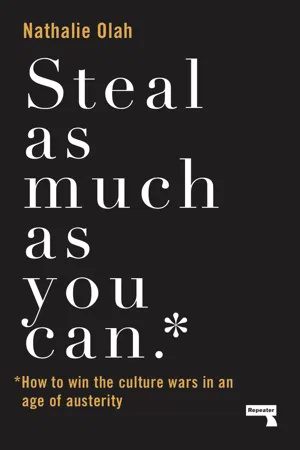
The 2010s have been a double-edged decade. Socioeconomic factors have led to the widespread and increased disenfranchisement of poorer people from the mainstream media and the institutions shaping it. This has coincided with a growing number of people from low income backgrounds also receiving better educations than ever before, and having the means at their disposal to both name and resent it. Steal as much as you can is the story of how this bright generation came to be, and what effective means are still at their disposal to challenge the establishment and ultimately win. By rejecting the established routines of achieving prosperity, and by stealing what you can from them on the way, this book offers hope to anyone who feels increasingly frustrated by our increasingly unequal society.
eBook - ePub
Steal as Much as You Can
How to Win the Culture Wars in an Age of Austerity
- English
- ePUB (mobile friendly)
- Available on iOS & Android
eBook - ePub
About this book
Information
The Problem with Tastefulness*
The ten years since the global economic crash of 2008 happened to coincide almost exactly with my twenties. If these were the years in which I was meant to start forming meaningful and lasting relationships, in which I started to apply my skills to better understand the kind of contribution I could make to the world around me — most importantly, if these were meant to be the years in which I started to take on greater responsibility and finally outgrow the vagaries of adolescence in order to achieve self-determination, contentedness and a solid sense of who I was — then they would fall far short of expectation.
Almost all of my friends who entered the job market at this time report a very different experience. Among the many highs and lows, the periods of depression, the moving between decrepit flats in an unregulated rental market, the break-ups, the career struggles, and the few moments of intense jubilation when our ambitions didn’t seem altogether doomed, it became difficult to see what was the result of global financial trends, personal failing, or a combination of the two. The one fact that always selfishly soothed me was knowing that I wasn’t alone. With me were millions of other young, hungry and ambitious people, who had faced the sharp end of the free market’s butterfly effect and felt frustrated by the large-scale forces of late capitalism, and the government policies implemented by the Conservative-led coalition, during what is now being termed the Lost Decade.
For many of us who entered the workplace in or around 2008, there was a feeling of having been sold a lie. That feeling was partly attributable to the global economic downturn, but it was exacerbated by a cultural climate that seemed to neglect the experiences of the majority suffering under austerity, for the sake of prioritising the narratives and cultural output of a more affluent elite. Detractors will argue that the fields of art and entertainment have always been incidental to the economy and therefore a luxury of the few who could afford to pursue them as careers. But as I have already argued, far from being incidental to it, both play a crucial role in the proper functioning of a democratic society, serving a crucial role in the formation of identity and the processes of self-determination.
The short answer as to why all this was happening was an aversion to risk. As market forces dictated that industries across the board became more risk-averse, minimising controversy and being more amenable to audiences might have seemed like straightforward business sense. But the values on which these judgements were being made can never be divorced from class. After all, how can you quantify risk in relation to something as intangible and subjective as our creative tastes? The answer, at least according to those in charge during the lost decade, was by eliminating the social outliers whose viewpoints differed from the vast majority of people steering the ship. What this meant, in real terms, was that while the majority white, majority middle-class gatekeepers of the creative industries might have more readily permitted working-class and minority voices — as well as their stories and ideas — during the boom periods of the 1980s, 1990s and early 2000s, they quickly reverted to type when faced with economic uncertainty, doubling down on the “safe” and easily marketable output of their peers.
In the meantime however, the working classes had been on the move, or at least left the house, reached the end of the road and been told to turn back. The myth of social mobility had stopped short of allowing them to have any meaningful impact on the avenues of culture, academia or government, and while the economic downturn might have created the basis on which to further justify a culture of unpaid internships and low-paid entry-level jobs, there was the added fact of these industries also having historic roots in nepotism and class discrimination. Take for example the fact that in my time as a journalist I have watched as the editorial teams of even the most seemingly progressive and anti-establishment magazines became increasingly composed of privately educated, middle-to-upper-class people, able to survive on their paltry salaries thanks to the Bank of Mum and Dad. Scratch beneath the surface some more, and you quickly uncover an attitude that believes this survival mechanism to be valid, on the grounds that many of its founders and editors themselves hail from similar economic backgrounds.
If New Labour had hoped that in addition to answering an immediate economic question, their education reforms might also lead to a more diverse and energised middle class to supplant the old, then their dreams have fallen far short of expectation. What we have instead is a better-educated working and lower-middle class still constrained by social, economic and cultural inequality. Smart, critical and angry, they would mount the first real existential threat in several decades to the country’s entrenched class hierarchies, and continue to antagonise and disrupt the political order with the very real hope of engendering change.
By 2017, the elected leader of this young and somewhat re-energised youth contingent, Jeremy Corbyn, would deliver an election campaign that sent shockwaves through the British establishment, giving it serious cause to believe that substantial and existential change was afoot. The anger that had been mounting since the previous decade, and which had few other mainstream avenues for expression, would finally be played out in the electoral gains made by the Labour Party in the general election of that year. Corbyn’s earlier election to the leadership of the party had been described as unexpected, and unpredicted, without any thought for what this said about the state of the media. Clearly, a whopping great portion of the electorate was not being served by its purposes, primarily on account of how few working- and lower-middle-class voices had been permitted entry and free rein to communicate their ideas in the years since austerity had first been imposed.
Much of the support for Corbyn was expressed via social media, a fact that newspaper journalists gleefully wielded as proof of its marginality while failing to recognise how far it served to reveal their own biases (again, we witnessed a snobbery towards the internet — the de facto medium of real, and of course younger, people everywhere). The legacy media continued to assert its superior quality — a claim that went beyond the straightforward assertion that broadsheet journalists are simply held to a higher level of editorial scrutiny, to also subtly imply their superior intellect and judgement; and it was a claim that would seem increasingly hubristic with every false election prediction.
It was the arrogance with which these commentators continued to promulgate their righteousness, in spite of overwhelming evidence to the contrary, that contributed to a growing disdain for the broadsheet commentariat and legacy news media. Any claim of being democratic, when it had shouted over and discredited the views of almost half the electorate, would help to serve the final death knell in its historic claim on superior quality. Clearly something was amiss. In trying to dissect why this had been allowed to happen, I spent a lot of time talking to and reading the output of today’s centrist and liberal commentariat, in order to better understand its motivations and perspectives. For most, hailing from affluent parts of London and having graduated from expensive schools, the call of journalism and centre-left politics seems to have been a radical decision within their immediate social circles, leading to a tendency among liberal-leaning journalists, who I’ve met, to reward themselves for not having pursued the more lucrative avenues of finance or law, for example — as if this alone rectified their privilege and bias. It’s this righteousness that goes some way to explaining the false sense of proximity that many of these commentators also feel to the marginalised experiences of the working classes. What’s more, with the decline of local journalism, and journalism as a trade, the dynamics of reporting have shifted, so that issues once covered by local correspondents with a close and intimate understanding — issues caused by austerity, for example — are being presented instead through the third-hand, vouyeristic lens of a small group of liberal media types largely contained within London. This is being further exacerbated by the fact that, with smaller budgets and tighter deadlines, fewer journalists are actually engaging in social anthropology, qualitative research or participant observation, and instead are applying theory learned from books to scenarios which they largely glean from third-party reports conducted by NGOs or similar.
This same self-righteousness that defines the liberal media also creates a culture in which it’s acceptable for them to breed contempt for poorer people who did respond to the call of social mobility in a bid to escape poverty and struggle. I can’t imagine there are many people reading this who feel sympathy for ex-Etonians occupying trading floors, but there will be many, I hope, who sympathise with the pull of a white-collar job for a working-class person wanting to obtain the same sense of security as those who were born into wealth. These motivations can never be separated from the circumstances of late capitalism as exacerbated under successive governments, nor the fact that few well-paid blue-collar and public sector jobs exist. And yet the short shrift given to these people, exemplified by the widely-mocked, upwardly mobile candidates we see on shows such as The Apprentice, under the sardonic gaze of a media class that fails to see its own place in an unequal system — and fails to realise that the opportunity to pursue a career in the media at the expense of other industries is itself a luxury — constitutes a glaring hypocrisy. In this sense, it is often capitalism’s greatest profiteers who are permitted to be most vocal about its shortcomings, and often in their very narrow worldview which places them front and centre of the class struggle, they end up flatly lumping under the same umbrella the old boy networks and the hungry upstarts looking to take advantage of the few avenues available to them for social mobility; unfairly castigating the latter for their vulgarity and stupidity.
In the Reagan and Thatcher model, professional success and financial attainment offered a possible route of redemption to those born outside of the entrenched and elitist methods of private and university education, even if our media continued to mock those who seized on its opportunities for their arrogant desire in wanting to have a larger share of the same pie. Under Blair, mobility and education became interchangeable. On the one hand this was a noble enterprise to give working-class children the same opportunities to learn as any of their middle-to-upper-class peers. But with it came an added dimension to the class struggle, one that stipulated the necessity of also being book-smart, demure and cognisant of the rules of taste that had also been defined by the establishment.
It is difficult to argue this point because of the success of the liberal project in asserting the unequivocal benefits of academic education. While I wholeheartedly believe that it is right for all people to have the same access to, and opportunities of, education, irrespective of their financial profile, I also believe that in the British context at least this has been skewed more towards the attainment of human capital, rather than being an end in and of itself. It is an imperative of a punitive class system, rather than a freedom or a choice. Higher education and cultural immersion might constitute something more valuable than straightforward wealth creation, but we would be fooling ourselves if we didn’t also accept that the former is in many ways equally driven by capitalist thinking. The pursuit of education for little more than adding to your CV or Linkedin profile, and to achieve the cultural signifiers of wealth and cultural cachet, is equivalent to any other form of status symbol and forms part of a capitalist value system. And by the same logic, entrepreneurialism without any of the subtle signifiers of education and high culture affords you only a slightly higher place on the social ladder than the council estate “chav” of previous decades.
The liberal bohemian, whose relatively comfortable existence affords them the opportunity, is often the worst culprit for deriding the “crass” efforts of a group forced, through historic oppression and struggle, to more frequently and explicitly participate in the capitalist system. Consider, for a second, how it feels to be derided by a liberal media class largely born into wealth, for seizing on the opportunities open to you, and to be mocked for not quite understanding the subtle idiosyncrasies and signifiers of middle-class “good taste”. The problem with tastefulness is that it is often posited as definitive and absolute, when in reality it is little more than a proxy for wider socio-economic dynamics. Those in the business of deciding what constitutes taste — again, the gatekeepers of our collective culture including publishers, broadcasters, editors and music industry bosses — are acting in the service of those dynamics, and constitute the cultural outposts of a much bigger campaign to uphold the ideals of the middle-class. Most of what is judged to be beautiful, important, moving or intriguing will have been decided under circumstances that sought to censor and deride the experiences of low earners, for the purposes of upholding the logic and imperatives of social mobility. It’s the smug grin of those initiated into the British establishment writ large on the pages of the books we read, the TV shows we watch and the music we hear on the radio.
It is here that we begin to see how universally applicable the famous Susan Sontag adage is — that rules of taste enforce structures of power. Taste, rather than being incidental to class, is the means by which reigning elites protect themselves — a hegemonic tool used to oppress and stifle any outside challenger. In Britain, in spite of a mild flirtation in previous decades with something more representative, taste has become increasingly judged by its proximity to the middle-class status quo, and by default, remains antithetical to anything culturally divergent. It is also a means of ensuring that the status quo is never challenged. Dress sense, interior design sensibility and cultural reference points all have the power to circumnavigate someone’s financial profile to grant them approval to the upper echelons of society. Crucially, it isn’t just wealth, but wealth coupled with a sound understanding of the subtle signifiers of the establishment, that now serves as a guarantee of social acceptance. As a result, we begin to see how taste serves as a proxy for submission; an external indicator of how far an individual is willing to be subsumed by the pervasive modes of power, and play the game of incremental class ascension.
By reverse, and to expose the shallow veneer of respectability that has been used to conceal policies and ideas that are both cruel and harmful to many people, we require art and culture that is permitted the freedom to flout good taste. We require art and culture that at times is allowed to go to extremes, to reflect the extremes that are felt by those communities who are not served by the present system, and who suffer under the effects of late capitalism and austerity.
I started to consider this phenomenon specifically in relation to books and publishing, which had always been the main focus of my critical attention as a journalist. There have been few books published in the past decade that I would consider to be controversial, challenging or dangerous. What has replaced them is a literary culture increasingly predicated on the idea of tastefulness. We have seen an explosion in the number of artfully-written memoirs, each presented in an array of photogenic, peach or “millennial pink”-coloured dust jackets and containing the quiet, internal struggles of their affluent authors and protagonists. This has arisen concurrently with trends in literary fiction circles around London, which I have engaged with to varying extents, whose authors are each striving for a nadir in cleanly-written prose, exquisite phraseology and well-executed pauses.
While there had always been a core degree of fetishisation towards these poetic and literary tropes, the trend has started to pervade the mainstream publishing industry in a way that we have never seen before; and yet, the ideas and subjects that these groups discuss would be largely impenetrable to anyone without a master’s degree in creative writing, whipping the wider publishing industry into a culture of ever-more obscure stakes. While the leading lights of literary fiction in the 1990s and even early 2000s had included the likes of Douglas Coupland, Irvine Welsh, Donna Tartt, Bret Easton Ellis and Zadie Smith — writers whose purview and focus was always very clear, and whose narratives were always compelling to a broad readership — their contemporary equivalents have mired themselves in a degree of introspection and literary stylistics that alienates almost anyone outside of the immediate, literary fray. Without naming names and isolating any one particular author, hardly any of the literary world’s leading lights today can claim to have achieved the same era-defining prominence and pop-cultural breakthrough as any of these earlier literary stars. And yet the publishing industry seems hardly to care about creating work with broad appeal or the ability to provoke, providing the middle-class consumer base allows it to meet its annual performance targets.
Much has been made by the publishing industry of the rise in book sales in recent years, but while we are seeing a trend towards the wider consumption of books, few of them are having the same mainstream impact as any one of the main titles written by those authors who rose to prominence in the 1980s, 1990s and early 2000s. What we’re seeing instead is a culture of Instagram posts and effusive Twitter reviews, which leads to a wider number of authors enjoying a moderate degree of success, rather than any one of them achieving popular status. It is an idea that sounds naive and idealistic now on account of how readily the publishing industry has accepted its fate as a marginal entity, whose responsibility is to serve the quiet, tasteful sensibilities of its middle-class readership — that the novelty value into which books and reading has been plunged represents one of the saddest parts of our cultural decline. Thanks to the twee picture painted by today’s publishing enthusiasts — “Curled up on the sofa with the latest Rachel Cusk!” — literature has become increasingly reframed as a lifestyle choice and pastime of the wealthy, rather than a valid means by which to convey important ideas.
Like several other aspects of our collective culture, reading has also become largely depoliticized and stripped of any militancy. This is because the publishing industry is more aware of its own mortality post-2008, and, as a result, keen to distract from the systems of elitism under which it operates. It is therefore less likely to engage with work that openly critiques or satirises the establishment, and therefore gives cause for any kind of real introspection. Work that is produced by the white middle classes is forced to become ever more tepid and non-partisan for the purposes of avoiding any close inspection of the credentials and biases of its authors. Meanwhile, the publishing industry confidently produces large volumes of work on subjects that it judges to be at a safe enough distance so as not to invite any true interrogation of its own power structures. The touristic mentality of the middle class is brought to bear in the wide range of books produced every year which focus on the experiences of people living under corrupt regimes in the global south, for example, but which rarely touch on the problematic dynamics of Western foreign policy, aid, white sa...
Table of contents
- Front Cover
- Half-Title Page
- Title Page
- Copyright Page
- Contents
- Introduction
- Education, Education, Education
- Cruel Britannia
- The Lost Decades
- The Problem with Tastefulness
- The Problem with Inclusion
- The Problem with Impostor Syndrome
- What Next?
- Notes
Trusted by 375,005 students
Access to over 1.5 million titles for a fair monthly price.
Study more efficiently using our study tools.
Frequently asked questions
Yes, you can cancel anytime from the Subscription tab in your account settings on the Perlego website. Your subscription will stay active until the end of your current billing period. Learn how to cancel your subscription
No, books cannot be downloaded as external files, such as PDFs, for use outside of Perlego. However, you can download books within the Perlego app for offline reading on mobile or tablet. Learn how to download books offline
Perlego offers two plans: Essential and Complete
- Essential is ideal for learners and professionals who enjoy exploring a wide range of subjects. Access the Essential Library with 800,000+ trusted titles and best-sellers across business, personal growth, and the humanities. Includes unlimited reading time and Standard Read Aloud voice.
- Complete: Perfect for advanced learners and researchers needing full, unrestricted access. Unlock 1.5M+ books across hundreds of subjects, including academic and specialized titles. The Complete Plan also includes advanced features like Premium Read Aloud and Research Assistant.
We are an online textbook subscription service, where you can get access to an entire online library for less than the price of a single book per month. With over 1.5 million books across 990+ topics, we’ve got you covered! Learn about our mission
Look out for the read-aloud symbol on your next book to see if you can listen to it. The read-aloud tool reads text aloud for you, highlighting the text as it is being read. You can pause it, speed it up and slow it down. Learn more about Read Aloud
Yes! You can use the Perlego app on both iOS and Android devices to read anytime, anywhere — even offline. Perfect for commutes or when you’re on the go.
Please note we cannot support devices running on iOS 13 and Android 7 or earlier. Learn more about using the app
Please note we cannot support devices running on iOS 13 and Android 7 or earlier. Learn more about using the app
Yes, you can access Steal as Much as You Can by Nathalie Olah in PDF and/or ePUB format, as well as other popular books in Politics & International Relations & Political History & Theory. We have over 1.5 million books available in our catalogue for you to explore.