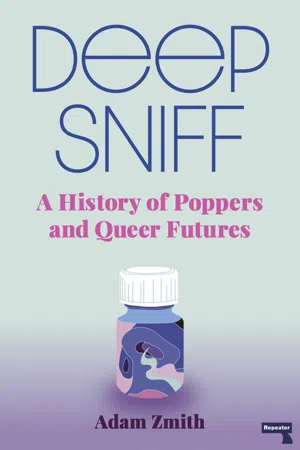
3, 2, 1... inhale, deep. From the Victorian infirmary and the sex clubs of the 1970s, poppers vapour has released the queer potential inside us all.This is the intriguing story of how poppers wafted out of the lab and into gay bars, corner shops, bedrooms and porn supercuts. Blending historical research with wry observation, Adam Zmith explores the cultural forces and improbable connections behind the power of poppers. What emerges is not just a history of pub raids, viral panics and pecs the size of dinner plates. It is a collection of fresh and provocative ideas about identity, sex, utopia, capitalism, law, freedom and the bodies that we use to experience the world.In Deep Sniff, what starts as a thoughtful enquiry into poppers becomes a manifesto for pleasure.
- English
- ePUB (mobile friendly)
- Available on iOS & Android
eBook - ePub
About this book
Information
1. Undesirable Purposes
A woman wearing smart clothes is reading about the exhibition when she notices the creature. She steps back and watches carefully. The looming figure has pale skin and black body hair, and it wears a red leotard that is adorned with glistening rhinestones. It could be a normal guy with a beard in east London. But tonight in the gallery he is a hairy gymnast performing a routine among strangers.
A person in round specs pauses their conversation to watch the performer dip onto his hands and knees, press his belly to the floor, stretch his feet then his hands... mimicking the length of the line. It is a thin white strip, pasted onto the floor, and it measures 16.97056274847714 metres – slicing right through the gallery space. A pair of people drinking wine from paper cups try to ignore the performance, but they also realise that they are standing on the performer’s line, and he is moving towards them. The creature-gymnast seems to balance, to fit all its twists and turns, its pointed toes and bent knees, onto that line.
The routine is that of a gymnast, yes, but also that of a dancer, of an actress on a stage, a person trying to live, a soul desperate to hit its marks on the line. The length is the same as the diagonal across the 12 x 12m square sprung floor where a gymnast usually shows her best skills. The line is a constraint on her power but also a channel for it. The creature brings all this meaning into the gallery tonight, at the opening of a group show that mostly comprises pictures and objects. As the visitors talk to each other the artworks are a backdrop – except for the gymnast who penetrates them in sparkling sweaty lycra. Concentrated, poised, mischievous, the performer is Luis Amália and he is showing us a life on the balance beam.
Amália conceived of this piece as part of his ongoing performance work that takes on various forms. His project is to express an embodiment of female gymnasts and actresses. What he feels for them is more than an affinity or an admiration. His work is not satire, not drag. When his obsessions coalesce into these precise, rehearsed manoeuvres across a film set or a gymnastics arena, they are moving as Amália feels. Never good enough. Desperate to connect. Waiting to be judged. And yet! His act of performing these moves on his line somehow eliminates the negative feelings; he is freed of them, for a moment.
If there is something queer here, it is an attitude. When we watch Luis, we are all moving with him, along the line, cutting through official space.
Looking into the history of poppers requires the same attitude, and that is why this book opens with Amália’s performance of a piece he named 16.97056274847714, which was performed in London at the Queer Art(ists) Now group art show in March 2020.1 A history of poppers finds dozens of characters like Amália: different, daring, difficult. Whenever Amália performs, there is something “wrong” about him. His non-binary body is hairy, pale, perceived as male – and yet his soul is textured differently, light and dark, every gender and none. The creature is mesmerising: a utopia of being, free from categories, cutting through the expectations placed on him.

I wish I had seen Amália’s performance when I was an adolescent, although I probably would have rejected it. As I grew up, I allowed categories and expectations far too much power, and I didn’t have the courage of Amália to explore them artistically or to try to shake them off. I would have seen the freedom he implied, and turned away with teenage worry.
Growing up I panicked about who I desired, and I felt the pressure to be a “man”, whatever that meant. It was bizarre to see that the men’s bodies I wanted as my own were also the ones I wanted to touch. I knew that this meant other people would place me in a certain category, which bothered me. People see me as “gay” and as a “man”. These categories were created long before I was. I inherited them, and had to fit them even though I didn’t want to. Today, I’m never comfortable with them, but at least I have “queer”, which is better. In this book I want to sniff out the multitudes contained in that word, and how this could help us to feel our way towards a future of uninhibited bodies and potential. To do that, I have to know where the idea of these labels “gay” and “man” came from in order to interrogate them. A history of poppers has some answers.
For a few years until 1976, the year my parents got married, the place to get poppers in London was Roland Chemist on Praed Street. This area, named Paddington after the railway station, was a busy district filled with shops, double-decker red buses, Ford Cortinas and Austin Allegros. Billboards advertised mass products like Guinness and Levi’s jeans. I can get a glimpse into poppers use at the time if I peer through the window of one small pharmacy in this bustling district. Roland Chemist, like any pharmacy in the UK, could lawfully sell amyl nitrite. The product was made by Burroughs Wellcome and marketed to those with heart problems. Amyl nitrite was sold in sealed glass ampoules, which were crushed by users to release the vapour of the liquid inside. This action made a “pop”. This is how amyl nitrite, and similar substances, were packaged and used before the little brown bottles with safety caps came along. It’s also how they got their name “poppers”.
At the same time as Roland Chemist was known for selling amyl, the Boots Chemists in Piccadilly stocked twenty-four ampoules of amyl nitrite, which would last from four to six weeks. That’s sales of around 250 per year.2 The amount of amyl nitrite sold through Roland Chemist in Paddington was extraordinary. In one twelve-month period between 1975 and 1976, at the height of the pharmacy’s poppers business, it sold 185,700 ampoules of amyl nitrite.3 Let there be a gold plaque to Peter Beaton Lucas and Paul Roland Fletcher, the directors of the business, for their contribution to the enhancement of pleasure. Fletcher and Lucas also had two other shops on Earl’s Court Road, close to a cluster of gay pubs including the Coleherne, which was popular with certain categories of gays including leathermen. They supplied their other shops through the Roland Chemist shop in Paddington.
Gay men would have made up the bulk of their customers. The pharmacists and shop directors were doing nothing wrong in selling amyl nitrite to anyone who asked: no law or regulation required a prescription for it. One of the pharmacists later said that he “did not ask questions” when asked for amyl nitrite, and usually just “sized people up and if they looked OK” he would make the sale.4 But they knew who their customers were: a sales assistant at one of the shops later remarked that amyl nitrite was frequently sold to gay people. A box of a dozen ampoules cost no more than 65p to manufacture, and was sold at £1.10.
Lucas and Fletcher tread along the same line as Amália in his performance work. No one told them they couldn’t do what they were doing. But their actions unsettled those around them, especially those with power. The problem started in 1975 when two men visiting Brighton walked into a pharmacy and asked for amyl nitrite. The pharmacist there asked for a prescription, so they told him they usually picked it up without one at Roland Chemist on Praed Street in London. Nice one, guys. This triggered a report to the police and an investigation by the Pharmaceutical Society, an industry body. The staff at Roland were spooked. They began to ask customers who requested amyl nitrite if they had a prescription. This must have troubled the gay men who were regular users. On December 29th, 1975, a volunteer at Gay Switchboard, the helpline, brought the problem to the attention of their comrades. He raised it in the pages of the log book that they used to communicate with each other between shifts. The volunteer asked: “Where can you get Amyl Nitrate [sic] NOT on prescription since Roland Chemist requires one now[?]”5

Within six months, the supremely well-informed Switchboard volunteers had heard what was going on. One of them wrote in the log book on June 7th 1976:
For those people who like “Poppers” and have had difficulty buying it at Chemists the reason is because the Chemists have received a letter, I think, from the National Health [Service], telling them of its misuse and asking them to use their discretion in serving people with it. It is apparently going to be added to the dangerous drug list soon.6
The heat was on. In September 1976, a committee at the Pharmaceutical Society considered Fletcher and Lucas’s business. The committee concluded that in selling vast quantities of amyl nitrite, Fletcher and Lucas turned a blind eye to the improper use of the product. The two men were kicked off the pharmacists’ register.
It took two years, but Fletcher and Lucas managed to overturn the verdict. The judges in the High Court did not rule that poppers were wonderful and safe and should be easily available. Instead, they upheld Fletcher and Lucas’s appeal on the grounds that the members of the Pharmaceutical Society committee had done something unfair when considering the earlier case. To help them understand amyl nitrite, the committee members had consulted an edition of William Martindale’s Extra Pharmacopoeia of Unofficial Drug and Chemical and Pharmaceutical Preparations – but they chose not to say so. This giant book, first published in 1883, synthesised all the recent advances in therapeutics.7 It was an alphabetical catalogue of drugs, each listed with reference to published evidence and guidance on how to administer it. In Martindale, amyl nitrite was listed as a very safe drug that could be used against various problems including angina, but could be detrimental to health if used improperly.8
It was not the first time the British establishment had worried about amyl nitrite. In 1956, the Home Secretary, Gwilym Lloyd George, heard that “some chemists in the West End of London have been selling amyl nitrite in circumstances which suggest that it is not required for legitimate medical purposes”.9 He held off from taking action against this, though. Lloyd George agreed with the Poisons Board that in principle it was not right to use prescriptions to control substances that are not highly poisonous “simply because they are liable to be used for undesirable purposes”. This might be the first free pass for poppers in history. (He was not so lenient with Ruth Ellis, a murderer, whose death sentence he refused to commute in 1955.)
But someone, somewhere, always wants to see sex as improper. Twenty years after Lloyd George’s liberal approach, the members of the Pharmaceutical Society’s committee assessing Fletcher and Lucas’s case decided that sniffing amyl during sex was not a correct use of the stuff, so someone who did this could be harmed. In inferring what they wanted from Martindale without admitting it as evidence, the committee had made their own improper use of the book. This left Fletcher and Lucas with no way of debating the committee’s claims. If they’d had that chance, they might have argued that by “improper use” the editors of Martindale meant drinking or eye drops. This is why the High Court upheld the pharmacists’ appeal in the summer of 1978.
By this time in the USA, the business of poppers was much more aggressive. Whereas Roland Chemist salespeople knew their customers were gay men, they didn’t market their product at them. In the USA, however, companies had begun to manufacture, distribute and advertise poppers as a product specifically for this demographic. Some of the famous brands from this time, Rush and Locker Room, endure to this day under the banner of a company called the Pacific Western Distributing Corporation (PWD), founded in 1976. It was the same year that other durable US brands were founded: Microsoft, Apple, Starbucks... To grow these businesses required obsessive minds focused on both product and experience, including the marketing of the product itself. For poppers, this is a credit that can go to a man called W. Jay Freezer. Within a year of founding PWD, he was claiming in the Wall Street Journal that his Rush brand of poppers ought to be sold alongside shampoo and macaroni cheese. “If Safeway supermarket customers want the product, I don’t see why it couldn’t eventually be sold there,” he is quoted as saying in an article from October 10th, 1977.10
Freezer pioneered the advertising of poppers in gay newspapers and magazines, such as Drummer. Based in Los Angeles, this publication was aimed at leathermen and, according to Jack Fritscher, who became its editor-in-chief in 1977, it was started by John Embry simply as a way to promote his own business selling poppers and leather wristbands by mail.11 The idea was to wrap reports and editorial columns on the leather scene around ads for gay products – and it worked. “Poppers kept Drummer flying high,” wrote Fritscher in his history of the magazine, Gay Pioneers.12 “Popper dealers paid a huge chunk of advertising dollars buying full-page display ads including expensive inside covers and back covers.”
With Rush poppers, Freezer was among the biggest advertisers of Drummer and other gay magazines. Business boomed. Any number of ampoules Fletcher and Lucas sold in the UK through their pharmacy pales in comparison to what was happening in the USA, where poppers were already sold in branded bottles of 10-15ml, like Rush. One report put the figure for 1977 at four million bottles sold.13 When Freezer spoke to the Journal that year, he claimed more than 60% of the market. This may be bluster, but it is also credible. Sniffing poppers in the 1970s was a huge part of gay life thanks to the ease of sending such a small product through the mail and the concentration of consumers in New York, Los Angeles and San Francisco. In New York, Pete Fisher, an activist and writer, was going to sex clubs where “poppers perfumed the thick, murky air”.14 This quote is taken from Fisher’s 1980 novel Dreamlovers, which is based on his relationship with his lover Marc Rubin, another gay activist.
So poppers vapour filled the air over America and, as in the UK, authorities grew jumpy. The State of Connecticut banned the sale of poppers, based on assumed harm due to misuse – the same reason why the pharmacists were struck off in London. As an entrepreneur, Freezer was determined. A big part of his strategy was to sell poppers as a “room odouriser”, not as an inhalant. And as well as aggressive advertising with erotic imagery and bizarre claims about enhanced masculinity, he did cheeky things like creating a new company and calling it Pharmex Ltd. This had the benefit of sounding like a more legitimate medical company and being a step removed from his distribution outfit. Through Pharmex, Freezer hired a bunch of experts to produce a report concluding that poppers were safe, and then he quoted from it when he spoke to journalists.
The report was authored by a group led by Mark Nickerson, a professor in the pharmacology department at McGill University in Montréal.15 Nickerson’s report seems initially very scientific and fair-minded in assessing the substance of amyl nitrite and its uses. But there is no mention in the body of the report about its sponsors Pharmex and Freezer’s poppers business, except a special thanks to PWD for assisting the study by supplying confidential information about its products. This omission may account for the fact that many of Nickerson’s claims about the harmlessness of inhaling amyl nitrite in fact come from research on workers in a bottling plant. The subjects only inhaled amyl nitrite vapour in their ambient environment. The research on them was disingenuous because it assumed that poppers were indeed used as sold, that is as a “room odouriser”.
But this is quite different to how users typically inhale, which is to hold a bottle of the liquid under one nostril, pressing closed the other, and taking a deep sniff of the rising vapour. The Nickerson report concludes that “it is difficult to envision any product with a better record of public safety”. Freezer must have loved it – a report that exonerated his product by scientists who were supported by an apparently benevolent and medical-sounding company called Pharmex. He cited the report in an interview with Jane See White, a journalist from the Associated Press, for a story that made it into the Palm Springs Desert Sun newspaper on September 17th, 1979.16 The peg for White’s story was the death of a thirty-year-old man who died after drinking isobutyl nitrite, another substance with the same effect as amyl nitrite. Freezer adv...
Table of contents
- Front Cover
- Half-Title Page
- Title Page
- Copyright Page
- Contents
- 1. Undesirable Purposes
- 2. Two Body Innovators
- 3. The Creation of Man?
- 4. Sex / Death
- 5. Utopia for a Moment
- 6. A Guilty Pleasure
- 7. HIT / HOLD / RELEASE
- 8. Antidote
- 9. The Next Forty-Five Seconds
- References
- Playlist
- Acknowledgements
Trusted by 375,005 students
Access to over 1.5 million titles for a fair monthly price.
Study more efficiently using our study tools.
Frequently asked questions
Yes, you can cancel anytime from the Subscription tab in your account settings on the Perlego website. Your subscription will stay active until the end of your current billing period. Learn how to cancel your subscription
No, books cannot be downloaded as external files, such as PDFs, for use outside of Perlego. However, you can download books within the Perlego app for offline reading on mobile or tablet. Learn how to download books offline
Perlego offers two plans: Essential and Complete
- Essential is ideal for learners and professionals who enjoy exploring a wide range of subjects. Access the Essential Library with 800,000+ trusted titles and best-sellers across business, personal growth, and the humanities. Includes unlimited reading time and Standard Read Aloud voice.
- Complete: Perfect for advanced learners and researchers needing full, unrestricted access. Unlock 1.5M+ books across hundreds of subjects, including academic and specialized titles. The Complete Plan also includes advanced features like Premium Read Aloud and Research Assistant.
We are an online textbook subscription service, where you can get access to an entire online library for less than the price of a single book per month. With over 1.5 million books across 990+ topics, we’ve got you covered! Learn about our mission
Look out for the read-aloud symbol on your next book to see if you can listen to it. The read-aloud tool reads text aloud for you, highlighting the text as it is being read. You can pause it, speed it up and slow it down. Learn more about Read Aloud
Yes! You can use the Perlego app on both iOS and Android devices to read anytime, anywhere — even offline. Perfect for commutes or when you’re on the go.
Please note we cannot support devices running on iOS 13 and Android 7 or earlier. Learn more about using the app
Please note we cannot support devices running on iOS 13 and Android 7 or earlier. Learn more about using the app
Yes, you can access Deep Sniff by Adam Zmith in PDF and/or ePUB format, as well as other popular books in Social Sciences & LGBT Studies. We have over 1.5 million books available in our catalogue for you to explore.