In many ways this is the most authoritative work on the thousand year reign of Christ ever to appear in English.
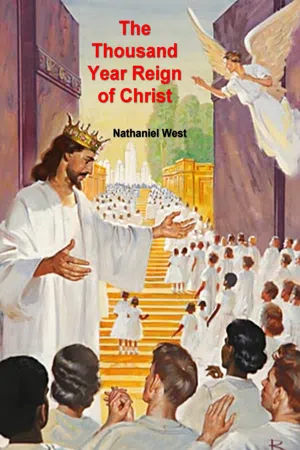
- English
- ePUB (mobile friendly)
- Available on iOS & Android
eBook - ePub
The Thousand Year Reign of Christ
About this book
Information
Topic
Theology & ReligionSubtopic
Biblical Studies The Thousand Year Reign of Christ
by
Nathaniel West
PART 1
It is a very common opinion, widely spread throughout Christendom, and in most cases believed to be true, that “the thousand years” of which John speaks in the Apocalypse, Rev. 20: 1-7, are mentioned nowhere else in the sacred Scriptures. The doctrine of a millennial kingdom on earth, introduced by the advent of Christ in His glory, is a Jewish fable without support from the word of God. A deeper study of the sacred volume dissipates this false prejudice and reveals the fact that, not only are “the thousand years” of which John speaks found everywhere in both Testaments, but that next to the eternal state, the millennial blessedness of God’s people on earth, and of the nations, is the one high point in all prophecy, from Moses to John, the bright, broad tableland of all eschatology. The prejudice against the study of a theme so sublime and far-reaching, and occupying so much space in the revelation of God has been pleased to give us, is as remarkable in our age, as [Page 2] it is inexcusable, although by no means surprising. To use the words of Prof. Van Oosterzee, “We cannot be surprised that the inner discrepancy between the modern theological philosophy and the prophetic and apostolic Scriptures should perhaps, on no point come forth so clearly, and apparently so irreconcilably, as precisely in reference to the doctrine of the ‘Last Things’ – Eschatology. Here, especially are the terms, ‘Jewish conception,’ ‘oriental garb,’ ‘poetic imagery,’ ‘accommodation to the narrow ideas of the age,’ etc., etc., the order of the day, and the doctrine of the consummation of the ages is ordinarily regarded as a moderately insignificant appendix to some philosophico-dogmatic system. In Scripture, on the contrary, it is distinctly presented in the foreground, and for the believer it attains, with every year and every century, increased significance, so that what for a time seems to be an appendix, becomes eventually the main question!” [ Person and work of the Redeemer, 450.]
Every faithful student of the Scriptures, unbiased by false theories of interpretation, will attest these words as true. What we find in the New Testament as its outcome in respect to the ages and thekingdom, has already lain in the bosom of the Old Testament from the beginning. The closing part of the New Testament is but the full flower of which the opening part of the Old Testament was the precious seed, the kingdom one and the same, in essence, all the way. Nothing appears in the latter revelation that was not hid in the earlier, nothing in John that was not in Moses. This is what Augustine meant by his golden maxim, “Novum Testamentum in Vetrere latet, Vetus in Novo patet.”“In the [page 3] Old Testament the New is concealed; in the New the Old is revealed.” We shall find “the thousand years” in many places of God’s word, long before the Rabbis ever had a being or a name.
We shall be obliged in this investigation to make use of what men call “technical” terms, in order to save circumlocution. We speak of the “Last Things.” The Greek term for this is “Eschata,” and by these are meant what should “come to pass,” not in the “latter,” as oftentimes King James’ version has it, but in the “last” days, as Moses, Joel, Isaiah, Ezekiel, Daniel, Peter, Paul and John, preferred to have it. If we study the eschatology of the Old Testament, we will find the Eschata there identical with the Eschata of the New Testament, and the Eschatology of both Testaments the same, only the New is more developed than the Old. Such is the organic and genetic character of revelation and of prophecy that if “the thousand years” are not in Moses, the Psalms, and the Prophets, they have no right to be in John. To understand the prophets it is necessary, however, to understand the Apocalypse, and to understand the Apocalypse it is necessary to understand the prophets. The one is light to the other, and reciprocally. In order to attain a clear conception of Old testament prophecy and its fulfilment, we must combine both Advents of Messiah, remembering that the first only brought the partial fulfilment of the prophetic word which yet awaits the second in order to secure itsplenary accomplishment.
Joel’s prophecy as to the outpouring of the Spirit in the last days, and of the great and notable day of the Lord, with all its terrestrial and celestial phenomena, the final redemption of Israel, and the transfiguration of the Holy Land, was only incipiently and partly [page 4] fulfilled to a few, an election out of Israel, at the first coming of Christ, and awaits a far larger fulfilment at His second appearing. So the prediction of Amos, in reference to the dispersion and sifting of Israel the “Sinful Kingdom,” and God’s visitation of the Gentiles, “after this,” to take out of them a people for His name, met a partial and precursive fulfilment in the first calling of the Gentiles to the knowledge of Christ, in the days of the apostles, as James in the first council at Jerusalem assures us. We see that by comparingActs 15: 13-18 with Amos 9: 8-12. But there is to be a grander fulfilment still in coming days, when, now that a Second Dispersion and Sifting of Israel has occurred, since James spoke, there shall be a fullness of the Gentiles “after this,” also, and finally the fallen Booth of David, or Israel’s proper Kingdom, as the prophets picture it, will be reerected with the fullness of Israel converted to God, and the glorious millennial age heave into view. So it is with reference to Isaiah’s Redeemer coming to Zion, and Hosea’s Israel abiding alone for many days, and Micah’s halting daughter of Zion to whom at length, comes the “former dominion.” Whatever occurred to Israel graciously, at the first coming of Christ, was only a preliminary fulfilment to be exhaustively completed for Israel, at His second coming. Such is the law of prophecy and the law of fulfilment, and it will save us from many an error, if only we are careful to remember it.
THE KINGDOM AND PROPHECY.
From first to last, the kingdom of God on earth, its inception, progress, conduct, and consummation in glory, is the one theme of Old Testament prophecy. To this end were the converts with Christ, Adam, [page 5] Noah, Abraham, Israel and David. To this end was the choice of the one national “Israel,” the “choice forever,” as a prophetic, priestly, kingly nation, a messianic and mediatorialnation, the one national “Servant of Jehovah,” and national Son of God, standing between God and mankind, and bringing salvation to a lost world; a people from whom should come the one personal “Israel,” Prophet, Priest and King, the one Mediator and true Messiah, Seed of the woman, Seed of Abraham, Seed of David, Son of Man and Son of God, in whom all nations should bless themselves –Jesus Christ. Identified with Him, individually, and called by His name, stands Israel collectively, in His whole Messianic work and kingdom. Neither acts without the other. The Pentateuch prophecies refer chiefly to the people. The Messianic Psalms emphasize the King, the Kingdom, and the Priest. Isaiah dwells upon the prophetic character of Israel; Ezekiel displays the priestly; Daniel reveals the kingly; Zechariah blends all in one. Old Testament prophecy knows no other subjects of discourse than these, Israel, Messiah, and the Nations. As to the kingdom, Israel had it, under the Old Testament, in its outward form; the Gentiles have it under New Testament, in its inward form;in the age to come, Jews and Gentiles together, shall have it, both forms in one, one kingdom of Messiah, spiritual, visible and glorious, with Israel still the central people, the prelude of the New Jerusalem and the nations walking in its light forever.
The division of the Davidic kingdom into two, laid the ground for all the prophecies concerning the “Kingdom of Israel” and the “Kingdom of Judah,” i.e., the ten-tribed Israel, called “Ephraim,” and the two-tribed Israel, called “Judah,” as distinguished from “all [page 6] Israel,” or the twelve-tribed Israel, an election from those children shall one day form the national nucleus of the millennial kingdom.
The catastrophe that brought destruction to Jerusalem and captivity to Judah under the ChaldeanKing, forms the ground of the common destruction of the canonical prophets into their present classification. The Babylonian exile is the middle point. If we study the prophecies that speak of theKingdom of Messiah, Israel’s kingdom, the Millennial Kingdom, and the relation of the nations to each, - all as parts of the Kingdom of God on earth, - we shall take in all the prophets. If we group these around the several great epochs of Israel’s history, they will fall into three main divisions, (1), pre-exile prophets (2), exile prophets (3), post-exile prophets. Or, to be still more specific, they will fall into five chief divisions: (1) The pre-Assyrian, viz., Obadiah, Joel, Jonah; i.e., the prophets of the period prior to the Assyrian invasion and captivity of Israel; (2), The Assyrian, viz., Amos, Hosea, Isaiah, Micah, Nahum: (3) The transition prophets, viz., Zephaniah and Habbakuk; (4) The prophets of the Chaldean period, viz., Jeremiah, Ezekiel, Daniel; (5) the Persian period, or period of the Restoration down to the close of prophecy, viz., Haggai, Zechariah, Malachi. Sixteen in all; all speaking of the Kingdom of God and its development through Israel in relation to the nations, amidst conflicts and victories, judgment and mercy, apostasy and recovery, until the whole world becomes subject to Israel and Israel’s king.
As a further help to our investigation, it is necessary we should know that the Kingdom of God, in its development, though one, exists in different forms, and runs through various ends of ages. Essentially, it is one. [page 7] Phenomenally, it is many. It is singular and plural, both. It is an everlasting kingdom in its essence. It is a temporal kingdom in its forms. It exists forever. The Dispensations pass away. The Kingdom still abides. New forms emerge along the ages until the endless age arrives, and the final form appears. And yet more. With the outer historic development of prophecy as well as of history, an inner genetic development runs parallel. The original propheticgrem, found in the first promise in the garden, true to scientific law, parts itself into law and gospel, divides, expands, and assumes more ample and concrete forms. What is at first most general,becomes particular. What is obscure becomes more clear. The ages and the ends are evolved according to the same law of “becoming,” which obtains in the natural world, viz., by division and integration. The result from all is that, as prophecy advances, what is folded up darkly, at first, is opened out in clearer and distincter statement later on. The ages and the ends come more definite. The later predictions explain the earlier ones. And, along this line of divine evolution, as there is no “spontaneous generation” in the kingdom of God, so there is no “transmutation of species.” God alone creates. Israel, the created people of God, abides Israel, and the history of Israel is not a mere frame in which to hang pictures of the New Testament Gentile church. The kingdom is ever the kingdom, one sided for Israel alone in time past, one sided for the Gentiles alone now, outward in the one case, inward in the other, but both sided for both in one, hereafter, Israel evermore the root, the centre, organic basis, and ground of all. By observation of this, we learn the characteristic differences between pre-exile prophecy on the one hand, and exile with post-exile prophecy on [page 8] the other. It is precisely along this line of development we detect the evolution of the ages in prophecy itself, and are obliged to hold that Prophecy as well as History as an “organism,” as is Nature, the kingdom and the Church – the one a parable of the other – “natural law in the spiritual world;” and “spiritual law in the natural world,” in short, as Newton showed, a system of universal and identical laws producing analogous phenomena in different spheres. Where there is life there is law. It is precisely along this line of study of the Word of God, we discover not only a description of the Millennial Kingdom yet to be, but are able to detect the relative location of the millennial age itself, even in Old Testament prophecy, and find it exactly as the Apostle John has pictured and located it – its character, its name, its measure, and the events by which it is opened and closed. The existence of “the 1,000 years” in the Old Testament is a matter of scientific demonstration, as truly as the existence of any geological age in the history of the planet, and is supported by an exegesis, grounded in the organic unity and continuity of prophecy in both Testaments, that is unassailable. It is another proof of the truth of the golden saying of Augustine, “The New Testament lies concealed in the Old, the Old stands revealed in the New.”
The six pre-exile prophets form a connected chain ending with Nahum. Of these, Isaiah is the chief, his radius of vision spanning all horizons, near, remote, and between and losing itself in the breast of eternal glory. He sees all things, however, in one divine perspective, one divine light, one divine picture, Messiah the centre of all, Israel around Him, the Nations around both. The ends and ages are all confounded in the [page 9] first end, and the age following. All is a composite photography, the events standing cheek to cheek, which only later prophecy can separate. On the earlier prophets, the exile and post-exile prophets rest as on sure ground, the spirit of prophecy being one. Their office is not to transcend, but develop, the earlier. What Isaiah was to the earlier, Daniel was to the later. He bequeaths to them, and to us, the great problem of the Millennial Age, whose epoch Isaiah, Micah, and Ezekiel, have fixed, the problem of Israel’s final future and relation to the nations, with Israel’s history between the return from exile, and Israel’s final redemption in the glory of the Kingdom at Messiah’s second coming. Its solution is given, also, in the various visions of the four empires, four beasts, and seventy weeks, whose last week is rent off from the rest in fulfilment, the Roman times of the Gentiles lying between – a seventieth week wholly eschatological, the basis of the seals, trumpets and vials in John’s Apocalypse. The same problem appears in another form to the night visions of Zechariah, Haggai’s shaking of the nations, and Malachi’s burning day, whose close is crowned with healing from the sun of righteousness. The solution of the great problem of Israel’s future, spring from the breach in David’s Kingdom, is the solution of the problem of the Millennial Kingdom, and comes with Israel’s future acceptance of David’s Son as their Lord, the closing up of the ancient breach in David’s Kingdom, the union of Israel and Judah in one nation, on the mountains of the fatherland forever; - in short, Israel a converted people and nation, acknowledged by Christ in person, the nations applauding. With that consummation, after judgments and mercies unknown before, and the revelation of Christ Himself [page 10] in His glory, dawns the Millennial Age. Search where we may, through all the prophets, this is the one theme, the redemption of Israel, after judgment has fallen on both, Christ the glory of all. It is the time of the “Kingdom restored toIsrael.” Search where we may, we shall nowhere find unveiled the mystery of the New Testament “Church.” See Rom. 16: 25. 1Cor. 2: 7, 8. Wph. 3: 8, 9. Col. 1: 24, 27. Nor does the disclosure of this, in the New Testament, avail to destroy the prophetic word of the Old in reference to Israel, or abolish the standing contrast in the Old between Israel and the Nations, or in the New betweenIsrael, the Nations, and the Church.
It is among the “Eschata,” or “Last Things,” the things to “come to pass in the last days,” or “End Time,” that we find the Millennial Age. It lies, as we shall see, between the “Yom Yehovah,” or “...
Table of contents
- Start
Trusted by 375,005 students
Access to over 1.5 million titles for a fair monthly price.
Study more efficiently using our study tools.
Frequently asked questions
Yes, you can cancel anytime from the Subscription tab in your account settings on the Perlego website. Your subscription will stay active until the end of your current billing period. Learn how to cancel your subscription
No, books cannot be downloaded as external files, such as PDFs, for use outside of Perlego. However, you can download books within the Perlego app for offline reading on mobile or tablet. Learn how to download books offline
Perlego offers two plans: Essential and Complete
- Essential is ideal for learners and professionals who enjoy exploring a wide range of subjects. Access the Essential Library with 800,000+ trusted titles and best-sellers across business, personal growth, and the humanities. Includes unlimited reading time and Standard Read Aloud voice.
- Complete: Perfect for advanced learners and researchers needing full, unrestricted access. Unlock 1.5M+ books across hundreds of subjects, including academic and specialized titles. The Complete Plan also includes advanced features like Premium Read Aloud and Research Assistant.
We are an online textbook subscription service, where you can get access to an entire online library for less than the price of a single book per month. With over 1.5 million books across 990+ topics, we’ve got you covered! Learn about our mission
Look out for the read-aloud symbol on your next book to see if you can listen to it. The read-aloud tool reads text aloud for you, highlighting the text as it is being read. You can pause it, speed it up and slow it down. Learn more about Read Aloud
Yes! You can use the Perlego app on both iOS and Android devices to read anytime, anywhere — even offline. Perfect for commutes or when you’re on the go.
Please note we cannot support devices running on iOS 13 and Android 7 or earlier. Learn more about using the app
Please note we cannot support devices running on iOS 13 and Android 7 or earlier. Learn more about using the app
Yes, you can access The Thousand Year Reign of Christ by Nathaniel West in PDF and/or ePUB format, as well as other popular books in Theology & Religion & Biblical Studies. We have over 1.5 million books available in our catalogue for you to explore.