The companion series to renowned theologian Herman Bavinck's Reformed Dogmatics masterwork
Herman Bavinck's four-volume Reformed Dogmatics is one of the most important theological works of the twentieth century. The English translation was edited by leading Bavinck expert John Bolt, who now brings forth a recently discovered manuscript from Bavinck that is being published for the first time.
Serving as a companion to Reformed Dogmatics, Reformed Ethics offers readers Bavinck's mature reflections on ethical issues. This second volume covers the duties of the Christian life and includes Bavinck's exposition of the Ten Commandments.
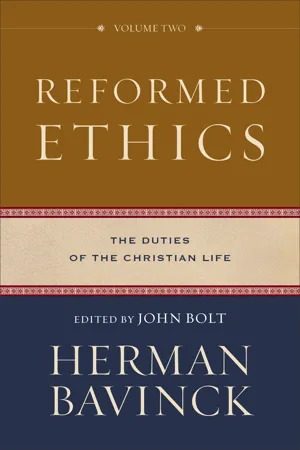
eBook - ePub
Reformed Ethics, Volume 2 : Volume 2 (Reformed Ethics)
The Duties of the Christian Life
- 544 pages
- English
- ePUB (mobile friendly)
- Available on iOS & Android
eBook - ePub
Reformed Ethics, Volume 2 : Volume 2 (Reformed Ethics)
The Duties of the Christian Life
About this book
Information
Subtopic
Dénominations chrétiennesPart A: Our Duties toward God
15
No Other Gods; No Images
The straightforward meaning of the First Commandment is that no other gods are to be kept as gods either instead of or next to YHWH and honored as such. The commandment thus prohibits idolatry and polytheism, heretical views of God such as Arianism, and self-justifying philosophical constructs of God by intellectuals, as well as the practical idolatry of which all are guilty who put their trust in something other than God.
The commandment also forbids superstitious attribution of power to words, things, or customs to deflect evil or obtain something good which they possess neither by nature nor according to God’s word. This includes thoughts of and belief in superhuman, supernatural powers and forces, ghosts, witches, omens, and the like. People either act in accordance with such beliefs or suffer under and from fear arising from these beliefs. Superstition is always pagan, either a remnant from a pagan past or a feature of a revived new paganism. Such superstition can be objective—imaginary and false ideas about God and the supernatural world—or subjective. In the latter case human beings claim to have in their possession and at their disposal spiritual powers that can control or employ God, fate, or other spiritual entities. This is called sorcery and also magic, and Scripture warns extensively against it. The confrontation between God and Pharaoh shows the power and the limits of sorcerers. King Saul’s encounter with the medium of Endor showed that the practice of sorcery and divination had not entirely been eradicated in Israel. We also read about sorcerers in Babylon (Daniel), and in the book of Acts we find several accounts of such practices. The Christian church acknowledges the reality of evil powers and human cooperation with such powers to do extraordinary things. But Holy Scripture strongly condemns all this magic and fortune-telling in many passages in both the Old and New Testaments.
Although Roman Catholic teaching distinguishes the adoration and worship that is due only to God from the invocation and veneration due to saints and angels, Protestants insist that the practice of Roman Catholics does not adequately avoid breaking the First Commandment. Angels and saints are entitled to conventional honor, but the popular piety of Roman Catholics involving pleading for all sorts of good, for mercy and healing, and the like, does look like religious adoration and risks discounting the position of Christ as Mediator.
Positively, the First Commandment prescribes faith and hope in and love for the Triune God: Father, Son, and Holy Spirit. Faith involves knowledge and trust. Faith-knowledge is both intellectual and moral; the child of God desires to know who God is and how he is to be served. To know God truly is to trust him, to rely on him for everything, to rest in the One who is completely faithful. Hope is that virtue by which we unquestionably and surely anticipate God’s future blessings, especially the future completion of our salvation. The object of hope is God’s promises and their fulfillment and leads to patient endurance and confession. Love follows faith and is its echo; in faith we receive, in love we give to God and to our neighbor.
The First Commandment deals with the true God; the Second Commandment deals with the true religion. It teaches us how we must worship God, according to his will and command. In accord with God’s spiritual being, such worship must be spiritual and not symbolic, using images. Aversion to images and to the visual arts arose among Jews after the return from exile and captivity and may have been transferred to individual Christians in response to the idolatrous art of the pagans. The early Christian church did not share this opposition, and Christian art can be found in places like the catacombs. However, paintings were not tolerated in churches until the fourth and fifth centuries, when they were introduced as “books for the laity.” Veneration of relics arose during the same time, leading to iconoclastic controversies, especially in the Eastern Church. Iconoclastic initiatives can also be found in the Western Church, but the Roman Catholic Church approved the placement and veneration of images and relics in churches at the Council of Trent. The veneration of such objects is justified as a veneration of the persons they represent and as a necessary teaching aid for the laity. It is noteworthy that the medieval church opposed laity reading Scripture on their own and strictly controlled all translations of the Bible into the vernacular.
There are good reasons for prohibiting images of the Triune God. First, it is impossible because God absolutely cannot be depicted. It is also insulting to God because all images are depictions of creatures, physical bodies: temporal, corruptible, works of sinful human beings. Images “exchange the glory of the immortal God for images resembling mortal man and birds and animals and creeping things” (Rom. 1:23). Idols are also destructive; they tempt people to superstition and vain imaginations that corrupt human souls and bodies.
The commandment does not rule out depictions of spiritual beings such as angels nor the use of symbolic or emblematic imagery (such as an eye within a triangle) that points to God or one of his attributes. What about portraits of Christ? Portraying Christ onstage should be ruled out because it is impossible to portray the whole living Christ. Paintings or sculptures only portray a single aspect of Christ’s being and are a different matter. Of course, Holy Scripture does speak about God in an anthropomorphic manner; it cannot do otherwise. We must, however, distinguish between thinking about God and imagining God. A conception of God is permissible, but not a material representation or imaginative construct, since representation always requires sensory, perceptible, physical forms, while thinking abstracts from all those forms and retains only the pure thoughts.
Arguments used by Roman Catholics to defend the veneration of images and relics depend on the key distinction between religious worship (latreia) and veneration (douleia). These distinctions do not pass the test of careful biblical exegesis. The Heidelberg Catechism provides a beautiful response to the Roman Catholic claim that images are necessary as “books for the laity”: “God wants the Christian ...
Table of contents
- Cover
- Half Title Page
- Title Page
- Copyright Page
- Dedication
- Contents
- Editor’s Preface
- Abbreviations
- Book III: Humanity after Conversion
- 13. Duties, Precepts and Counsels, Adiaphora
- 14. Collision and Classification of Duties
- Part A: Our Duties toward God
- Part B: Our Duties toward Ourselves
- Part C: Duties toward Our Neighbor
- Bibliography
- Selected Scripture Index
- Name Index
- Subject Index
- Cover Flaps
- Back Cover
Trusted by 375,005 students
Access to over 1.5 million titles for a fair monthly price.
Study more efficiently using our study tools.
Frequently asked questions
Yes, you can cancel anytime from the Subscription tab in your account settings on the Perlego website. Your subscription will stay active until the end of your current billing period. Learn how to cancel your subscription
No, books cannot be downloaded as external files, such as PDFs, for use outside of Perlego. However, you can download books within the Perlego app for offline reading on mobile or tablet. Learn how to download books offline
Perlego offers two plans: Essential and Complete
- Essential is ideal for learners and professionals who enjoy exploring a wide range of subjects. Access the Essential Library with 800,000+ trusted titles and best-sellers across business, personal growth, and the humanities. Includes unlimited reading time and Standard Read Aloud voice.
- Complete: Perfect for advanced learners and researchers needing full, unrestricted access. Unlock 1.5M+ books across hundreds of subjects, including academic and specialized titles. The Complete Plan also includes advanced features like Premium Read Aloud and Research Assistant.
We are an online textbook subscription service, where you can get access to an entire online library for less than the price of a single book per month. With over 1.5 million books across 990+ topics, we’ve got you covered! Learn about our mission
Look out for the read-aloud symbol on your next book to see if you can listen to it. The read-aloud tool reads text aloud for you, highlighting the text as it is being read. You can pause it, speed it up and slow it down. Learn more about Read Aloud
Yes! You can use the Perlego app on both iOS and Android devices to read anytime, anywhere — even offline. Perfect for commutes or when you’re on the go.
Please note we cannot support devices running on iOS 13 and Android 7 or earlier. Learn more about using the app
Please note we cannot support devices running on iOS 13 and Android 7 or earlier. Learn more about using the app
Yes, you can access Reformed Ethics, Volume 2 : Volume 2 (Reformed Ethics) by Herman Bavinck, John Bolt in PDF and/or ePUB format, as well as other popular books in Théologie et religion & Dénominations chrétiennes. We have over 1.5 million books available in our catalogue for you to explore.