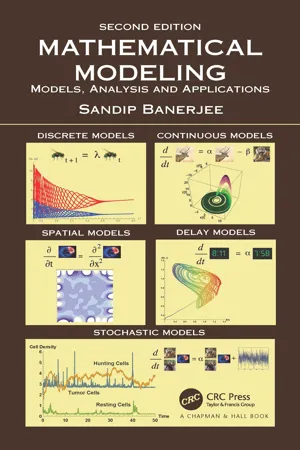
Mathematical Modeling: Models, Analysis and Applications, Second Edition introduces models of both discrete and continuous systems. This book is aimed at newcomers who desires to learn mathematical modeling, especially students taking a first course in the subject. Beginning with the step-by-step guidance of model formulation, this book equips the reader about modeling with difference equations (discrete models), ODE's, PDE's, delay and stochastic differential equations (continuous models). This book provides interdisciplinary and integrative overview of mathematical modeling, making it a complete textbook for a wide audience.
A unique feature of the book is the breadth of coverage of different examples on mathematical modelling, which include population models, economic models, arms race models, combat models, learning model, alcohol dynamics model, carbon dating, drug distribution models, mechanical oscillation models, epidemic models, tumor models, traffic flow models, crime flow models, spatial models, football team performance model, breathing model, two neuron system model, zombie model and model on love affairs. Common themes such as equilibrium points, stability, phase plane analysis, bifurcations, limit cycles, period doubling and chaos run through several chapters and their interpretations in the context of the model have been highlighted. In chapter 3, a section on estimation of system parameters with real life data for model validation has also been discussed.
Features
- Covers discrete, continuous, spatial, delayed and stochastic models.
- Over 250 illustrations, 300 examples and exercises with complete solutions.
- Incorporates MATHEMATICA® and MATLAB®, each chapter contains Mathematica and Matlab codes used to display numerical results (available at CRC website).
- Separate sections for Projects. Several exercise problems can also be used for projects.
- Presents real life examples of discrete and continuous scenarios.
The book is ideal for an introductory course for undergraduate and graduate students, engineers, applied mathematicians and researchers working in various areas of natural and applied sciences.