Busyness is a sickness of the soul that affects many today—and it is especially detrimental to young people, who are finding their identity shaped by ongoing resume-building, constant digital communication, and unceasing activity. The last thing they have time for is rest. But rest—Sabbath—is necessary for youth, not just because of who they are socially, emotionally, and physiologically, but because of who God has made them to be and wants them to be.
Nathan Stucky shows that rest challenges youth whose identities are rooted in productivity, efficiency, achievement, and accomplishment. For them, the notion of Sabbath grace both appeals and disorients. Yet through the Sabbath, God invites young people into an identity rooted and grounded in the grace, life, and provision of God. Wrestling with Rest offers biblical and practical advice for helping youth to discover their God-given identity, in which they can truly find rest.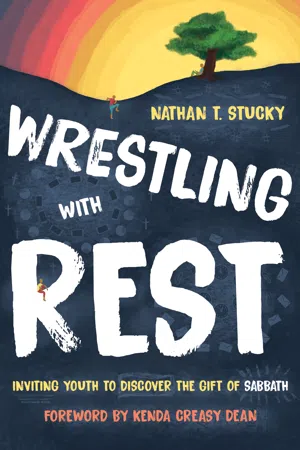
- 224 pages
- English
- ePUB (mobile friendly)
- Available on iOS & Android
eBook - ePub
About this book
Information
Topic
Theology & ReligionSubtopic
Christian Ministry1Wrestling with Rest:
Whoever Said This Was Easy?
Whoever Said This Was Easy?
A Day in the Life of Danny: Blessed Busyness
Danny doesn’t have much time for rest, but he doesn’t seem to mind.
I met Danny a few years ago, when he was a senior in high school and I was leading a retreat for his youth group. Danny lives in a town close enough to Washington, DC, to allow his parents to commute, yet far enough away for farms, orchards, and livestock to dot the countryside nearby. Danny is tall and slender, understated and confident. He is well-liked by his peers and a clear leader in his youth group. He loves his friends and is an accomplished musician.
Like many young people his age, school, sports, rehearsals, college prep, and friends keep Danny’s schedule full. He’s learned to manage his time carefully, prioritize wisely, and limit leisure as he pursues a host of lofty goals.
In a single day, Danny juggles AP Environmental Science, AP Psychology, AP Calculus, Intro to Engineering, an online business development course, his application to MIT, rehearsal for a performance at the Kennedy Center, a lacrosse fundraiser, and over three hours of practicing music. In the midst of this busy day, Danny still finds time to pack for an upcoming youth retreat, touch base with friends, and go to the dentist.
Danny is a devoted member of his hometown United Methodist Church, which offers an excellent youth music program that has allowed Danny to participate in youth choirs and orchestras throughout his childhood. The youth choir sings each Sunday during worship and travels on a much-anticipated choir tour each spring.1
Danny pursues excellence in all he does, and his church’s music program provides yet another outlet for expressing this passion and discipline. Danny’s many commitments demand a lot, but he doesn’t seem to mind. On the contrary, he wears his busy schedule like a badge of honor. Yet what remains unclear in Danny’s life is whether any distinction can be made between the rhythm of life that functions at his church, and the rhythm of life that emerges from the opportunities and demands of Danny’s life in school, on the playing field, and on the stage.
Danny’s life overflows with good things and good opportunities, which all contribute to an extraordinarily full schedule that the church and society generally applaud. Is this as it should be? Are we right to assume that a full schedule equals a life well-lived? Should the rhythm of the life of the church be distinct from the rhythms—or arrhythmias—of a hyper-connected, consumption-driven society? If so, on what basis?
The degree to which Danny’s church contributes to and promotes a rhythm of life which knows no ceasing leads to distinctively theological questions. What does all this time on the go say about Danny’s and Danny’s church’s understanding of who God is? What image of God does such a rhythm suggest? Danny’s church takes great pride in its musical program for youth. The leaders among the youth are the ones who are most involved. His church appears to equate greater involvement and increased activity with superior faithfulness. In other words, the norms at Danny’s church suggest that the more faithful you are, the busier you’ll be.
Does Danny ever question how constant activity influences his understanding of who God is? Is this what faithfulness to God is supposed to look like? Does he ever question the influence of constant activity on his own identity? Does Danny’s church ever help him ask such questions, or are Danny and his fellow youth left to assume that the life of faith is a life of continuous motion?
The roots of the word “Sabbath” literally mean “to desist” or “to stop,”2 yet Danny loves to be on the go. He loves his full schedule, and his church loves to fill it. So, how can Danny know a relationship with God which regularly includes Sabbath rest when his church seems to only echo the broader society in its encouragement to go, go, go?
Texting with Cliff3
Cliff is a sophomore at Silver Academy. Like the vast majority of American teens, Cliff texts to stay connected with others.4 Texting lets Cliff communicate with his friends virtually all the time, yet Cliff realizes that this isn’t always a good thing. He recognizes that, in sociologist Sherry Turkle’s words, texting “generates its own demand.”5 Though texting lets Cliff get a message instantaneously to his friends, a received text demands a response with similar promptness. Cliff sums up things succinctly—“Texting is pressure”—and he struggles to imagine a scenario where it would be okay to fail to respond to a text. “Ten minutes, maximum,” is how Cliff responds to a question about how much time he has for sending a reply.
At first glance, Danny and Cliff appear to lead very different lives. We don’t read about Cliff’s hyper-scheduled life, and he never mentions any lofty vocational or educational goals. Danny seems to exercise great restraint when it comes to technology. Yet through the differences, a common theme emerges which stands in stark contrast to the Sabbath. In a very real sense, neither Danny nor Cliff ever stops. Cliff never escapes the pressure to text; Danny never steps out of his hectic schedule. In Danny’s case we questioned the implications of his endless activity on his understanding of and relationship to God. In Cliff’s case, we notice the irony of a technology that promises to keep people connected, but is being used in a way that ultimately fosters discontent and dissatisfaction.
Cliff feels no freedom to exercise his own ability to make decisions when it comes to texting. When asked about possible situations in which it would be acceptable to fail to respond to a text, he can think of only two: “Your class has a test. Or you lost your signal.”6 In both cases, the choice to not respond is imposed on Cliff. He doesn’t choose it for himself, and he seems incapable of imagining a scenario in which he would impose a limit on his ability to respond to a text.
Why does this matter? It matters because vibrant relationships depend on limits. In marriage, a person devotes herself to another, thus limiting every other relationship. In faith, God commands that we have no other gods before the one true God. When the limits are removed or ignored, relationships falter.
We catch a glimpse of this in both Danny and Cliff. While Danny’s schedule prevents him from knowing and experiencing God’s Sabbath rest, Cliff’s way of texting ironically prevents him from knowing satisfied relationships with his friends. What choice do Danny and Cliff have but to know some form of ceaselessness as inherent to their identities? What would it take for them to imagine rest as a God-given gift and integral rather than contradictory to who they are?
Sabbath: Disorienting Grace
This book is for anyone who has worked tirelessly in the hope that young people may know themselves as God’s beloved children. (It is also for anyone who has worked tirelessly to know her- or himself as a beloved child of God.) It raises a simple but identity-shaking question about our efforts and rest. We’ve been willing to work tirelessly on behalf of young people. But are we willing to rest on their behalf as well? If that question seems illogical or lazy, I hope you’ll keep reading. I’ve had that reaction, and I still struggle with it; but a real invitation—a divine and holy invitation—continues. It is the invitation to a Sabbath journey, a journey of work and rest, but one that happens to begin, in utterly disorienting fashion, with rest. We have said that we would do anything for the young people we love. But are we willing to recognize that there is work we were never meant to do?
I would caution the reader at the outset that this is not an easy journey. Though books on the Sabbath overwhelmingly use words like “rest,” “delight,” “pleasure,” “recreation,” and “rejuvenation,” such a Sabbath vocabulary fails to account for either young people’s anxious experience of rest or the anxiety and turmoil that frequently accompany the accounts of the Sabbath in Scripture. The Israelites in the wilderness struggle; the Pharisees struggle; Jesus seems to struggle; and Cliff and Danny struggle, too. The Sabbath journey challenges and disorients for very logical reasons. You see, if we’ve been staking our identity on the fact that we would do anything for our young people, yet through the Sabbath, God invites us to rest and recognize that our endless work can save neither ourselves nor our young, then the foundations of our identity are shaken. We struggle to know who we are.
I’m convinced this is precisely the point.
God’s invitation to us for Sabbath rest is an invitation to come and die. It’s an invitation that exposes the degrees to which we have trusted our work and ability more than we have trusted God, but then surprises us with the news that our truest identity never depended on what we could do or accomplish. If we’re willing to receive God’s gift of Sabbath rest—to die to identities founded on mere human efforts—we may rise anew to the realization that we are God’s beloved children. We may then find that our labor on behalf of the young people we love finds its bearings and roots not in our productivity or efficiency, but in God’s all-powerful grace.7
To begin grasping this, let’s explore three more Sabbath stories.
Story #1: Sue’s Sabbath
Sue Miller has known life—or rather, the lack of life—that results from an existence that knows no Sabbath rest. Sue grew up in southern California, with both her single mother and her grandmother raising her. Sue’s mom was a devoted Methodist who worked the night shift to make ends meet; Sue’s grandmother was a strong, spunky Mennonite from Minnesota who held vigorously to her faith. Every summer, Sue would fly to Minnesota to spend a month with her grandma, and every winter, Sue’s grandma would escape the cold Minnesota winters by spending two months with Sue and her mother in California.
Sue’s earliest impressions of the Sabbath all go back to her relationship with her grandmother. While Sue has no memory of her mother even using the word “Sabbath,” her grandmother never used the word “Sunday.” She only spoke of the Sabbath. “She was very legalistic—very, very legalistic.” The fact that her grandmother wouldn’t allow her to latch-hook on Sundays left a particularly strong impression.8 “This is the Sabbath. We don’t do this on the Sabbath.” As Sue entered adolescence, she found herself more and more dissatisfied with her grandmother’s legalism.
After giving birth at seventeen to her son, Alex, Sue followed the path of her own mother by juggling parenthood, education, and career. Sue earned her undergraduate degree in social work, and then spent the next dozen years raising Alex and working at a home for new and expecting teen moms. Half of those years included working an additional part-time job at a bank. In the midst of the demands of single parenthood and career, Sue managed to maintain the weekly rhythm of her own childhood and take Alex to church each Sunday. Looking back, she sees those Sundays neither as a continuation of her grandmother’s legalism nor as days of intentional Sabbath practice. It was just something she did.
During those years of raising Alex and pursuing a career in social work, Sue also discerned a call to ministry. The year after Alex graduated from high school, Sue headed for seminary. Her experience with young people in social work, her gifts for ministry, and her strong mind led her to attend a well-respected, East Coast seminary that had a reputation for combining academic rigor and passion for the church. Her first semesters proved to be more of a challenge than she had anticipated.
In spite of the fact that Sue quickly made friends with a few other seminary students, she consistently found herself suffering from impostor syndrome.9 She felt like a fraud. In the context of other strong students and in the midst of trying to learn unfamiliar theological terms and ideas, Sue constantly felt insufficient and out of place. She would walk into the seminary dining hall, scan the crowd, and think, “Everybody in this room knows more theological language than I do; they know more about the Bible than I do; they know more about—I don’t know, fill in the blank, than I do, and in order for me to fit in or to belong here, I need to read every single thing so I know even a little bit compared to these other people.”
Impostor syndrome virtually paralyzed Sue in both mind and body. She describes the experience vividly: “[I felt] constant anxiety. My chest was heavy; it was harder to breathe. It manifested itself in a way where my brain was constantly spinning, and I wasn’t even able to slow down and focus because I was so anxious . . . trying to appear like I belonged here.” Term papers made the symptoms all the more severe. In time, she found herself curled into the fetal position on her bed, contemplating how she would explain to her denomination why she had withdrawn from seminary. Had it not been for the intervention of her seminary friends, Sue suspects she wouldn’t have survived those first semesters. She says it felt like pursuing an identity she could never attain.
During Sue’s second year of seminary, she learned about an understanding of the Sabbath that starkly contrasted with her grandmother’s narrow legalism. This broader view of the Sabbath invited Sue to consider Sabbath not as a heavy-handed burden, but as an opportunity to receive and embrace gifts of rest, grace, and life from God. On this view, Sabbath provides an opportunity for God’s people to remember that their lives and their identities ultimately find their rooting and basis in God’s grace and provision, not in endless work.
In other words, Sue was reminded that her truest and deepest identity didn’t depend on how many books she had read or how well she knew different theologians or theologies. According to Sue, this broader view of the Sabbath “convicted and inspired” her as it opened her eyes to the insufficiency of her grandmother’s legalism—a view which in many ways reduced Sabbath to another example of endless human effort.
After a number of weeks of discernment and ongoing conversation, Sue realized what she needed to let go as her way of practicing the Sabbath. Sue decided she would radically trust God’s grace and practice Sabbath by letting go of the impostor syndrome. In some sense, her life had come to depend on the syndrome: it drove her identity as a student; it told her she could never be enough. Though it insisted that she always read, know, and do more, Sue never could have reached a point where she had read, known, or done enough. In this way, impostor syndrome cursed Sue by insisting that she constantly pursue an identity she could never attain. In other words, it held her captive. So, to practice Sabbath by letting go of the impostor syndrome meant “do[ing] something that I thought was going to be impossible.”
Sue committed to observing a twenty-four-hour, weekly Sabbath, and during her Sabbath she chose not to do homework and focused instead on building relationships. This practice wasn’t easy; it occasionally meant staying up until midnight on Saturday night and waking up early on Monday morning to finish homework. Sabbath practice in and of itself created some of its own anxiety, but it also opened up a vast space—a whole weekly, twenty-four-hour window—through which new life emerged. Suddenly, Sue had time to catch up with family back home; she savored dinner with friends; she attended church more prepared to worship; she took naps. She took naps!
Ultimately, the Sabbath opened a space for Sue to hear God’s affirmation of her identity in Christ—an identity that couldn’t be earned by endless work, an identity that upended the impostor syndrome, and an identity that had actually been hers all along. When I asked Sue what God had been doing in and through her Sabbath practice, she paused thoughtfully and then said, “Through the Sabbath I heard God tell me, ‘You are my beloved child.’ ”10
Sue’s Story Is a Church Story
If those of us in the church fail to listen carefully to Sue’s story, we may simply smile and feel good about the fact that she ultimately figured it out. But that would be a profound misunderstanding of both Sue’s story and the church’s place in it. Sue’s story should challenge the church to its core. In reality, her story has very little to do with her “figuring it out,” and everything to do with her realizing the limits of her own efforts—of what she could “figure out.” Sue allowed herself to be embraced by a God large enough to make space for both her work and her rest.
To suggest tha...
Table of contents
- Title Page
- Copyright
- Dedication
- Contents
- Foreword by Kenda Creasy Dean
- Acknowledgments
- Introduction
- 1. Wrestling with Rest: Whoever Said This Was Easy?
- 2. Rest Is for the Weak . . . and You’ll Die without It
- 3. Anxious for Rest . . . Anxious at Rest
- 4. On the Seventh Day, God Rested
- 5. Jesus and Sabbath
- 6. What Do We Do Now?
- Appendix: What Is Practical Theology?
- Notes
- Bibliography
- Index
Trusted by 375,005 students
Access to over 1.5 million titles for a fair monthly price.
Study more efficiently using our study tools.
Frequently asked questions
Yes, you can cancel anytime from the Subscription tab in your account settings on the Perlego website. Your subscription will stay active until the end of your current billing period. Learn how to cancel your subscription
No, books cannot be downloaded as external files, such as PDFs, for use outside of Perlego. However, you can download books within the Perlego app for offline reading on mobile or tablet. Learn how to download books offline
Perlego offers two plans: Essential and Complete
- Essential is ideal for learners and professionals who enjoy exploring a wide range of subjects. Access the Essential Library with 800,000+ trusted titles and best-sellers across business, personal growth, and the humanities. Includes unlimited reading time and Standard Read Aloud voice.
- Complete: Perfect for advanced learners and researchers needing full, unrestricted access. Unlock 1.5M+ books across hundreds of subjects, including academic and specialized titles. The Complete Plan also includes advanced features like Premium Read Aloud and Research Assistant.
We are an online textbook subscription service, where you can get access to an entire online library for less than the price of a single book per month. With over 1.5 million books across 990+ topics, we’ve got you covered! Learn about our mission
Look out for the read-aloud symbol on your next book to see if you can listen to it. The read-aloud tool reads text aloud for you, highlighting the text as it is being read. You can pause it, speed it up and slow it down. Learn more about Read Aloud
Yes! You can use the Perlego app on both iOS and Android devices to read anytime, anywhere — even offline. Perfect for commutes or when you’re on the go.
Please note we cannot support devices running on iOS 13 and Android 7 or earlier. Learn more about using the app
Please note we cannot support devices running on iOS 13 and Android 7 or earlier. Learn more about using the app
Yes, you can access Wrestling with Rest by Nathan T. Stucky in PDF and/or ePUB format, as well as other popular books in Theology & Religion & Christian Ministry. We have over 1.5 million books available in our catalogue for you to explore.