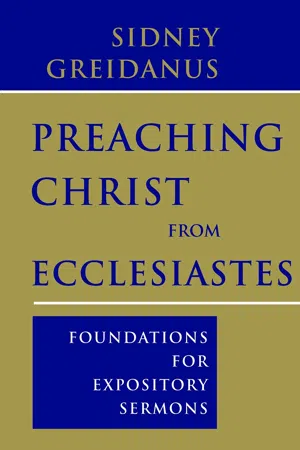
As Sidney Greidanus points out, the biblical book of Ecclesiastes is especially relevant for our contemporary culture because it confronts such secular enticements as materialism, hedonism, cut-throat competition, and self-sufficiency. But how can preachers best convey the ancient Teacher's message to congregations today?
A respected expert in both hermeneutics and homiletics, Greidanus does preachers a great service here by providing the foundations for a series of expository sermons on Ecclesiastes. He walks students and preachers through the steps from text to sermon for all of the book's fifteen major literary units, explores various ways to move from Ecclesiastes to Jesus Christ in the New Testament, and offers insightful expositions that help the preacher in sermon production but omit the theoretical and often impractical discussions in many commentaries.
- 376 pages
- English
- ePUB (mobile friendly)
- Available on iOS & Android
eBook - ePub
About this book
Information
Topic
Theology & ReligionSubtopic
Christian MinistryCHAPTER 1
Preaching Ecclesiastes
Vanity of vanities, says the Teacher,
vanity of vanities! All is vanity.
(Eccl 1:2)
Ecclesiastes may be the most difficult biblical book to interpret and preach. A major reason for this difficulty is that Old Testament scholars are not agreed on key issues: the number of authors involved in writing this book; the identity of the main author; when, where, and why the book was written; the quality of the Hebrew style; which sections are poetry and which are prose;1 the book’s structure, or lack thereof; and whether its message is pessimistic or positive.2 Duane Garrett adds, “Perhaps an even greater hindrance to preaching Wisdom is the suspicion many have that it contains no gospel.”3 Small wonder that many preachers consider it the better part of wisdom to omit Ecclesiastes from their preaching schedule. In fact, the Revised Common Lectionary assigns readings from Ecclesiastes for only two worship services: for New Year’s Eve (Years ABC), Ecclesiastes 3:1–13; and for the Sunday closest to August 3 (Year C), as an alternative to Hosea 11:1–11, Ecclesiastes 1:12–14 and 2:(1–7, 11) 18–23.4 Unfortunately, omitting Ecclesiastes from one’s preaching schedule is a major loss for the church.
The Value of Preaching Ecclesiastes
Ecclesiastes offers a unique perspective on human life—a perspective that is extremely relevant for the church today.5 Iain Provan observes, “In focusing our attention on this life rather than the next, indeed, this book contributes to the correction of an all-too-frequent imbalance throughout the ages in Christian thinking, which has sometimes presented Christianity as if it were more a matter of waiting for something than a matter of living.”6 Sandy and Giese state, “The Book of Ecclesiastes is one of the most important possessions of the Christian church, since it compels us to continually evaluate and correct our understanding of God and our teaching about God in the light of the whole of biblical revelation.… The reflections of the sage in Ecclesiastes unmask the myth of human autonomy and self-sufficiency and drive us in all our frailty and inability to find meaning in a crooked world in the Creator-creature relationship—the ultimate polarity.”7
Moreover, Ecclesiastes is relevant especially for our culture because it tackles many of the temptations posed by secularism. Leland Ryken calls Ecclesiastes “the most contemporary book in the Bible. Ecclesiastes is a satiric attack on an acquisitive, hedonistic, and materialistic society. It exposes the mad quest to find satisfaction in knowledge, wealth, pleasure, work, fame, and sex.”8
Before preachers can preach Ecclesiastes with integrity, however, they will have to gain some clarity on the difficulties with which commentators have struggled for more than two thousand years.9 We shall first explore difficulties in interpreting Ecclesiastes and next difficulties in preaching this book.
Difficulties in Interpreting Ecclesiastes
We shall discuss in turn five major issues in interpreting Ecclesiastes: the nature of wisdom literature, the historical setting of Ecclesiastes, its genre and forms, its structure, and its overall message.
The Nature of Wisdom Literature
One cannot rightly interpret and preach a text until one has taken into account its specific genre. Wisdom literature, like Hebrew narrative, Psalms, prophecy, and apocalyptic literature, is a specific literary genre. Therefore a key question is, What is the nature of wisdom literature? Elizabeth Achtemeier responds, “Wisdom is the result of practical experience and the careful observation of both the natural and human worlds. Out of all of the chaos of experience, Wisdom finds customary ‘orders’ in the world—ways in which human beings and natural phenomena ordinarily behave. Its aim, then, is to teach men and women these ‘orders,’ so they may know how to act in harmony with the world around them.”10 J. A. Loader observes similarly, “Wisdom is concerned with the correct ordering of life. Wise action is that which integrates people harmoniously into the order God has created. The rules of life that prescribe how human beings must integrate themselves into that order are the precepts of wisdom.”11
The Relation of Wisdom to Redemptive History
In contrast to other biblical genres, wisdom literature does not deal with the mighty acts of God. Graeme Goldsworthy observes that this does not mean that wisdom is “a self-contained and alternative way of looking at God and reality.” Wisdom, he states, “complements the perspective of salvation history. Indeed, we should go further than that and say that wisdom is a theology of the redeemed man living in the world under God’s rule. It is thus as much an aspect of kingdom theology as salvation history is.”12
There are also clear connections between Ecclesiastes and the beginning of redemptive history as recounted in the early chapters of Genesis. As Genesis 1 teaches that God is the sovereign Creator, so Ecclesiastes proclaims the sovereignty of God (3:14; 8:17). As Genesis teaches that God in the beginning set the times (day and night, 1:3–5) and upholds the seasons (8:22), so Ecclesiastes teaches that God has set the times (3:1–8) and “made everything suitable for its time” (3:11). As Genesis teaches that God created this world good (ṭôb, 7 times), so Ecclesiastes acknowledges that there is still good to be found in this world (ṭôb, e.g., 2:24; 3:12–13; 5:18). As Genesis teaches that God created human beings upright, so does Ecclesiastes (7:29). As Genesis (1:27; 2:15) teaches that human beings were created for fellowship with God, so does Ecclesiastes (12:13). Genesis further relates that human beings broke this relationship by rebelling against God (3:6), subsequently hiding from God (3:10), being driven out of the Garden of God (3:24), and suffering the penalty of living in a God-cursed creation (3:17) where meaningful work (2:15) would become toil (3:17–19) and where life would inevitably end in death (3:19, “You are dust, and to dust you shall return”). Ecclesiastes similarly speaks of our present distance from God (5:2), God’s curse on the earth (1:15; 7:13), the burden of human toil (1:3; 2:22), and the tragedy of death (3:20; 12:7: “The dust returns to the earth as it was”). Moreover, Genesis reveals that evil resides in the human heart (6:5) and that sin unchecked (4:7) leads to murder—the first victim appropriately named Abel (4:8, Hebel = vanity). Ecclesiastes, similarly, shows that evil dwells in human hearts (7:20, 29; 8:11; 9:3)—one of the reasons for its repeated declaration that “all is vanity” (hebel, 1:2; 12:8).13
In spite of these connections with Genesis and the beginnings of redemptive history, Ecclesiastes does not focus on God’s redemptive acts. Duane Garrett formulates the contrast this way: “Genesis tells the story of how humans—originally in a state of life, paradise, and innocence—fell into guilt, toil, and mortality. Ecclesiastes tells how persons now made weak and mortal should live.”14 William Brown observes, “Most conspicuous about the wisdom literature is its ‘ahistorical’ character. Strikingly absent among Proverbs, Job, and Ecclesiastes are the great themes of biblical history, such as the exodus, covenant, and conquest of the land. God’s role as deliverer and lawgiver, in turn, is scarcely mentioned in the wisdom traditions. Rather, emphasis is placed upon creation and humanity’s place in it.”15
This does not mean, however, that God is absent from Ecclesiastes. God is the great Creator (12:1) who made and still “makes everything” (11:5). God set the times and “has made everything suitable for its time” (3:11). God gave human beings their breath (12:7) and made them “straightforward [upright], but they have devised many schemes” (7:29). God made “the day of prosperity” as well as “the day of adversity” (7:14). God gives us “the days of life” (5:18; 8:15), “wealth and possessions,” and the ability “to enjoy them” and to “find enjoyment [even] in toil” (5:19; 6:2). God gives “wisdom and knowledge and joy” (2:26), as well as “the collected sayings” of wisdom (12:11). God wants people to enjoy life, “for God has long ago approved what you do” (9:7). God tests people (3:18), “has no pleasure in fools” (5:4), and can become angry (5:6). God holds people accountable for their actions and “will judge the righteous and the wicked” (3:16; 11:9; 12:14). Therefore people should “rejoice” in all their years (11:9), remember their “Creator” (12:1), “fear God” (3:14; 5:7; 7:18; 8:12), and “keep his commandments” (12:13).
Goldsworthy notes that wisdom, like salvation history, “finds its goal and fulfilment in Christ.… Three aspects of wisdom confront us in the New Testament. First, the Gospel narratives portray Jesus as the wise man who, in the form and content of many of his sayings, follows in the traditions of Israel’s wisdom teachers. Secondly, Jesus goes beyond this actually to claim to be the wisdom of God. Thirdly, certain New Testament writers … understand the meaning of Christ’s person and work in the light of certain wisdom ideas.”16
Contradictions
Several commentators have faulted Ecclesiastes for its contradictions. Compare, for example, the Teacher’s assertions, “I thought the dead, who have already died, more fortunate than the living, who are still alive” (4:2), and, “Whoever is joined with all the living has hope, for a living dog is better than a dead lion” (9:4). Or consider the contradiction within a single passage: “I know it will be well with those who fear God, because they stand in fear of him, but it will not be well with the wicked” (8:12–13), and, “There are righteous people who are treated according to the conduct of the wicked, and there are wicked people who are treated according to the conduct of the righteous” (8:14).
Contradictions, however, are natural in wisdom literature because life is complex.17 One of the clearest examples of contradictory advic...
Table of contents
- Cover
- Title Page
- Copyright
- Dedication
- Contents
- Preface
- Acknowledgments
- Abbreviations
- Transliterations
- 1. Preaching Ecclesiastes
- 2. No Gain from All Our Toil—Ecclesiastes 1:1–11
- 3. The Teacher’s Search for Meaning—Ecclesiastes 1:12–2:26
- 4. God Set the Times—Ecclesiastes 3:1–15
- 5. Working in a Wicked World—Ecclesiastes 3:16–4:6
- 6. Working Together—Ecclesiastes 4:7–16
- 7. Worshiping in God’s House—Ecclesiastes 5:1–7
- 8. The Love of Money—Ecclesiastes 5:8–6:9
- 9. How to Handle Adversity—Ecclesiastes 6:10–7:14
- 10. How to Act in a Paradoxical World—Ecclesiastes 7:15–29
- 11. Use Wisdom but Know Its Limitations—Ecclesiastes 8:1–17
- 12. Enjoy Life!—Ecclesiastes 9:1–12
- 13. Because of the Harm Inflicted by Folly, Use Wisdom!—Ecclesiastes 9:13–10:20
- 14. Take Risks Boldly but Wisely!—Ecclesiastes 11:1–6
- 15. Remember Your Creator!—Ecclesiastes 11:7–12:8
- 16. Fear God, and Keep His Commandments!—Ecclesiastes 12:9–14
- Appendixes
- Select Bibliography
Trusted by 375,005 students
Access to over 1.5 million titles for a fair monthly price.
Study more efficiently using our study tools.
Frequently asked questions
Yes, you can cancel anytime from the Subscription tab in your account settings on the Perlego website. Your subscription will stay active until the end of your current billing period. Learn how to cancel your subscription
No, books cannot be downloaded as external files, such as PDFs, for use outside of Perlego. However, you can download books within the Perlego app for offline reading on mobile or tablet. Learn how to download books offline
Perlego offers two plans: Essential and Complete
- Essential is ideal for learners and professionals who enjoy exploring a wide range of subjects. Access the Essential Library with 800,000+ trusted titles and best-sellers across business, personal growth, and the humanities. Includes unlimited reading time and Standard Read Aloud voice.
- Complete: Perfect for advanced learners and researchers needing full, unrestricted access. Unlock 1.5M+ books across hundreds of subjects, including academic and specialized titles. The Complete Plan also includes advanced features like Premium Read Aloud and Research Assistant.
We are an online textbook subscription service, where you can get access to an entire online library for less than the price of a single book per month. With over 1.5 million books across 990+ topics, we’ve got you covered! Learn about our mission
Look out for the read-aloud symbol on your next book to see if you can listen to it. The read-aloud tool reads text aloud for you, highlighting the text as it is being read. You can pause it, speed it up and slow it down. Learn more about Read Aloud
Yes! You can use the Perlego app on both iOS and Android devices to read anytime, anywhere — even offline. Perfect for commutes or when you’re on the go.
Please note we cannot support devices running on iOS 13 and Android 7 or earlier. Learn more about using the app
Please note we cannot support devices running on iOS 13 and Android 7 or earlier. Learn more about using the app
Yes, you can access Preaching Christ from Ecclesiastes by Sidney Greidanus in PDF and/or ePUB format, as well as other popular books in Theology & Religion & Christian Ministry. We have over 1.5 million books available in our catalogue for you to explore.