The first installment in a wide and deep constructive theology for our time
In
Christ and Reconciliation Veli-Matti Karkkainen develops a constructive Christology and theology of salvation in dialogue with the best of Christian tradition, with contemporary theology in its global and contextual diversity, and with other major living faiths.
Karkkainen's Constructive Christian Theology for the Pluralistic World is a five-volume project that aims to develop a new approach to and method of doing Christian theology in our pluralistic world at the beginning of the third millennium. Topics such as diversity, inclusivity, violence, power, cultural hybridity, and justice are part of the constructive theological discussion along with classical topics such as the messianic consciousness, incarnation, atonement, and the person of Christ.
With the metaphor of hospitality serving as the framework for his discussion, Karkkainen engages Judaism, Islam, Buddhism, and Hinduism in sympathetic and critical mutual dialogue while remaining robustly Christian in his convictions. Never before has a full-scale doctrinal theology been attempted in such a wide and deep dialogical mode.
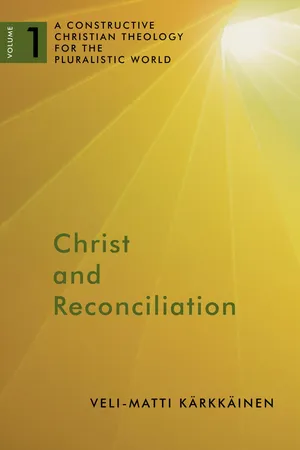
eBook - ePub
Christ and Reconciliation
A Constructive Christian Theology for the Pluralistic World, vol. 1
- 467 pages
- English
- ePUB (mobile friendly)
- Available on iOS & Android
eBook - ePub
Christ and Reconciliation
A Constructive Christian Theology for the Pluralistic World, vol. 1
About this book
Information
Topic
Theology & ReligionSubtopic
Christian TheologyI.
Christ
Few Christian theologians would oppose the claim that Christology, the doctrine of Christ’s person and work, lies at the heart of Christian theology. As the Roman Catholic John P. Galvin puts it succinctly: “While no theology can confine itself exclusively to Christology, no Christian theology would be complete without serious reflection on Jesus Christ.”1 The keen interest in christological topics is not only confined to traditional theological academia. As the Nigerian theologian and bishop John Olorunfemi Onaiyekan remarks, the claim that “Christology is at the very heart of all Christian theology . . . is particularly true for African Christian theology.”2
That said, the last two hundred years have also testified to ever-diversifying and intense debates about what is Christology, what are its main claims, and how to do Christology, so to speak, in the aftermath of modernity, and now in the dynamic matrix of modernity, postmodernity/later-modernity, globalization, and culture-religious diversity. The positive side effect of this debate has been an unprecedented interest and productivity in key christological topics, particularly in Protestant theology and, from the mid–twentieth century on, also in Roman Catholic theology.
In light of the short discussion on theological method in the introduction to this volume, it is a truism that there hardly is a chosen “method” of Christology. Proliferation of approaches, perspectives, and procedures is the order of the day. However — or perhaps: particularly for that reason — the theological investigation into Christology has to begin with some remarks on the “method.” In keeping with this methodological vision, the ensuing discussion of part I will begin with a careful look at the theological significance of Jesus’ earthly life and ministry, focusing on the importance of the messianic ministry in deeds, words, and reaching out to the marginalized of the society (chap. 2). An integral part of that discussion is the investigation of the theological meaning of Jesus’ earthly ministry in various local contexts such as in Africa and in varying life-situations and agendas, including those of women, black theologians, Latin American and other liberationists, as well as postcolonialists (chap. 3). Chapter 4 places the theological meaning of Jesus’ ministry and emerging confession of faith in his person within the wider Jewish messianic context and seeks connections with and distinctive features from the OT messianic expectations.
Before launching the lengthier discussion of standard christological topics stemming from creedal traditions, a focused reflection on the meaning of Chalcedon is in order (chap. 5). The Christian confession of the deity and humanity of Jesus Christ, based on the historical and theological claim of his resurrection, will occupy chapter 6; that discussion both affirms the material content of the classical creeds and seeks to revise it in light of contemporary systematic, historical, and biblical research. The interrelated topics of incarnation and kenosis, preexistence, virgin birth, and sinlessness will be studied next (chap. 7). Chapter 8 focuses on the relation of Christ to Spirit/Spirit to Christ and its implications for understanding the person and ministry of the Messiah.
In light of its importance to the discussion of religious plurality and pluralisms, the topic of incarnation will be taken up again in chapter 9 with the focus on contemporary Christian efforts both in the Global North and Asia to make Christian confession of the divine embodiment more inclusive and capable of linking with other faiths. While engagement of other living faiths, where relevant, takes place throughout the discussion of this volume (as well as the rest of the series), the last, long chapter will focus on specific and concentrated dialogues with Jewish, Islamic, Buddhist, and Hindu traditions. That dialogue will be taken up again at the end of part II of this volume. (The detailed plan for part II will be presented in the beginning of that section.)
1.
How to Do Christology
On the “Method”
The traditional methodological problem of Christology is simply this: “Should we begin with the basis in God and his initiative in sending the Son, or should we move on the plane of human reality, on which we must show that the event took place, if it really took place at all?”1 The Christology “From Above” as presented in the NT simply begins with lofty titles related to Jesus Christ expressing belief in the divinity. The postbiblical traditions culminating in the classic creeds conceive the uniqueness of Jesus Christ through the lens of the preexistent divine Son of God in relation to God himself. With the mind-set of the Enlightenment, prepared by the antitrinitarian and Socinian doubts toward the deity and preexistence of the Son, the Christology “From Below” emerged. In this approach, the historical Christ is the starting point and criterion.2 Whether it culminates in the confession of the deity — and thus becomes “From Below to Above”3 — was considered to be the matter of historical and critical investigation.4
The task of the From Below method is to test and justify christological statements by “inquiring into the actual inner necessity of christological developments in the NT and the continuation of this logic into the christology of the early church,”5 especially as expressed in the creeds of the undivided church. Obviously, such conclusions also help sort out views orthodox and heretical. Of particular interest to us is whether the confessions of Chalcedon and preceding councils faithfully and appropriately develop the testimonies, narratives, titles, and incipient creedal traditions of the NT; otherwise, we are forced to conclude with Adolf von Harnack and others that the development of tradition is nothing but the “deterioration of dogma.”6 While Harnack’s view is not followed by many in contemporary theology, there are weighty reasons why a From Below approach should not be abandoned: in the aftermath of the Enlightenment, merely affirming Jesus’ divinity without rational argumentation would mean theology’s capitulation before the court of reason; the uniquely Jewish and other historical bases of the person of Jesus would not be otherwise properly acknowledged; and, as Pannenberg puts it, a Christology From Above simply assumes “God’s point of view,” which is not accessible to us.7
The From Above approach is by no means the legacy of only the pre-Enlightenment noncritical tradition. It has had important followers in the twentieth century as well, even though for different reasons than tradition. In response to the failed nineteenth-century quest of the historical Jesus, which sought to establish the meaning of Jesus solely on the basis of historical knowledge, a counterproposal was raised to the effect of basing Jesus’ significance on the kerygma, the proclamation of the church.8 Rudolf Bultmann famously decried and dismissed any attempt to rest the assertion of faith on the shifting sands of historical evidence.9 In systematic theology, Barth similarly rejected all notions of historical evidence not only as something useless but also as counterproductive to what he took as the genuine notion of faith as trust.10 Behind this distancing from historical study was the influence of the “existentialist-before-existentialism,” Søren Kierkegaard’s distinction between the “religion of Socrates,” based on the immanence of the truth as self-knowledge, and the “religion of Jesus,” based on the work and person of the Savior and Redeemer who remains paradox. It is faith rather than reason that matters.11
The distinction between the two approaches is not either-or but rather both-and; “the two lines of argument from above and from below are complementary.”12 It is rather the matter of methodologically beginning from below toward constructing a high Christology acknowledging that “material primacy belongs to the eternal Son, who has become man by his incarnation in Jesus of Nazareth.”13 The obvious danger of From Above divorced from the history of Jesus is the violation of the biblical insistence on Jesus as the way to the knowledge of God (John 14:6). Otherwise, an abstract view of God emerges rather than the Father of Jesus Christ. The danger of one-sided From Below is that it can at its best discover a generic nature of humanity rather than thinking “in terms of the God of the revelation in Christ as the basis of its interpretation of the coming and the special history of Jesus.”14 This method easily dissolves into mere “Jesuology” that dismisses the preexistent and exalted Christ altogether. That said, we shouldn’t lose sight of the integral connection between anthropology and Christology15 — if the Christian claim to the coming to flesh of the divine Logos is to be true.16 On the other hand, for the divine Word rather than an elevated human consciousness or influence to become flesh, God is to be presupposed. Rather than being a matter of circular reasoning, it is the matter of reciprocal conditioning between theology and anthropology.17 This christological orientation is an indication of the profound connection of humanity to God as discussed in the context of theological anthropology.18 The mutual conditioning of From Below and From Above means that the historical investigation is in the service of the theological one. Moltmann puts it well, in keeping with his overall focus on the cross: “We shall attempt to achieve an understanding of the crucified Christ, first of all in the light of his life and ministry, which led to his crucifixion, and then in the light of the eschatological faith which proclaims his resurrection from the dead, and in so doing proclaims him as the Christ.”19 The mutual conditioning means to correct the long-standing bias in scholarship to “keep history and theology, or history and faith, at arm’s length from one another.”20
In this outlook, the old divide between the person and work of Christ also gets properly qualified. While the distinction should be maintained, it has to be maintained carefully and in a way that does not posit separation. Ontology and functionality cannot be distinguished in such a categorical way as older theology did, nor is it useful to do so. Who Jesus Christ is determines what he does; what he does reflects and grows out of who he is. The biblical t...
Table of contents
- Title Page
- Copyright Page
- Contents
- Abbreviations
- Preface
- Introduction: A Methodological Vision in a New Key
- PART I: CHRIST
- PART II: RECONCILIATION
- Epilogue: Continuing Methodological Miscellanea
- Bibliography
- Index of Authors
- Index of Subjects
Trusted by 375,005 students
Access to over 1.5 million titles for a fair monthly price.
Study more efficiently using our study tools.
Frequently asked questions
Yes, you can cancel anytime from the Subscription tab in your account settings on the Perlego website. Your subscription will stay active until the end of your current billing period. Learn how to cancel your subscription
No, books cannot be downloaded as external files, such as PDFs, for use outside of Perlego. However, you can download books within the Perlego app for offline reading on mobile or tablet. Learn how to download books offline
Perlego offers two plans: Essential and Complete
- Essential is ideal for learners and professionals who enjoy exploring a wide range of subjects. Access the Essential Library with 800,000+ trusted titles and best-sellers across business, personal growth, and the humanities. Includes unlimited reading time and Standard Read Aloud voice.
- Complete: Perfect for advanced learners and researchers needing full, unrestricted access. Unlock 1.5M+ books across hundreds of subjects, including academic and specialized titles. The Complete Plan also includes advanced features like Premium Read Aloud and Research Assistant.
We are an online textbook subscription service, where you can get access to an entire online library for less than the price of a single book per month. With over 1.5 million books across 990+ topics, we’ve got you covered! Learn about our mission
Look out for the read-aloud symbol on your next book to see if you can listen to it. The read-aloud tool reads text aloud for you, highlighting the text as it is being read. You can pause it, speed it up and slow it down. Learn more about Read Aloud
Yes! You can use the Perlego app on both iOS and Android devices to read anytime, anywhere — even offline. Perfect for commutes or when you’re on the go.
Please note we cannot support devices running on iOS 13 and Android 7 or earlier. Learn more about using the app
Please note we cannot support devices running on iOS 13 and Android 7 or earlier. Learn more about using the app
Yes, you can access Christ and Reconciliation by Veli-Matti Kärkkäinen in PDF and/or ePUB format, as well as other popular books in Theology & Religion & Christian Theology. We have over 1.5 million books available in our catalogue for you to explore.