- 240 pages
- English
- ePUB (mobile friendly)
- Available on iOS & Android
eBook - ePub
About this book
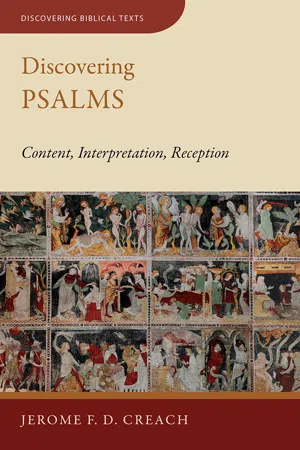
This compact introduction to the interpretation of the book of Psalms encourages in-depth study of the text and genuine grappling with related theological and historical questions by providing a critical assessment of key interpreters and interpretative debates. It draws on a range of methodological approaches (author-, text-, and reader-centered) and reflects the growing scholarly attention to the reception history of biblical texts, increasingly viewed as a vital aspect of interpretation rather than an optional extra.
Information
Print ISBN
9780802878069
Part 1
ISSUES IN READING THE PSALMS AND THE PSALTER
1
What is a psalm?
The word ‘psalm’ refers to a religious poem or song from Ancient Israel. Psalms were part of the Israelites’ public worship and private prayer. Therefore, it should not be a surprise that psalms appear in Old Testament narrative reports of Israelites praising God (Exod. 15.1–8) or calling on God for help (Jonah 2). The Hebrew prophets frequently include psalms to help convey their messages of judgement or hope (Isa. 44.23) or to plead with God on behalf of the people (Jer. 8.18—9.3). These and all other psalms in the Old Testament share many literary and stylistic features. The term ‘psalm’, however, has a special meaning when it applies to the poems and songs in the book we call ‘The Psalms’. This book is a deposit of religious poems and songs that now forms a distinct part of the canon for Jews and Christians. Although the poems in this book are in many ways like the prayers and songs that appear in narrative and prophetic sections of the Old Testament, they are part of a unique collection that became a distinct canonical book. The Church recognizes this book as perhaps its greatest spiritual resource and one of the most important sources of theology as well.
The distinctive place the book of Psalms occupies in Christian Scripture and tradition is due in part to its identity as a collection of model prayers and songs that give believers words to say in prayer and worship. While the psalm-like passages in narrative books appear as the prayers of particular characters – Moses (Deut. 33) and Hannah (1 Sam. 2.1–10), for example – those in the Psalms are uniquely our prayers. Even if we read them as people have for centuries as prayers of David, it is clear that David does not own them. Rather, he is our example and he offers the words to us to take up as our own.
Titles for the book
The expression ‘book of Psalms’ appears first in Acts 1.20 in Peter’s first address to the disciples after the Ascension of Jesus. By that time ‘Psalms’ had already become an accepted title for the collection and Christians recognized it as a canonical book (see Luke 24.44). ‘Psalm’ comes from a Greek term, psalmos, that refers to a song with musical accompaniment. The verbal root from which the word derives (psallo) means ‘to play a stringed instrument with the fingers’. This title appeared for the first time on a Greek manuscript in the fourth century CE (Codex Vaticanus). This Greek title, however, translates the Hebrew term mizmor, which appears in the titles of many individual psalms. The Hebrew word also refers to a song accompanied by stringed music. So, this most familiar title for the book refers to the collection of psalms as a songbook. Many interpreters have therefore called the Psalms ‘the hymnal of the Second Temple’.
Another common title for the book is Psalter, from the Greek word psalterion. This term refers to the lyre, the instrument David played to soothe Saul’s troubled spirit (1 Sam. 16.14–23) and the favourite of musicians in the Jerusalem Temple (1 Chron. 15.16, 21, 28; 16.5). A fifth-century manuscript, Codex Alexandrinus, uses this expression as the title for the Psalms, most likely because those who wrote the document thought these poems were songs meant for singing or performing.1
The Hebrew tradition gives a title that describes more the content than the purpose of the psalms in the book. It calls the collection sepher tehillim, which means ‘book of praises’. The Jewish philosopher Philo and the Jewish historian Josephus, both in the first century CE, translated this expression with the Greek word meaning ‘hymns’. It is curious that the Hebrew scribes and these two early interpreters used words that highlight praise as the purpose and character of the Psalms. Most of the psalms are in fact prayers that complain to God and petition God for help. So, in what sense is this book a ‘book of praises’? This label may come from the fact that the Psalter moves from complaints and prayers for help, which dominate the first part of the book, to psalms of praise that conclude it (Pss. 146—150).2 Or ‘praises’ may intend to capture the Psalter’s variegated expressions of faith, including doubt and lament, in a way that acknowledges all of it as appropriate address to God and in some sense as praise.
What is certain is that the titles of this book reflect the various uses of the Psalms for Jews and Christians. The Psalms are liturgy, song and prayer. In all their uses they give words for us to respond to God’s salvation with praise and thanksgiving and to cry to God for help when we are in trouble or grieving. As a book of Scripture, they also provide a rich resource for theology.
How many psalms?
Those who read the Psalms in English encounter 150 individual psalms. The answer to the question ‘How many psalms?’, however, is much more complex than our English translations let on. There are two dimensions to the problem. First, the Hebrew and Greek versions of the Psalms both have 150 psalms, but they come to that number in different ways. The primary Hebrew manuscript, known as the Leningrad Codex (which dates to 1008 CE; some now call it the St Petersburg Codex), has the arrangement of psalms that English translators follow today. Thus, the Hebrew tradition seems to present the same 150 psalms that we find in the Bible. The Greek version of the Hebrew Scriptures, sometimes called the Septuagint, however, divides some of the psalms differently. Assuming that the Hebrew order is the standard, the Greek version:
- combines Psalms 9 and 10 into one psalm;
- combines Psalms 114 and 115 into one psalm;
- divides Psalm 116 into two psalms (vv. 1–9, 10–19);
- divides Psalm 147 into two psalms (vv. 1–11, 12–20).
In addition, the Greek version includes an additional psalm (Ps. 151) that does not appear in the Leningrad Codex. A note attached to this psalm indicates it is ‘outside the number’. This note perhaps indicates an awareness that the final poem is not canonical.3 Thus, the familiar number of psalms appears in both traditions, but the Hebrew and Greek versions do not agree at every point on where one psalm ends and another begins. To complicate matters more, there are some psalms that appear as separate poems in both Hebrew and Greek even though they clearly read as one psalm. The best example is Psalms 42—43. Furthermore, some psalms material appears in more than one psalm. Psalm 14 is essentially the same as Psalm 53; Psalm 40.13–17(14–18) is also Psalm 70; and Psalm 108 is a combination of parts of Psalms 57 and 60. Each of these psalms is distinct, but the fact that some psalms material reappears complicates the question of how many psalms we have in the Psalter.
The second problem is that some ancient and medieval Hebrew manuscripts divide some of the psalms differently from the Leningrad Codex and the Greek version, and they even vary in the final number of psalms. Some of these manuscripts have as few as 147 psalms and others as many as 154.4 This problem stems in part from the fact that scribes who copied manuscripts by hand were more likely to divide some psalms into two and combine others. With the invention of moveable type in 1517 the order and number of psalms in the Psalter stabilized into what we now have in our Bibles.5 Most of the psalms in the collection develop clearly from beginning to end and divide naturally from the psalms around them. Nevertheless, the process of arriving at the 150 individual psalms we have in our Bible was not simple. The process of preserving and transmitting the Psalms should caution us against making definitive statements about the significance of the number and ordering of the psalms in the book.
Anatomy of a psalm
Most readers approach the Psalms one psalm at a time. The most familiar aspects of the Psalms are the particular verses such as ‘The LORD is my shepherd’ (Ps. 23.1) and ‘The stone that the builders rejected has become the chief cornerstone’ (Ps. 118.22). The individual psalms contain many other features, however, that may be less familiar and yet are important for understanding them. To explore the various elements of individual psalms we will begin with Psalm 6 as an example:
To the leader: with s tringed ins truments; according to The Sheminith. A Psalm of David.
1 O LORD, do not rebuke me in your anger,
or discipline me in your wrath.
2 Be gracious to me, O LORD, for I am languishing;
O LORD, heal me, for my bones are shaking with terror.
3 My soul also is struck with terror,
while you, O LORD – how long?
4 Turn, O LORD, save my life;
deliver me for the sake of your steadfast love.
5 For in death there is no remembrance of you;
in Sheol who can give you praise?
6 I am weary with my moaning;
every night I flood my bed with tears;
I drench my couch with my weeping.
7 My eyes waste away because of grief;
they grow weak because of all my foes.
8 Depart from me, all you workers of evil,
for the LORD has heard the sound of my weeping.
9 The LORD has heard my supplication;
the LORD accepts my prayer.
10 All my enemies shall be ashamed and struck with terror;
they shall turn back, and in a moment be put to shame.
The heading
The first item in Psalm 6 is a heading: ‘To the leader: with stringed instruments; according to The Sheminith. A Psalm of David.’ As scribes preserved the psalms, they often put information about the psalm at the beginning in a heading or superscription like this one. Nearly three-quarters of the psalms have such a heading. The headings are not part of the psalm proper, however, and they do not have a verse number in English. The lack of a verse number in English creates in some psalms a different verse number from that in the modern Hebrew edition used by scholars to translate the Psalms.6 In the case of Psalm 6, the edited Hebrew Bible counts the heading as verse 1. As a result, the verse numbers for Psalm 6 in Hebrew and English are off by one. Verse 1 in English is verse 2 in Hebrew, and so on. Where such differences occur we will refer to verses in English and put the Hebrew verse number in parentheses (e.g. Ps. 6.2(3)).
The heading of Psalm 6 has four distinct elements. Most scholars interpret the first three as musical directives, though their exact meaning and significance are not clear.
1. The expression ‘to the leader’ translates a word that includes a Hebrew root meaning ‘supervise’. In Ezra 3.8 the word refers to the Levites leading the work of the Temple. Therefore, many scholars have concluded that the form of the word in Psalm 6 refers to a music leader in the Jerusalem Temple (so RSV: ‘choirmaster’).
2. The second expression, ‘with stringed instruments’ (Hebrew binginoth), consists of a preposition (b)...
Table of contents
- Cover
- Title Page
- Copyright
- Dedication
- Contents
- Acknowledgements
- Abbreviations
- Introduction: The role of the Psalms in the life of the Church
- Part 1. Issues in Reading the Psalms and the Psalter
- Part 2. Reading the Psalms Together
- Part 3. The Psalms as Prayers
- Conclusion: The Psalms and Jesus Christ
- Works cited
- Copyright acknowledgements
Trusted by 375,005 students
Access to over 1.5 million titles for a fair monthly price.
Study more efficiently using our study tools.
Frequently asked questions
Yes, you can cancel anytime from the Subscription tab in your account settings on the Perlego website. Your subscription will stay active until the end of your current billing period. Learn how to cancel your subscription
No, books cannot be downloaded as external files, such as PDFs, for use outside of Perlego. However, you can download books within the Perlego app for offline reading on mobile or tablet. Learn how to download books offline
Perlego offers two plans: Essential and Complete
- Essential is ideal for learners and professionals who enjoy exploring a wide range of subjects. Access the Essential Library with 800,000+ trusted titles and best-sellers across business, personal growth, and the humanities. Includes unlimited reading time and Standard Read Aloud voice.
- Complete: Perfect for advanced learners and researchers needing full, unrestricted access. Unlock 1.5M+ books across hundreds of subjects, including academic and specialized titles. The Complete Plan also includes advanced features like Premium Read Aloud and Research Assistant.
We are an online textbook subscription service, where you can get access to an entire online library for less than the price of a single book per month. With over 1.5 million books across 990+ topics, we’ve got you covered! Learn about our mission
Look out for the read-aloud symbol on your next book to see if you can listen to it. The read-aloud tool reads text aloud for you, highlighting the text as it is being read. You can pause it, speed it up and slow it down. Learn more about Read Aloud
Yes! You can use the Perlego app on both iOS and Android devices to read anytime, anywhere — even offline. Perfect for commutes or when you’re on the go.
Please note we cannot support devices running on iOS 13 and Android 7 or earlier. Learn more about using the app
Please note we cannot support devices running on iOS 13 and Android 7 or earlier. Learn more about using the app
Yes, you can access Discovering Psalms by Jerome F D Creach in PDF and/or ePUB format. We have over 1.5 million books available in our catalogue for you to explore.