Franklin Delano Roosevelt, when asked at a press conference about the roots of his political philosophy, responded simply, "I am a Christian and a Democrat." This is the story of how the first informed the second—how his upbringing in the Episcopal Church and matriculation at the Groton School under legendary educator and minister Endicott Peabody molded Roosevelt into a leader whose politics were fundamentally shaped by the Social Gospel.
A work begun by religious historian John Woolverton (1926 2014) and recently completed by James Bratt, A Christian and a Democrat is an engaging analysis of the surprisingly spiritual life of one of the most consequential presidents in US history. Reading Woolverton's account of FDR's response to the toxic demagoguery of his day will reassure readers today that a constructive way forward is possible for Christians, for Americans, and for the world.
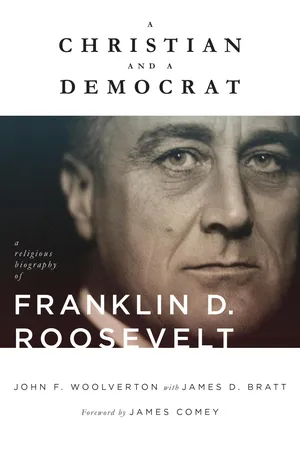
eBook - ePub
A Christian and a Democrat
A Religious Biography of Franklin D. Roosevelt
- 280 pages
- English
- ePUB (mobile friendly)
- Available on iOS & Android
eBook - ePub
A Christian and a Democrat
A Religious Biography of Franklin D. Roosevelt
About this book
Trusted by 375,005 students
Access to over 1.5 million titles for a fair monthly price.
Study more efficiently using our study tools.
Information
Topic
Theology & ReligionSubtopic
Political BiographiesPART I
Formation
Chapter One
Son, Vestryman, and Church Politician
On July 10, 1944, George K. Weston, a resident of Montclair, New Jersey, wrote to the president’s press secretary, Stephen Early, about some “foolish remarks” he had recently heard in a sermon. It was an election year; Weston professed himself to be “a staunch Roosevelt supporter,” but Montclair was Republican territory. A guest minister had complained from the pulpit that Roosevelt was failing to put “the religious need of the postwar problem to the forefront.” Worse still, on the way out of church he alleged to Weston that “Mr. Roosevelt does not contribute a cent to the church in Hyde Park, of which he is a member.” Press Secretary Early responded that such rumors habitually arose during an election year. “The President,” wrote Early, “does contribute regularly to the support of his church in Hyde Park” and “has been Senior Warden of this church for many years”; further, “much of the business of the church is transacted at his home at meetings where the President presides.”1 The first two remarks were true; the latter was not. In accordance with the canons of the Episcopal Church, the rector chaired all meetings of the vestry, whether they took place in the home of the president of the United States or not. Only once, after the rector joined the armed forces in World War II, did Roosevelt as senior warden chair a meeting.2
This episode shows several facets of Franklin Roosevelt’s lifelong role as an Episcopal layman. First, as president during the worst depression in American history and then during the nation’s most far-flung war, he continued his active role in leadership of his parish church. Second, the cut-and-thrust about politicians and religion was not just a phenomenon of election season, nor limited to presidents alone. For all the official rhetoric about “separation of church and state,” religion and politics have always intersected in American history—sometimes, as recently, from the Right but just as often from the Left and everywhere in between.3 FDR would have thus found the New Jersey incident par for the course. He might have added that he had plenty of experience on the other side of the street too, with the church politics in his own denomination. Above all, his curt self-description at that news conference—“I’m a Christian and a Democrat”—indicated how basic religion was to his identity and aspirations, also as a politician. A particular kind of liberal Protestantism shaped his convictions, his values, his ideal of a good society, and the menu of policies designed to make that ideal come true. That worldview was nurtured and stocked by his education at an Episcopal boarding school. Behind that lay the nurture of parents who were faithful churchgoers, mindful of instilling in their son Christian faith and values as they understood them.
Early Nurture
Franklin Roosevelt’s paternal line did not begin as Episcopalians, nor was that the heritage of his mother, Sara Delano. As settlers in New Amsterdam in the early 1650s, the Roosevelts had been loyal, leading members in the Dutch Reformed Church. As FDR reported in a history paper he wrote at Harvard, an inscription on a new church that the denomination erected in New York City in 1769 “for the English service” attested that “Mr. Jacobus Roosevelt” had presided at the laying of the cornerstone as “Senior Elder” while construction went forward “under the auspices of . . . Isaac Roosevelt” as deacon.4 FDR’s father, James, was Isaac’s great-grandson and was reared in that denomination. Franklin’s mother came from a different but no less venerable lineage. Sara’s mother, Catherine Robbins Lyman, was a native of Jonathan Edwards’s old town of Northampton, Massachusetts, and daughter of a state supreme court justice. Sara’s father, Warren Delano Jr., was the scion of an eminent shipping family from near New Bedford, Massachusetts. He became very wealthy very young in the China trade, particularly opium; lost everything in the Panic of 1857; then took his family—Sara included—to Hong Kong to recoup his fortune. The Delano name attested to Huguenot origins (de Lannay, de la Noye), while the Lymans were of old New England stock. Sara’s history thus was rooted far back in Puritan New England, although by the time of her childhood the family, like many others of that class, had migrated theologically to Unitarianism.5
Sara’s kin raised an eyebrow when the widowed and now fifty-two-year-old James proposed in 1880 to marry the stunning young lady only half his age. They raised their other eyebrow at the Episcopal affiliation that James had adopted as a young man. These were not insurmountable objections, however, and Sara joined her new husband in membership at St. James’ Episcopal Church in Hyde Park.6 James had been a vestryman and senior warden in the parish since 1858 and would remain so until his death on December 8, 1900. Franklin was baptized there before he was two months old and was inducted as a child into an “unfailing regularity of Sunday morning church attendance.” At a certain age he started offering equally habitual reasons to be excused; father James called them “Sunday headaches.” Writes Frank Freidel: “On a cold windy February day when he was ten he [Franklin] fortuitously came down with an almost undetectable ailment, which would have been more impressive had he not laughingly announced its imminence the day before.” It was no good; to church he went.7 If FDR was chronically erratic at Sabbath observance as an adult, he did not neglect his duty as village squire. He was elected to the vestry in 1906, eventually serving as senior warden from 1928 until his death in 1945.
Franklin received his early education from his mother, from his governess, and from the family’s substantial collection of books. More on the first two in a moment; first, the books. They served Franklin’s fascination with—and began his lifelong passion to protect and conserve—the birds, trees, land, soil, and history of Hyde Park, of Dutchess County, and of the Hudson River valley. Later, the sea, ships, and world geography, physical and social, enthralled him. As for his moral and religious formation, we know that when he fell ill of typhoid in England at age seven, his mother read him “the sentimental and moral children’s tales of her youth” in conjunction with Louisa May Alcott’s Little Men, Daniel Defoe’s Robinson Crusoe, and Johann David Wyss’s Swiss Family Robinson.8 Like other children of his time, Franklin was treated to the popular chapbooks with their nursery rhymes and the moralistic stories of “Peter Parley” that lent instruction in biography, history, geography, and science. From age eight to age ten he read Jacob Abbott’s Rollo Series, which encouraged inquisitiveness about foreign lands while also appealing to a sense of honor and exemplary conduct. Abbott was a reformist Congregational minister and professor of mathematics at Amherst College who had a wide reputation both in America and in Europe. Roosevelt’s sense of adventure and love of travel were widened by the patriotic if priggish heroes served up by “Oliver Optic” (William Taylor Adams), while the tales of the more business-oriented Horatio Alger inducted him into the primal rags-to-riches mythology of American culture.
These authors marked a turning point in American primary education and moral formation. To mid-nineteenth-century authorities on child nurture, the old-school practice of “drilling children in denominational theology seemed unduly harsh.” Instead, “writers of popular fiction insisted that this literature should instruct the modern reader in religious values just as the Bible did.”9 But this could be a treacherous path, as the rise of Mark Twain demonstrated. Roosevelt certainly read The Adventures of Tom Sawyer (1876), for he chose it for the collection of books at Top Cottage, the retreat he built on the Hyde Park estate in the 1930s. In fact, he had met the author in 1887 when accompanying James Roosevelt on a trip through New England. James made a point of paying a call on Samuel Clemens at his home in Hartford, Connecticut. It was a memorable event, even if FDR demonstrably misremembered it.10 However, Twain’s masterpiece, Huckleberry Finn, published just two years before that visit, does not appear in any Roosevelt library, possibly because of the harsh reviews that the monitors of proper taste and morals leveled upon the book: “its coarseness of language and questionable morals,” they intoned, “its very low grade morality” and “rough, coarse, inelegant expressions” rendered it “trash of the veriest sort.”11
More formal religious volumes abounded in Franklin’s library. He chose Selections from the Psalms of David in Metre: With Hymns Suited to the Feasts and Fasts of the Church (1865) for the first cabinet in the “President’s Room” at Hyde Park, along with other books of hymns and songs such as The Union Temperance Song Book (1843), Anna Barbauld’s Hymns in Prose for Children (1809), and the Bromsgrove Sunday School’s Anthems, Psalms & Hymns (1809). These no doubt contributed to Roosevelt’s marked love of hymnody. His juvenile books included the King James Bible and the Book of Common Prayer along with The Shorter Catechism of the Westminster Assembly (1843), John Stirling’s Cathechismus et Articuli Ecclesiae Anglicanae (1747), The Sunday Picture Book (1875), Theodore Soares’s Heroes of Israel (1908), and the French Bible du jeune âge: Histoire de l’Ancien et du Nouveau Testament (1866). He collected some twenty lives of Christ.12 A brace of “Christmas Carols,” one by Charles Dickens, another by Phillips Brooks, sat next to John Bunyan’s The Pilgrim’s Progress. Both Bunyan’s and Dickens’s titles made a profound impression on Roosevelt, as we shall see.
Supplementing the nurture of parents and books was the influence of Jeanne Sandoz, an extraordinary young Swiss woman hired in 1891 to be Franklin’s governess and teacher. Like her charge, she keenly enjoyed history, geography, and science. Franklin’s powers of concentration, his memory, and his ability to read quickly and retain what he had read made him an apt pupil. Sandoz’s teaching also conveyed a strong social concern that grew out of her Christian faith. In January 1933, just prior to his inauguration as president, the former governess reminded him that the “ignorance of the masses, the collective selfishness of nationalists, the violence and cupidity of the masters of money, the spiritual weakness and poverty of the men in power led to the world tragedy of 1914.” Then, in words that proved prophetic, she challenged him: “The churches and the men now in power must now put the cause of humanity above everything and must not rest until the spirit of the gospel is diffused throughout the external world—that of business, of national and international politics.” He soon replied, “I have often thought that it was you more than anyone else who laid the foundation for my education.”13 Her wish for his global influence came true soon enough. Just as Abraham Lincoln’s picture adorned the parlors of miners’ homes in Yorkshire in the nineteenth century, so in the 1930s Franklin Roosevelt’s photograph was tacked up in the one-room homes of the peasants of Luciana in fascist Italy. Carlo Levi recalled in his autobiographical novel Christ Stopped at Eboli that two pictures hung “in almost every house”: one of “the black scowling face, with its large, inhuman eyes, of the Madonna of Viggiano,” the other “a colored print of the sparkling eyes, behind gleaming glasses, and the hearty grin of President Roosevelt.” Levi added, “I never saw other pictures or images than these: not the King nor the Duce, nor even Garibaldi; no famous Italian of any kind, nor any one of the appropriate saints, only Roosevelt and the Madonna of Viggiano never failed to be present.”14
Sara and James Roosevelt
Still, the strongest influence upon young Franklin came from his parents. They shaped his character, his values, and his sense of life’s opportunities and obligations. Mother Sara, especially, instilled in him a sense of destiny. He was born to do great things, she was sure, and he had the talent and gifts to accomplish them. Her vision ran with the age’s emphasis upon the personal—in regard to her son and also in regard to social obligations. She did not deny the presence of poverty and need in the world but stuck to her class’s conventions about how these problems were to be addressed. People of privilege were to undertake charitable gestures, also by way of setting an example, toward individuals known to them personally. Lady Bountiful, in short. Sara took “baskets of food to the sick, flowers to the hospital, and clothing to the poor.” She made dolls at Christmas for children in the hospital (the dolls went on the Christmas trees in the wards, not in children’s arms), and followed up with patients who had been discharged from the State Hospital for the Insane at Poughkeepsie. Sara remained loyal for twenty years to one insensate woman, ensuring her well-being and paying her lodging bills long after the woman’s eccentricities had increased to the point that the landlord was seeking her removal.15
This was quite a bit narrower than the holistic public vision of Sara’s New England forebears, whether Puritan or Unitarian. Their models of social ethics certainly included personal charity but went well beyond that. In the colonial era their dream had been to build not just good citizens or sound churches but a “holy commonwealth.” After the Revolution and religious disestablishment, they resumed that project via organized voluntary crusades against public evils: drunkenness, abusive prisons, exploitation of women and children, and finally slavery. This was the “benevolent empire” of the Second Great Awakening.16 Its rhetoric could be imperialistic indeed, and by our standards it was highly moralistic and judgmental. Nor did it finally escape its theoretical center in individual free will. But it changed the landscape of pre–Civil War America, especially in the Northeast and the Midwest, and with the Union’s triumph in the Civil War, it could claim to have achieved its noblest end. Sara, having come to consciousness during that war and then spending much of her youth abroad, seems to have lost the reforming passion. Or perhaps she thought her role was to model noblesse oblige from the upper echelons of a nation that had achieved as much collective righteousness as was possible. One part of her heritage that she did pass along was the Delanos’ remarkably ambitious, adventurous spirit. Here Franklin proved himself to be most decidedly his mother’s son.
Father James Roosevelt was a milder and of course much older parent, majoring in care and encouragement for his son. He bore a complicated heritage as to religion and public life. Historically, the Dutch Reformed had kept their distance from New Englanders’ zeal, being more concerned to protect their rights in the polyglot colony that had been seized by the English in 1664. However, James’s father (Isaac) had insisted that his son go to Union College in Schenectady, New York, a flagship institution of the revival-and-reform complex. Isaac was a high-strung evangelical himself, much given to anxiety over the state of his soul and that of his son. Union’s head, Eliphalet Nott, the longest-serving college president in American history, had a reputation for redeeming boys deemed to be bad, or potentially so. But he also aimed to recruit them into the armies of public righteousness. James Roosevelt was sent to Union after a year at the worldlier New York University and stayed on to graduate under Nott’s supervision in July 1847. Even at Union, however, he found a way to rebel by joining a secret student society, much to his father’s dismay.17 Once married, James switched denominations, leaving the Dutch Reformed for the Episcopal Church. Given their roots in the Church of England, a religious est...
Table of contents
- Title Page
- Copyright
- Contents
- Foreword by James Comey
- Preface by James D. Bratt
- Author’s Preface and Acknowledgments
- Introduction: “The Strongest and Most Mysterious Force”
- Part I: Formation
- Part II: Faith
- Part III: Interpretation
- Afterword: Politics and Religion in Lincoln, Hoover, and Roosevelt
- Index
Frequently asked questions
Yes, you can cancel anytime from the Subscription tab in your account settings on the Perlego website. Your subscription will stay active until the end of your current billing period. Learn how to cancel your subscription
No, books cannot be downloaded as external files, such as PDFs, for use outside of Perlego. However, you can download books within the Perlego app for offline reading on mobile or tablet. Learn how to download books offline
Perlego offers two plans: Essential and Complete
- Essential is ideal for learners and professionals who enjoy exploring a wide range of subjects. Access the Essential Library with 800,000+ trusted titles and best-sellers across business, personal growth, and the humanities. Includes unlimited reading time and Standard Read Aloud voice.
- Complete: Perfect for advanced learners and researchers needing full, unrestricted access. Unlock 1.5M+ books across hundreds of subjects, including academic and specialized titles. The Complete Plan also includes advanced features like Premium Read Aloud and Research Assistant.
We are an online textbook subscription service, where you can get access to an entire online library for less than the price of a single book per month. With over 1.5 million books across 990+ topics, we’ve got you covered! Learn about our mission
Look out for the read-aloud symbol on your next book to see if you can listen to it. The read-aloud tool reads text aloud for you, highlighting the text as it is being read. You can pause it, speed it up and slow it down. Learn more about Read Aloud
Yes! You can use the Perlego app on both iOS and Android devices to read anytime, anywhere — even offline. Perfect for commutes or when you’re on the go.
Please note we cannot support devices running on iOS 13 and Android 7 or earlier. Learn more about using the app
Please note we cannot support devices running on iOS 13 and Android 7 or earlier. Learn more about using the app
Yes, you can access A Christian and a Democrat by John F. Woolverton,James D. Bratt in PDF and/or ePUB format, as well as other popular books in Theology & Religion & Political Biographies. We have over 1.5 million books available in our catalogue for you to explore.