Disciplines from literary studies to environmentalism have recently undergone a spectacular reorientation that has refocused entire fields, methodologies, and vocabularies on the world and its sister terms such as globe, planet, and earth.
The Bloomsbury Handbook of World Theory examines what "world" means and what it accomplishes in different zones of academic study. The contributors raise questions such as: What happens when "world" is appended to a particular form of humanistic or scientific inquiry? How exactly does "worlding" bear on the theoretical operating system and the history of that field? What is the theory or theoretical model that allows "world" to function in a meaningful way in coordination with that knowledge domain?
With contributions from 38 leading theorists from a vast range of fields, including queer studies, religion, and pop culture, this is the first large reference work to consider the profound effect, both within and outside the academy, of the worlding of discourse in the 21st century.
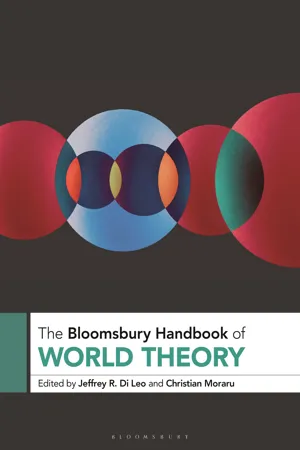
eBook - ePub
The Bloomsbury Handbook of World Theory
- 528 pages
- English
- ePUB (mobile friendly)
- Available on iOS & Android
eBook - ePub
The Bloomsbury Handbook of World Theory
About this book
Information
PART ONE
Arts and Humanities
CHAPTER ONE
Worlding History
porer mukhe jhal khaowa
[to taste the taste of chili from other people’s mouths]
Dipesh Chakrabarty, in Amitav Ghosh and Dipesh Chakrabarty, “A Correspondence on Provincializing Europe”1
Historians have been at the forefront of analyzing how humans have conceived of their continuities and discontinuities with others, diachronically as well as synchronically, as worlds of similarity or difference. Perhaps this is because, unlike all other human sciences, history literally permeates everything human about the world. Consider that we can easily conceive a history of everything but not an everything of history, except figuratively speaking—a history of chemistry but not a chemistry of history in any comparable way. Historians’ concerns for categories, then, are inherently global. However, our brief here is more specific: to explore how history as a discipline has been and will continue to be worlded for good research reasons; not just as a choice (to which this essay’s title gestures) but as an obligation to do something beyond what Linda Colley has wittily called “selective history.” For even really good national history-writing on occasion “hampers” our understanding of the particular historical event or phenomenon under scrutiny.2 Accordingly, we will re-survey historiographical territory already well mapped out only to keep ourselves on this track.3 The toughest questions lie elsewhere, if we take for granted that Marc Bloch was right in saying in 1934 that “The shared location [of multiple phenomena over time] is nothing but chaos: only the unity of the [historical] question provides focus.”4 When is world, then, the right qualifier for an investigation’s answer?
Consideration must initially involve the metaphorical ambiguity attached to world(ing) in historical investigations. Sorting this out not by stipulating axiomatic scales of analysis but by dissecting the diverse relationships of researcher to evidence (meta-analytical, substantive, and subjective) will lead us to a prescriptive set of interrelated correctives concerning agency and intentionality. Precise understanding of the researcher-evidence pairing arguably constitutes history’s greatest cognitive contribution to the human sciences—in company with its two closest sister disciplines, diagnostic medicine and forensic fact-finding or law (analogous processes in my view if we adapt Sanjay Subrahmanyam’s description of “source criticism” as “the method by which one approaches, evaluates, reconciles, or rejects” not just textual evidence but any evidence of reality).5 For the how, what, when, and where of the things we did and the why we did them constitute the only historicizable parts of reality; and being able to document the factual existence of, and differentiate between, specific persons’ agency and intentionality, their “complex rationalizations”—to name names in histoire événementielle while analyzing the multiple contexts of any person’s or people’s experience of a singular event—takes us from anonymous “prehistory” into “history.”6
It is nevertheless salutary to remain skeptical as to why the world today (or at least the experts who spill so much ink over it, who constitute perhaps a world unto themselves in this age of anti-expertism) is so obsessed with its own worldliness, if I am permitted the irreverent pun. “It would be perverse,” writes one medievalist judiciously, “to imbue connectedness with some sort of innate glamour.”7 As Andreas Wimmer and Nina Glick Schiller have stressed, it is good to steer our investigations carefully between the Charybdis of traditional history’s “methodological nationalism” and today’s penchant for “the Scylla of methodological fluidism.”8 At the largest remove of “universal history” Hervé Inglebert advises us wisely to nurture “methodological doubt” about past persons’ “totalities” of meaningfulness (saying people’s might assume a unified ethnic totality): just because the planet is “an important notion for us, it does not follow that it was so at other times or elsewhere, or even that it was conceived as such.”9 Besides, globalization’s hold on us may be loosening, as micro-meso-macro linkages between the physical totalities from local to global levels are upset or even replaced by what I call the electronic shelf (the world wide web). Business people, Marc Augé observes, can live mostly—and sometimes most successfully—in “non-places,” in airplanes, for instance, travelling from business-homogenized point to point, in electronic communion with each other but practically not with anyone else around them: networks, not worlds may be becoming the hegemonic metaphor for life itself.10
Yet, lest we hypothesize rashly about a too modern complexity fueled by totalizing petrol and electricity, we should recall how the Anglo-Saxon word weorold, like the Christian Latin saecula, could mean the globe, all humanity (occasionally, just Christians), an era, or an individual’s total life; and, beyond that, all earthly possessions and the labor we put into them. Augé’s modern globalizing point-to-point electronic corporate network would, I think, have been convincingly dismissed by Alfred the Great’s translation of Boethius’s Consolation of Philosophy as nothing but another worthless, self-important ambition to constitute oneself as the world: “in the vastness of the real world your glory will be like a small point.”11
Historicizing such projections (of self or others) while disambiguating them hermeneutically is the key, whether one agrees with Sanjay Subrahmanyam’s deep medieval origins for scholarly worlding12 or with Bruce Mazlish’s thesis that post-Enlightenment globalization history is not world or universal history.13 Nor need one accept Arif Dirlik’s insistence that “worldwide” and “transnational” should always be differentiated, for even a national history is rarely about the history of all the nationals living in it; and evidence of enough transnationality makes for globality of a kind, I suggest, akin to weorold’s and saecula’s meanings. Descending or ascending scales of analysis do not imply imprecision, as William McNeill observed in 1982:
The Kingdom of England is just as real as the city of London or the borough of Westminster, and for some purposes, the larger entity is both more definite and more important … A tree is a tree. It is also several millions of cells and millions upon millions of molecules and atoms. But no one supposes that accurate description of a tree can only be attempted by describing all its cells, still less every molecule and atom. On the contrary, the tree is liable to disappear entirely if one tries to descend to such minutiae … in recognizing each tree as part of a forest and the forest as part of an ecosphere that extends right round the globe, we change scale without necessarily losing precision of meaning … Precision and truthfulness do not necessarily increase as the scale becomes smaller.14
Though I take issue with McNeill’s conflation of precision and accuracy, I would readily agree that historical worlding which reveals the forest previously obscured by the trees does indeed uncover, as one view puts it, “an interpretive dimension that is less parcelled-out” than, say, the all too familiar and under-theorized national one (and can do so without “falling into the model-based schematisms offered by traditional ‘grand narratives’.”)15 An inquiry ideally matching heuristic categories with evidential ones can achieve, as the legal historian Mirjan Damaška puts it, “sufficient cognitive empathy with the then-dominant worldview,” even disagreeable ones like medieval torture16—or with subaltern worldviews, as the case may be.
One should not shy away, nevertheless, from the incontrovertible evidence that professional world history was established alongside nineteenth-century nationalist historicism, leaving us with globalizing and nationalizing agendas as paradoxical partners (though a Rankean case will be made later for re-reading historicism as empiricist historism17 and then pondering its ironic link to worlding). Inevitable resistance often appears in somewhat convincing arguments against “facile” imitative de-nationalizing or “deprovincializing” of historical writing, which risks “importing cultural” models of “internationalization” interpreted today sometimes as “globalization” that is simply Americanization—a not unwarranted suspicion.18 McNeill himself admitted his highly influential Rise of the West was entrenched in “a form of [1960s] intellectual imperialism” trying “to understand global history on the basis of the concept of cultural diffusion developed among American anthropologists in the 1930s.”19 A short prosopographical explanation, then, of why leading historians have taken up worlding’s analytical usefulness is in order.
WHEN IS WORLDING NOT INTERPRETATIVELY INCIDENTAL BUT CRITICAL?
Let us rephrase the question, borrowing a felicitous description of historical praxis by one of its best practitioners, Felipe Fernández-Armesto, as “the confrontation of tough problems” with a “respect for the sources, and the quest for the truth.”20 How has world operated as a necessary scalpel to dissect truth, in Fernández-Armesto’s sense of “truth” as “language that matches reality”?21
The best recent answers focus on how changing the spatial zoom on our analytical lenses helps us grasp certain realities better: “[z]ooming in allows you to see things previously invisible; stepping back, widening the lens, has the same effect, although the things you see are different.”22 But before presenting further examples, the ironic twist referred to above concerning historism’s relationship to worlding must be addressed since figuratively (and perhaps, as one film historian hints, literally?)23 zooming in and out was nothing new to Leopold Ranke.
The “ideological birthmarks” of the conception of the modern profession of history in the nineteenth century, Eurocentrism and nationalism, were (in the words of Jerry Bentley, my predecessor as editor of the Journal of World History) “the conditions” determining that worlding perspectives somehow remained for many the antithesis of professionalism.24 At their worst, grand scales smacked of superficial surveys,25 equated with writing textbooks since “[i]nterest” in such endeavors “often did not spread from scholarship to teaching but rather the other way around.”26
Certainly, Ranke’s greatest contribution to our method was to teach that one should construct the edifice of historical understanding not by derivatively trusting hearsay chroniclers’ or historians’ accounts but instead, as he explained when founding his Berlin research seminar in 1825, by meticulously building up one’s “own judgment” of “how it really was” (his famous 1824 quip) from archival evidence. At its best this comes in the form of non-hearsay testimony in which the fact in question inheres—to borrow an important qualification from the law of evidence—such as the original copy of a treaty. Thus, only Quelle and Urkunde, not Bearbeitung, that is, derivative sources, “proved” things.27
But, as many scholars have noted, “there is no global ‘archive.’”28 It seems impossible to argue against Peer Vries’s observation that “classical standards of professionalism for traditional historians … presuppose intimate knowledge of a confined field with its sources, archives and literature, and the ability to critically analyse one’s primary source material;” and “[t]hese requirements cannot simply be transferred to global history.”29 Jack Goldstone’s recollection that the stellar work of Marshall Hodgson, Philip Curtin, and Robert R. Palmer remained “highly controversial, even if widely admired,” is an accurate description of a fairly widespread attitude.30 Unlike (modern) national histories, world histories appea...
Table of contents
- Cover
- Halftitle Page
- Title Page
- Contents
- Preface and Acknowledgments
- Notes on Contributors
- Introduction: World Theory in the New Millennium
- Part One: Arts and Humanities
- Part Two: Social and Behavioral Sciences
- Part Three: The Professions
- Part Four: Natural and Formal Sciences
- Index
- Imprint
Trusted by 375,005 students
Access to over 1.5 million titles for a fair monthly price.
Study more efficiently using our study tools.
Frequently asked questions
Yes, you can cancel anytime from the Subscription tab in your account settings on the Perlego website. Your subscription will stay active until the end of your current billing period. Learn how to cancel your subscription
No, books cannot be downloaded as external files, such as PDFs, for use outside of Perlego. However, you can download books within the Perlego app for offline reading on mobile or tablet. Learn how to download books offline
Perlego offers two plans: Essential and Complete
- Essential is ideal for learners and professionals who enjoy exploring a wide range of subjects. Access the Essential Library with 800,000+ trusted titles and best-sellers across business, personal growth, and the humanities. Includes unlimited reading time and Standard Read Aloud voice.
- Complete: Perfect for advanced learners and researchers needing full, unrestricted access. Unlock 1.5M+ books across hundreds of subjects, including academic and specialized titles. The Complete Plan also includes advanced features like Premium Read Aloud and Research Assistant.
We are an online textbook subscription service, where you can get access to an entire online library for less than the price of a single book per month. With over 1.5 million books across 990+ topics, we’ve got you covered! Learn about our mission
Look out for the read-aloud symbol on your next book to see if you can listen to it. The read-aloud tool reads text aloud for you, highlighting the text as it is being read. You can pause it, speed it up and slow it down. Learn more about Read Aloud
Yes! You can use the Perlego app on both iOS and Android devices to read anytime, anywhere — even offline. Perfect for commutes or when you’re on the go.
Please note we cannot support devices running on iOS 13 and Android 7 or earlier. Learn more about using the app
Please note we cannot support devices running on iOS 13 and Android 7 or earlier. Learn more about using the app
Yes, you can access The Bloomsbury Handbook of World Theory by Jeffrey R. Di Leo, Christian Moraru, Jeffrey R. Di Leo,Christian Moraru in PDF and/or ePUB format, as well as other popular books in Literature & Literary Criticism for Comparative Literature. We have over 1.5 million books available in our catalogue for you to explore.