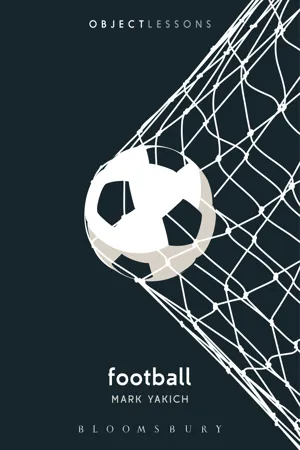
Object Lessons is a series of short, beautifully designed books about the hidden lives of ordinary things.
When is the "beautiful game" at its most beautiful? How does football function as a lens through which so many view their daily lives? What's right in front of fans that they never see? Football celebrates and scrutinizes the world's most popular sport-from top-tier professionals to children just learning the game.
As an American who began playing football in the 1970s as it gained a foothold in the States, Mark Yakich reflects on his own experiences alongside the sport's social and political implications, its narrative and documentary depictions, and its linguistic idiosyncrasies. Illustrating how football can be at once absolutely vital and "only a game," this book will be surprising and insightful for the casual and diehard fan alike.
Object Lessons is published in partnership with an essay series in The Atlantic.
eBook - ePub
Football
About this book
Information
1 Introduction to a Slightly New Game
It was the first week of April, and I hadn’t planned on doing it. I’d gone for a run in Audubon Park in New Orleans, where I’d been running more and more since the stay-at-home order was mandated three weeks earlier. This time, I’d taken a route through the golf course closed to golfers but open to walkers, bikers, picnickers, solo karate practitioners, and anyone else who wanted to take up space on a fairway, bunker, or green. When I popped out the other side of the course, near the spot where I’ve played soccer on Sundays for a decade, I couldn’t quite believe what I was seeing: four men, two 3’ by 6’ pop-up goals, and a ball.
It was beautiful and it was illegal. The mayor had just banned contact sports.
I stopped in my tracks.
“Where are your cleats?” asked Jimmy, one of the regulars.
“How’s this gonna work?” I said.
“Just keep your six feet,” he said. “It’ll be okay.”
“We did it last week,” added Kanu, another regular. “You get only three touches, but you can shoot from anywhere.”
“You playing, or what?” said John, a sometimes-regular who approached.
Another guy was standing nearby, on his phone. I didn’t know him, but he was wearing cleats. I figured I’d better join before he took the fourth spot in the game of 2-a-side.
Between a live oak whose limbs barely touched the ground, as a kind of backstop, and a cedar sapling, we spaced the goals out about 40 yards. I tightened the laces on my running shoes. No one bothered to stretch, thinking, as I was, that surely someone in the hordes of walkers, or more likely park security would soon come over to squelch our little game.
The old bliss began the moment my foot made contact with the ball. Who needed shin pads or a mouthguard (I’d lost a tooth a few years back) or a sweatband? It had been three weeks without playing, without endorphins, endocannabinoids, dopamine, or whatever it was that my brain normally released from sprinting and kicking and trapping and falling for six or seven miles each Sunday from ten until noon or one, depending on how much familial scorn I felt I could tolerate once I returned home.
After a couple of series up and down our mini-pitch, I said, “The three-touch rule is changing my entire game—I can’t attack on defense like I usually do.”
John said, “This is going to show who knows how to use space.”
“It’s all about cutting off angles,” said Kanu.
Jimmy said nothing. He was busy finding the space and angle to put the ball into the back of the net from a distance.
We played for an hour and a half, the score something like 10-7. I put in the final goal, a left-footed chip from twenty yards out, a small miracle.
Usually after the game ended, we would high-five and embrace each other. This time we didn’t even elbow-bump. We said awkward goodbyes. On my walk home, I tried to replay the match in my head, the accurate passes, the feints, the stunning shots; but my mind kept coming back to one thing: the moment I’d accidentally violated the six-feet rule in defending John. I could still feel his wet shoulder brushing against my arm. Could one get the virus from sweat? From body odor? If I could smell my buddy’s deodorant, wouldn’t that mean that possible virus molecules were passing through my sinuses and into my lungs?
Then a graver thought: Should I tell my wife I played?
At home, I admitted that I “kicked the ball around with a couple of guys in the park.” She nodded. I didn’t expand.
The same day the following week I returned to the spot in the park, but only a few sunbathers were there. I was so disappointed that I didn’t finish my run, just turned around and moped home.
The following week I couldn’t get myself to go for a run.
But a week later, it was Sunday morning again. I’d been in a bad slump for five days in a row. Genuine depression, the kind I knew well from four years earlier, after both my parents died—the kind where one can’t get out of bed and if one does, because one has to help with three small children, one finds oneself laying down before noon on any available flat surface hidden from the gaze of others. I knew I couldn’t afford a sixth day, the turning point into full-blown numbness, in which profound sadness would be a welcome relief.
I put on my turf shoes, and began to fumblingly confess to my wife what I was going to do.
“It’s all right,” she said. I looked up.
“Go,” she said.
I didn’t run. I rode my bike, with my ball bouncing around in the milk crate jerry-rigged to the back rack.
In the park, from a distance, I thought I could make out the small nets and players. My heart may or may not have raced. When I got close enough, the bike just fell out from beneath me, crashing to the ground, and I yelled: “Can I play!”
John yelled back: “Did you bring a kid?”
I tried to fathom his words, then glanced over to the spot: a few kids and our friend Jimmy lingered.
“You have to bring one of your kids to play. The virus and all. We have to limit the bubble.”
I didn’t really understand the logic of bringing more people—bubble or no bubble. But I did wish that my twelve-year-old son, a very good soccer player, would come out and play too. I was having trouble even getting him to kick the ball back and forth with me on the sidewalk in front of our house.
Jimmy walked over.
“Fuck it,” he smiled, “we’ll make an exception.”
From that day on, a handful of the old regulars began playing as much as possible—once, twice, then three times each week. Soon I found myself bringing the ball, pop-up nets, and pinnies, and coordinating group messaging so that everyone knew when and where we’d play. It still wasn’t technically legal, but we took the risk. I had a new personal risk as well: the tendonitis in my right knee, for which I’d been doing physical therapy for five months, was becoming a chronic condition. After two weeks the tendon below my left kneecap also became inflamed. It couldn’t be helped. This was the pandemic. Nothing, it seemed, could be helped. But the thing about chronic conditions is that some of them turn positive; even if I could no lon
ger watch professionals play live games, I could live in this new moment if I kept playing the game—chronically.
2 A Concession
It strikes me a bit funny that a number of well-known books about the sport begin the same way—with a concession. “I was the worst wooden leg ever to set foot on the little soccer fields of my country,” says Eduardo Galeano on the first page of Football in Sun and Shadow. “I suck at soccer,” writes Franklin Foer in the first sentence of How Soccer Explains the World.
I don’t suck. I began playing at age eight when my mother drove me to a neighboring Chicago suburb to try a sport she’d never heard of, and ten years later I started at left fullback for my college team. But I was never good enough to play professionally, and never did I want to. I’m not a rabid fan, or even a fan of a particular club. And there’s a whole swath of history about football of which I have only cursory knowledge. To be frank, there were years when I didn’t think about the game very much—while I was in my late twenties and early thirties living overseas, or in graduate school, obsessed instead with reading and writing poems. But football came back for me. In fact, I suspect it was underneath the surface of my being the whole time. Which sounds rather hokey. But the pandemic has turned even hokeyness on its ear. Outside of my family, football is now the most reliable and consistent presence in my life—and its facets keep opening up to me.
For example, one evening, weeks into lockdown, as I was lamenting the absence of live football broadcasts, I came across “blind football.” I began watching YouTube videos of pre-pandemic matches, utterly entranced. The game is played on futsal pitches (essentially the same size as a basketball court), with four outfield players, each wearing eye shades to maintain fairness in case a player can detect some light, and one goalkeeper who may be partially blind but more often is sighted. As with the indoor soccer I played as a teenager, there are boards on the perimeter of the pitch facilitating a continual play. The ball’s panels are equipped with metal bearings so that the ball can be heard and located; the sound is a cross between a tambourine and the jingling of coins in a pants pocket. Perhaps most important, all fans remain silent during play.
I remained mesmerized by player after player, who seemed to roller skate across the turf, their insteps handling the ball as though they were playing ping-pong. As I imagined how a defender must defend by sound and what must be vacillations of air currents, I began to comprehend the virtually unlimited nature and adaptation of the game of football. Long past midnight I watched, drifting into an equanimity equal to any I’ve known during years of practicing yoga and meditation.
3 The Name of the Game
What I love about The Beautiful Game is that I didn’t know it was called “The Beautiful Game” until I’d played it for more than thirty years. I love, too, that outside of authors of books about football, nobody who plays or watches the sport refers to it by that moniker—just as nobody who lives in New Orleans calls it “The Big Easy.”
The Sunday morning match I’ve played for years is technically a pickup game, “pickup” connoting a take-it or leave-it quality. While the game is open to anyone—men, women, even at times a pre-teen or two—the game is anything but random, anything but inconsequential. The match is far better than any religious service, and when I miss it, the whole week seems to be off-kilter, like I’m being punished for not running around the pitch madly for hours.
Over the years I have suffered innumerable, inglorious bangs and cuts and knocks, a pair of bruised ribs, a concussion, a torn PCL, and a broken tooth. Three weeks ago, a hornet bit me in the right butt cheek as I was retrieving the ball from a thick patch of hosta plants. The welt lasted a week and there’s still a scar where the stinger went in.
What I love about the game is that I no longer tell my wife how it went—and certainly not about the injuries. After the damaged knee and subsequent months of physical therapy, she urged me to quit playing. I found myself stumbling to explain the game’s importance to my well-being. I may have used the word “survival.” I know that she was well-intentioned in her admonishing, worrying about my body as I approached age fifty; but she couldn’t quite grasp what I said about my mental health, even as a licensed therapist.
Except for when I was an expat in Europe and variously called the game le foot (France) or Fußball (Germany) or football (UK), I know the game as soccer. That name derives from “soc,” a slang term for “association” as in association football, the name the game was given to distinguish...
Table of contents
- Cover
- Half-Title
- Series
- Dedication
- Title
- Contents
- 1 Introduction to a Slightly New Game
- 2 A Concession
- 3 The Name of the Game
- 4 Popularity, Contests
- 5 Standstill
- 6 How to Make a Football
- 7 Two Games
- 8 90-Minute Meds
- 9 Geisterspiel
- 10 Pickup
- 11 The Life-Changing Magic of Three-Touch
- 12 Of Nutmegs and Fish up a Tree
- 13 For the Love of a Pretty Move
- 14 Zone
- 15 A 21st CenturyPortrait
- 16 Zone Painting
- 17 Future Stronger in Color
- 18 Reset
- 19 The Best Seats
- 20 Hacking, Diving, Hugging
- 21 Intersectionality
- 22 Live Football in a Pandemic
- 23 Child’s Play
- 24 Assessment
- Acknowledgements
- Index
- Copyright
Trusted by 375,005 students
Access to over 1.5 million titles for a fair monthly price.
Study more efficiently using our study tools.
Frequently asked questions
Yes, you can cancel anytime from the Subscription tab in your account settings on the Perlego website. Your subscription will stay active until the end of your current billing period. Learn how to cancel your subscription
No, books cannot be downloaded as external files, such as PDFs, for use outside of Perlego. However, you can download books within the Perlego app for offline reading on mobile or tablet. Learn how to download books offline
Perlego offers two plans: Essential and Complete
- Essential is ideal for learners and professionals who enjoy exploring a wide range of subjects. Access the Essential Library with 800,000+ trusted titles and best-sellers across business, personal growth, and the humanities. Includes unlimited reading time and Standard Read Aloud voice.
- Complete: Perfect for advanced learners and researchers needing full, unrestricted access. Unlock 1.5M+ books across hundreds of subjects, including academic and specialized titles. The Complete Plan also includes advanced features like Premium Read Aloud and Research Assistant.
We are an online textbook subscription service, where you can get access to an entire online library for less than the price of a single book per month. With over 1.5 million books across 990+ topics, we’ve got you covered! Learn about our mission
Look out for the read-aloud symbol on your next book to see if you can listen to it. The read-aloud tool reads text aloud for you, highlighting the text as it is being read. You can pause it, speed it up and slow it down. Learn more about Read Aloud
Yes! You can use the Perlego app on both iOS and Android devices to read anytime, anywhere — even offline. Perfect for commutes or when you’re on the go.
Please note we cannot support devices running on iOS 13 and Android 7 or earlier. Learn more about using the app
Please note we cannot support devices running on iOS 13 and Android 7 or earlier. Learn more about using the app
Yes, you can access Football by Mark Yakich in PDF and/or ePUB format, as well as other popular books in Literature & Literary Criticism Theory. We have over 1.5 million books available in our catalogue for you to explore.