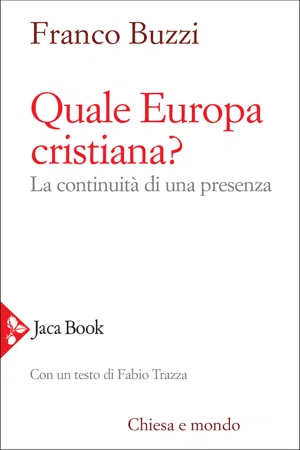
L'Europa trova le sue radici culturali nell'eredità della civiltà greca e latina, potentemente innervata, corretta e rilanciata dall'alterità del pensiero cristiano. Il cristianesimo, infatti, ergendosi sui pilastri portanti della religione ebraica, ha potuto assumere, approfondire e piegare alle novità della rivelazione ebraico-cristiana anche le strutture del pensiero greco e la forza organizzativa e pratica del mondo latino. L'energia plasmatrice della cultura cristiana ha dato forma alla civiltà europea in Oriente e in Occidente, nonostante le dolorose fratture, succedutesi nel corso dei secoli, all'interno dell'unica Chiesa. Il libro, focalizzandosi, anche a livello di arti figurative, sul momento critico della Riforma e delle sue conseguenze, intende mostrare come le dimensioni fondamentali che definiscono l'universale appartenenza al consorzio umano - esprimibili in termini di anima, libertà, ragione, fede, volontà, azione e spirito - abbiano attraversato il mondo occidentale dando luogo a forme diverse di cultura cristiana che aspirano a una rinnovata unità. Tale unità può far leva sul caposaldo culturale e politico del Consiglio d'Europa, sorto prima ancora dei vari trattati economici. Si evidenzia così come il recupero dello spirito del Consiglio, immune dalla contingenza accusatoria formulata da un composito fronte sovranista, sia il rinnovato principio culturale della famiglia cristiana europea. Con un testo di Fabio Trazza.
- English
- ePUB (mobile friendly)
- Available on iOS & Android
eBook - ePub
About this book
Information
Topic
Theology & ReligionSubtopic
ChristianityTable of contents
- Copertina
- Frontespizio
- Copyright
- Dedica
- INDICE
- Abbreviazioni
- INTRODUZIONE
- I: RADICI CULTURALI DELL’EUROPA CRISTIANA
- II: L’«ANIMA»: EREDITÀ GRECA E PENSIERO DEI PADRI
- III: «ESTRANEITÀ» E «APPARTENENZA» NEL CRISTIANESIMO ANTICO E MODERNO
- IV: ERASMO E LUTERO IN ITALIA NEL XVI SECOLO: DUE AUTORI ASSIMILATI?
- V: LA TEOLOGIA DELLA CREAZIONE IN LUTERO
- VI: CHIESA VISIBILE E INVISIBILE IN LUTERO E JOHANN GERHARD
- VII: LE VICENDE DELLA «RAGIONE» SECONDO LUTERO
- VIII: LOGOS – PAROLA – RAGIONE: GV 1,1 TRA MODERNITÀ E ILLUMINISMO
- IX: LUTERO E LA MODERNITÀ
- X: LE ARTI A SERVIZIO DELLA PAROLA NEL PENSIERO DI LUTERO
- XI: RAFFAELLO: CRISTIANESIMO E CLASSICITÀ NELLA STANZA DELLA SEGNATURA
- XII: LUCAS CRANACH IL VECCHIO: L’ALTARE DELLA CHIESA DI WITTENBERG
- XIII: FICHTE, GOETHE, NOVALIS E LUTERO ESTETICA – FILOSOFIA – PROFEZIA
- XIV: LA STAGIONE DELL’ECUMENISMO CRISTIANO E LE SUE RAGIONI
- XV: UN’EUROPA UNITA ANCORA CRISTIANA?
- CONCLUSIONE
- APPENDICE
- Tavola delle pubblicazioni
- Gli Autori
Trusted by 375,005 students
Access to over 1.5 million titles for a fair monthly price.
Study more efficiently using our study tools.
Frequently asked questions
Yes, you can cancel anytime from the Subscription tab in your account settings on the Perlego website. Your subscription will stay active until the end of your current billing period. Learn how to cancel your subscription
No, books cannot be downloaded as external files, such as PDFs, for use outside of Perlego. However, you can download books within the Perlego app for offline reading on mobile or tablet. Learn how to download books offline
Perlego offers two plans: Essential and Complete
- Essential is ideal for learners and professionals who enjoy exploring a wide range of subjects. Access the Essential Library with 800,000+ trusted titles and best-sellers across business, personal growth, and the humanities. Includes unlimited reading time and Standard Read Aloud voice.
- Complete: Perfect for advanced learners and researchers needing full, unrestricted access. Unlock 1.5M+ books across hundreds of subjects, including academic and specialized titles. The Complete Plan also includes advanced features like Premium Read Aloud and Research Assistant.
We are an online textbook subscription service, where you can get access to an entire online library for less than the price of a single book per month. With over 1.5 million books across 990+ topics, we’ve got you covered! Learn about our mission
Look out for the read-aloud symbol on your next book to see if you can listen to it. The read-aloud tool reads text aloud for you, highlighting the text as it is being read. You can pause it, speed it up and slow it down. Learn more about Read Aloud
Yes! You can use the Perlego app on both iOS and Android devices to read anytime, anywhere — even offline. Perfect for commutes or when you’re on the go.
Please note we cannot support devices running on iOS 13 and Android 7 or earlier. Learn more about using the app
Please note we cannot support devices running on iOS 13 and Android 7 or earlier. Learn more about using the app
Yes, you can access Quale Europa cristiana? by Franco Buzzi in PDF and/or ePUB format, as well as other popular books in Theology & Religion & Christianity. We have over 1.5 million books available in our catalogue for you to explore.