- 161 pages
- English
- ePUB (mobile friendly)
- Available on iOS & Android
eBook - ePub
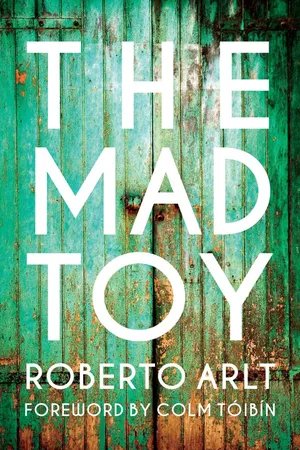
The Mad Toy
About this book
The first novel by one of the greatest writers of Latin American literature, The Mad Toy is a semi-autobiographical story reflecting the energy and chaos of the early twentieth century in Argentina. First published in 1920, The Mad Toy is set in Buenos Aires in the early twentieth century. Feeling the alienation of youth, Silvio Astier's gang tours neighbourhoods, inflicting waves of petty crime, stealing from homes and shops until the police are forced to intervene. Drifting then from one career and subsequent crime to another, Silvio's main difficulty is his own intelligence, with which he grapples. Writing in the language of the streets and basing his writings in part on his own experience, with his characters wandering in a modern world, Arlt creates a book that combines realism, humour and anger with detective story. Trailblazing for Boom writers who were to follow him such as Gabriel García Márquez and Isabel Allende, Roberto Arlt is rated as one of the greatest Argentinean writers. Although astronomically famous in South America, Roberto Arlt's name is still relatively unknown in Anglophone circles, but the rising wave of appreciation of South American literature is bringing him to the fore.
Information
Topic
LiteraturaSubtopic
ClásicosChapter 1
The Thieves
When I was fourteen an old Andalusian cobbler, who had his shop next to an ironmonger’s with a green and white façade, in the archway of an old house in Avenida Rivadavia between South America and Bolivia Streets, initiated me into the delights and thrills of outlaw literature.
The front of the hovel was decorated with polychrome covers of pulp books that told the adventures of Montbars the Pirate and Wenongo the Mohican. On our way back from school, we kids took great pleasure in looking at the prints that hung, discoloured by the sun, on the door.
Sometimes we’d go in to buy half a pack of Barriletes, and the man would grumble about having to leave his bench to come and deal with us.
He was slump-shouldered, sunken-cheeked and bearded, and fairly lame as well, with a strange limp, his foot round like a mule’s hoof, with the heel pointing outwards.
Whenever I saw him I would remember a proverb my mother used a lot: ‘Beware the people marked by God.’
Normally he’d toss a few phrases my way; and as he looked for some particular half of a boot among the mess of shoetrees and rolls of leather, he would introduce me, with the bitterness of a born failure, to the stories of the most famous bandits of Spain, or else would recite a eulogy for a lavish customer whose boots he had polished and who had given him twenty centavos as a tip.
As he was a covetous man, he smiled to recall this client, and his filthy smile that didn’t succeed in filling out his cheeks would wrinkle his lip over his blackened teeth.
Although he was bearish he took a liking to me and for the odd five centavos he’d rent me out the serial novels he had collected over long subscriptions.
And so, as he gave me the story of Diego Corrientes, he’d say:
‘Boy, thith guy… what a guy! He were more beautiful than a rothe and the milithia killed him…’
The artisan’s voice trembled hoarsely:
‘More beautiful than a rothe… but he wath born under an unlucky thtar…’
Then he would recapitulate:
‘Jutht you imagine… he give the poor wha’ he took from the rich… he had a woman at every farm in the mountainth… he were more beautiful than a rothe…’
In this lean-to that stank of paste and leather, his voice would awaken a dream of green mountains. There were gypsies dancing in the ravines… a mountainous and sensual land appeared before my eyes as he evoked it.
‘He were more beautiful than a rothe,’ and then this lame man would vent his sadness by tenderising a sole with his hammer, beating it against an iron plate which he supported on his knees.
Then, shrugging his shoulders as if to rid himself of an unwelcome idea, he would spit through his teeth into a corner, sharpening his awl on the whetstone with quick movements.
Later he would add:
‘You’ll thee, there’th a beautiful bit when you get to Doña Inethita and Uncle Clodfoot’th inn,’ and, seeing that I was taking the book with me, he’d shout a warning:
‘Careful, lad, it cothtth money,’ and turning back to his work he’d lower his head, the mouse-coloured cap pulled down over his ears, rummage in a box with his fingers all dirty from glue and, filling his mouth with nails, would carry on with his hammer, tap… tap… tap…
These books, which I would devour in their numerous ‘batches’, were stories of José María, the Lightning Bolt of Andalusia, or of the adventures of Don Jaime the Bearded and other rogues, more or less authentic and picturesque, as could be seen from the prints that showed them as follows:
Horsemen on stupendously saddled colts, with extra-black side burns on their ruddy faces, their bullfighter’s ponytail covered by an extremely shiny cordobés hat, and a blunderbuss mounted in the saddletree. They would usually be offering, with a magnanimous gesture, a yellow bag of money to a widow standing at the foot of a little green hill with a babe in her arms.
Back then I dreamt of being a bandit and of strangling libidinous senior magistrates; I would right wrongs and protect widows, and I would be loved by exceptional maidens.
I needed a comrade for my youthful adventures, and this comrade was Enrique Irzubeta.
Enrique was a layabout who was always known by the edifying nickname of ‘The Faker’.
His story shows how one can establish a reputation; and how fame, once won, can nurture all those who wish to study the laudable art of leading the ignorant up the garden path.
Enrique was fourteen when he cheated the owner of a sweet factory, which is clear proof that the gods had decided what the destiny of our friend Enrique would be. But because the gods are crafty at heart, I am not surprised, as I write my memoirs, to discover that Enrique is now being put up in one of those hotels that the State provides for hooligans and rascals.
The truth is this:
A certain factory owner, in order to stimulate the sale of his products, announced a competition, with prizes for those who could put together a complete set of the flags of South America which he had had printed on the underside of each sweet wrapper.
The difficulty lay in finding the wrapper with the flag of Nicaragua, given its extreme scarcity.
These absurd contests, as you know, excite young boys, who, under the banner of a common interest, add up every day the results of their searches and the development of their patient investigations.
And so Enrique promised his neighbourhood friends, the carpenter’s apprentices and the dairyman’s sons, that he would fake the Nicaraguan flag if someone brought him a copy.
The lads were doubtful… they vacillated, knowing Irzubeta’s reputation, even though Enrique magnanimously offered as hostage two volumes of the History of France, written by M. Guizot, so that his probity would not be called into question.
And so the bargain was struck on the pavement in a cul-de-sac, with green-painted streetlights on the street corners, with few houses and tall brick walls. The blue curve of the sky sat atop the distant brushwood-topped walls, and the street was made all the more sad by the monotonous murmur of endless sawing and the cows mooing in the dairy.
Later I found out that Enrique, using Indian ink and blood, had reproduced the Nicaraguan flag so convincingly that it was impossible to tell the original from the copy.
A few days later Irzubeta showed off a brand new airgun that he later sold to a second-hand clothes dealer in Reconquista Street. This happened while brave Bonnot and valiant Valet were terrorising Paris.1
I had already read the forty-odd volumes that the Viscount of Ponson du Terrail had written about Mother Fipart’s adopted son, the admirable Rocambole, and I aspired to become a bandit in the high style.
Well, one summer day, in the sordid neighbourhood grocery shop, I met Irzubeta.
The hot siesta hour weighed on the streets, and there was I, sitting on a cask of yerba,2 chatting to Hipólito, who took advantage of his father’s being asleep to make bamboo-framework aeroplanes. Hipólito wanted to be a pilot, ‘but first he had to solve the problem of natural stability’. At other times he was preoccupied with perpetual motion and would ask me about the possible implications of his musing.
Hipólito, with his elbows on a lard-stained newspaper, between the cheese counter and the red levers on the till, listened to my suggestions with the utmost attention:
‘A clock mechanism is no use for the propeller. Give it a tiny little electric motor and put the dry batteries in the fuselage.’
‘You mean like in submarines…’
‘Submarines? What submarines? The only danger is that the current could burn out the motor, but the plane’ll go much more smoothly and you’ll have a while before the batteries die.’
‘Che, couldn’t we make the motor work via a wireless telegraph? You’ll have to see how that might work. It’d be great, wouldn’t it?’
At this moment Enrique came in.
‘Che, Hipólito, my mum says do you want to give me half a kilo of sugar on tick.’
‘I can’t, che; the old man says that until you sort out your bill…’
Enrique frowned slightly.
‘I’m surprised to hear it, Hipólito.’
Hipólito added, conciliatory:
‘If it was down to me, you know… but it’s the old man, che.’ And he pointed at me, happy to be able to change the subject, and said to Enrique:
‘Che, don’t you know Silvio? He made the cannon.’
Irzubeta’s face lit up respectfully.
‘Oh, was that you? Well done. The guy who mucks out the dairy said it fired like a Krupp…’
While he was talking, I observed him.
He was tall and skinny. Over his rounded forehead, stippled with freckles, lustrous black hair waved in a lordly fashion. His eyes were the colour of tobacco, slightly slanted, and he wore a brown suit that had been fitted to his figure by hands unskilled in the couturier’s art.
He leant on the edge of the counter, balancing his chin on the palm of his hand. He seemed to be reflecting on something.
The adventure of my cannon was a resonant one, and pleasant to remember.
I bought an iron tube and several pounds of lead from some workers at the electricity company. With these elements I fabricated what I called a culverin or ‘bombard’. The manufacture went as follows:
Into a hexagonal wooden mould, lined on the inside with mud, I inserted the iron tube. The space between the two interior faces was filled with molten lead. After breaking the covering, I smooth...
Table of contents
- Cover
- Title Page
- Contents
- Foreword by Colm Tóibín
- Introduction by James Womack
- Chapter 1: The Thieves
- Chapter 2: Works and Days
- Chapter 3: The Mad Toy
- Chapter 4: Judas Iscariot
- Biographical note
- Notes
- About the Publisher
- Selected Titles from Hesperus Press
- Copyright
Trusted by 375,005 students
Access to over 1.5 million titles for a fair monthly price.
Study more efficiently using our study tools.
Frequently asked questions
Yes, you can cancel anytime from the Subscription tab in your account settings on the Perlego website. Your subscription will stay active until the end of your current billing period. Learn how to cancel your subscription
No, books cannot be downloaded as external files, such as PDFs, for use outside of Perlego. However, you can download books within the Perlego app for offline reading on mobile or tablet. Learn how to download books offline
Perlego offers two plans: Essential and Complete
- Essential is ideal for learners and professionals who enjoy exploring a wide range of subjects. Access the Essential Library with 800,000+ trusted titles and best-sellers across business, personal growth, and the humanities. Includes unlimited reading time and Standard Read Aloud voice.
- Complete: Perfect for advanced learners and researchers needing full, unrestricted access. Unlock 1.5M+ books across hundreds of subjects, including academic and specialized titles. The Complete Plan also includes advanced features like Premium Read Aloud and Research Assistant.
We are an online textbook subscription service, where you can get access to an entire online library for less than the price of a single book per month. With over 1.5 million books across 990+ topics, we’ve got you covered! Learn about our mission
Look out for the read-aloud symbol on your next book to see if you can listen to it. The read-aloud tool reads text aloud for you, highlighting the text as it is being read. You can pause it, speed it up and slow it down. Learn more about Read Aloud
Yes! You can use the Perlego app on both iOS and Android devices to read anytime, anywhere — even offline. Perfect for commutes or when you’re on the go.
Please note we cannot support devices running on iOS 13 and Android 7 or earlier. Learn more about using the app
Please note we cannot support devices running on iOS 13 and Android 7 or earlier. Learn more about using the app
Yes, you can access The Mad Toy by Roberto Arlt,Robert Arlt, James Womack in PDF and/or ePUB format, as well as other popular books in Literatura & Clásicos. We have over 1.5 million books available in our catalogue for you to explore.