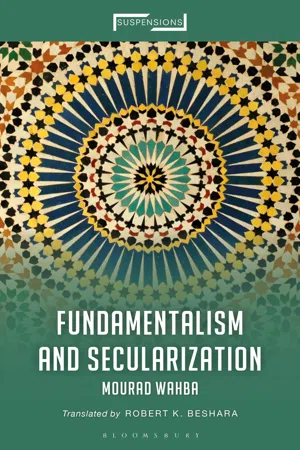
In Fundamentalism and Secularization, Egyptian philosopher Mourad Wahba traces the historical origins of fundamentalism and secularization as ideas and practices in order to theorize their symbiotic relationship, and how it is impacted by global capitalism and, more recently, postmodernism.
This gives voice to an argument from within the Islamic world that is very different to that given platform in the mainstream, showing that fundamentalism does not arise normally and naturally from Islam but is a complex phenomenon linked to modernization and the development of capitalism in dependent countries, that is, tied to imperialism.
Wahba's central argument concerns the organic relationship between fundamentalism and parasitic capitalism. Wahba is equally critical of religious fundamentalism and global capitalism, which for him are obstructions to secularization and democracy. While the three Abrahamic religions are examined when it comes to fundamentalism, Wahba deconstructs Islamic fundamentalism in particular and in the process reconstructs an Islamic humanism.
Including a new preface by the author and translator, Fundamentalism and Secularism provides invaluable insights into how Middle Eastern philosophies open up new lines of thought in thinking through contemporary crises.
- 176 pages
- English
- ePUB (mobile friendly)
- Available on iOS & Android
eBook - ePub
Fundamentalism and Secularization
About this book
Information
PART I
Fundamentalism and Secularization
1
What Is Fundamentalism?
What is the role of religion in today’s world? Or, more precisely: What roles do the eleven1 [largest and medium-sized] religions play in today’s world?
The answer to this question warrants, to begin with, determining the features of today’s world. What are these features?
The path of today’s world is governed by tomorrow’s world because tomorrow is the future and the starting point since history moves from the future and not from the past. What is this history?
There are terms that are starting to become prevalent now that could define the features of a futuristic vision; they are “universalism,” “globalism,” “and interdependence.”
Universalism is a style of thinking that is trying to holistically understand the universe or more precisely, reality—returning the parts to this whole. A universal vision establishes itself by rejecting closure and remaining open and self-critical, its purpose being establishing a universal consciousness that obliterates human alienation in this universe. Religions, in all their varieties, have put forth universal visions. And now, thanks to the scientific and technological revolution, space has been invaded, and it is now possible for science to present a scientific, universal vision.
As for globalism, it arises from universalism, and it means viewing planet Earth as a singularity and not as assembled from independent parts.
That is why interdependence is necessary in globalism, for it is the negation of both dependence and the traditional understanding of independence, that is, the negation of the absolute authority of the State; therefore, it is impossible to solve regional problems, such as overpopulation, environmental pollution, and the crisis of natural resources, except within a framework of globalism. However, interdependence is no longer restricted to regional problems but extends to scientific problems, as science can no longer function in isolation from the other sciences. The emergence of “interdisciplinary sciences” forms a bridge between the different sciences, wherein it is possible, in the end, to realize the unity of knowledge within a framework of the universe’s unity.
The realization of this unity elicits a questioning of the destiny of this abundance of religions, or, more precisely, it provokes an inquiry into the relationship between the one and the many. Religious philosophies have faced this query, but in the scope of the relationship between God and the world, their question was: How do the many emanate from the one? Although there are multiple answers, they could be reduced to two answers.
One of them is occupied with the unity of existence, so does not distinguish between the one and the many. Perhaps the Indians were the first people to express this doctrine, wherein all that exists emanates from Brahma as a general source. Will, in Brahma, is about the desire of abundance and uniqueness. As for natural philosophers, in sixth-century BCE Greece, they had reduced all that exists, as a whole, to one substance that varied according to their various opinions: water for Thales, air for Anaximenes, and fire for Heraclitus.
Emanationism was the other answer; Plotinus was taken by this theory, and it relates that one is a simplex to the extent that one negates Rationalizing and Understanding. So if something flows, it flows from the one oriented toward themself. In this orientation to themself, they see and their vision contemplates their Logos. As their Logos contemplates things that are at their disposal, it gives birth to the Universal Soul. And from this multitude, Number, Quantity, and Quality are born. Ibn Sīnā [Avicenna] and al-Fārābī [Alpharabius] were influenced by the theory of emanation, which led to their creation of the theory of ten intellects.
That was long ago. As for now, the question of the relationship between the one and the many is not presented within the framework of the question of creation but of world peace.
The question then becomes: What is the relationship between world peace and this abundance of religions? To answer this question requires an inquiry into every religion’s view of the other religions in the modern era. In 1860, the first conference on missions was held in Liverpool with a research focus on non-Christian religions because of the political hegemony of Christian culture. What is noteworthy is that three years before the conference was held, a number of missionaries were killed amid the violence of the Indian Mutiny of 1857. Eleven years after the conference, Bishop John Coleridge Patteson was killed in Melanesia. Additionally, a hundred missionaries were killed in China. As the nineteenth century came to a close, missionaries were living in isolation. And in 1871, Edward Burnett Tylor published his two-volume book, Primitive Culture. On the first page of the first section, which is titled The Science of Culture, he says:
The condition of culture among the various societies of mankind [sic], in so far as it is capable of being investigated on general principles, is a subject apt for the study of laws of human thought and action. On the one hand, the uniformity which so largely pervades civilization may be ascribed, in great measure, to the uniform action of uniform causes; while on the other hand its various grades may be regarded as stages of development or evolution, each the outcome of previous history, and about to do its proper part in shaping the history of the future. [Tylor, 1871/2016, p. 25]2
Tylor then unveiled the existence of non-Christian religious ideas among peoples that were regarded [by Europeans] as barbarians.
In 1875, Max Müller published the first book in the series, The Sacred Books of the East, wherein he tackled the religions of Asia. And in 1890, Frazer published his book, The Golden Bough, which was received with astonishment and appreciation. The reason for this is his demonstration that Christianity is not the only religion. In 1965, Pope John XXIII called for the Second Vatican Council and ended up with recommendations—among which was the establishment of Nostra Aetate: Declaration of the Church to Non-Christian Religions—given that God unveiled themself in new forms of faith. And in 1968, the Temple of Understanding’s first Spiritual Summit Conference was held in Calcutta, India, and it included representatives from the eleven religions. The theme of the conference was the significance of religion in the modern world. All of the research generated during the conference revolved around the finding that no religion holds the Absolute Truth, but each religion holds a form of the truth. Therefore, there is no justification for any religion’s superiority over another, and the negation of this justification entails proving another justification, which is the necessity for the convergence of the various religious forms of truth since they can be considered perspectives on an Absolute Truth. Subsequently, no religion has the right to determine this Absolute Truth because any religion’s determination of this truth involves the omission of the other religions. So if a faith claims that religion is the belief in God and eternity, then this saying signifies omitting Confucianism since it does not hold that belief. And if a faith is determined by revelation, there are religions free of revelation. Certainly, the phrase “the Absolute Truth” arouses our questioning about its origin and the justification for bearing it.
Philosophically, it can be said that the human, since their inception, sought the Absolute Truth by virtue of the human mind’s propensity for the unification of human knowledge. It is for this reason that they wander through every field of this knowledge. Then, in an organic unity, they join all the fields together, and link them, which prevents the separation of a part from the whole since that may lead to the Being’s complete elimination. The propensity of the mind for oneness is, at the same time, a propensity for the Absolute.3 The human seeks the Absolute Truth as well by virtue of feeling unsettled in this unknown universe.
However, attaining the Absolute Truth was never a simple matter. As Absolute Truths have multiplied, the Absolute has subsequently multiplied; the Absolute’s multiplicity entered into a liminal contradiction by virtue of the Absolute’s unity—that it cannot but be one. Accordingly, the human is a bearer of the Absolute Truth, is barred from [by] it, or is searching for it. Furthermore, in Ancient Greece, this trinity crystallized philosophically, and it was in a state of conflict, but the bearers of the Absolute Truth prevailed.
Breaking it down: in the fifth century BCE, Anaxagoras denied the divine nature of the heavenly bodies. He went on to say that the Moon is a land on which there are mountains and valleys, and that the sun and the planets are fiery stones, whose nature is no different from the nature of earthly bodies. The bearers of the Absolute Truth could not stand such a saying, as uttered by Anaxagoras, because they believed that all that is heavenly is divine, and that whoever deals with such things in a scientific manner is committing treason. They accused him of impiety, so he was forced to leave Athens, where he was living and philosophizing.
Then Protagoras came to Athens around 450 BCE, and he published a book titled Truth, wherein the following phrase appeared: “The human is the measure of all things.” The meaning of this phrase is that the truth is relative to the human’s relativity. Subsequently, out of this phrase, he constructed another phrase, which is his saying: “I cannot know whether the gods exist or do not exist. Many things stand in the way between me and this knowledge, especially the ambiguity of the matter and the shortness of life.” Thus, Protagoras was accused of impiety and his books were burned, and he was sentenced the death penalty, but he ran away.
As for Socrates, he believed that his wisdom arose from his knowledge of his own ignorance [simple ignorance] as opposed to others who were ignorant but pretended to know [double ignorance]. No sooner had he gone on to dialogue with politicians on extensive occasions than it was brought to light to them that they knew nothing, so they accused him of impiety and corruption of the youth. He was sentenced the death penalty, a verdict which Socrates accepted.
In the last half of the second century CE, a sect of skeptics originated under the leadership of Sextus Empiricus, that is, the experimental Sextus. It transpires in one of his writings that the basic principle for the doctrine of skepticism, around which it revolves, is: “For every argument there is a counterargument.” He then goes on to say: “We believe that of the prerequisites for this principle is the arrival at a point, at which we cease to be dogmatic.” And the meaning of this, according to him, is that “the skeptic refuses dogma.”4 What is peculiar, in the case of Sextus and his companions, is that the translation of their writings is both rare and difficult to find. Our ignorance of the texts of this school of skepticism resulted in the word “skeptic” being emptied out of its meaning. Our ignorance of the texts is, most likely, a function of the authority of the bearers of the Absolute Truth, that is, the dogmatists.
In twelfth-century Córdoba, Ibn Rushd [Averroës] called for the philosopher’s right in “interpreting” religious texts consi...
Table of contents
- Cover
- Half-Title
- Series
- Title
- Contents
- Acknowledgments
- Foreword: An Interview with Mourad Wahba (2019)
- Translator’s Preface to the English Edition
- Author’s Preface to the Arabic Edition (1995)
- Part I Fundamentalism and Secularization
- Part II Essays
- Index
- Copyright
Trusted by 375,005 students
Access to over 1.5 million titles for a fair monthly price.
Study more efficiently using our study tools.
Frequently asked questions
Yes, you can cancel anytime from the Subscription tab in your account settings on the Perlego website. Your subscription will stay active until the end of your current billing period. Learn how to cancel your subscription
No, books cannot be downloaded as external files, such as PDFs, for use outside of Perlego. However, you can download books within the Perlego app for offline reading on mobile or tablet. Learn how to download books offline
Perlego offers two plans: Essential and Complete
- Essential is ideal for learners and professionals who enjoy exploring a wide range of subjects. Access the Essential Library with 800,000+ trusted titles and best-sellers across business, personal growth, and the humanities. Includes unlimited reading time and Standard Read Aloud voice.
- Complete: Perfect for advanced learners and researchers needing full, unrestricted access. Unlock 1.5M+ books across hundreds of subjects, including academic and specialized titles. The Complete Plan also includes advanced features like Premium Read Aloud and Research Assistant.
We are an online textbook subscription service, where you can get access to an entire online library for less than the price of a single book per month. With over 1.5 million books across 990+ topics, we’ve got you covered! Learn about our mission
Look out for the read-aloud symbol on your next book to see if you can listen to it. The read-aloud tool reads text aloud for you, highlighting the text as it is being read. You can pause it, speed it up and slow it down. Learn more about Read Aloud
Yes! You can use the Perlego app on both iOS and Android devices to read anytime, anywhere — even offline. Perfect for commutes or when you’re on the go.
Please note we cannot support devices running on iOS 13 and Android 7 or earlier. Learn more about using the app
Please note we cannot support devices running on iOS 13 and Android 7 or earlier. Learn more about using the app
Yes, you can access Fundamentalism and Secularization by Mourad Wahba, Robert K. Beshara in PDF and/or ePUB format, as well as other popular books in Theology & Religion & Philosophy History & Theory. We have over 1.5 million books available in our catalogue for you to explore.