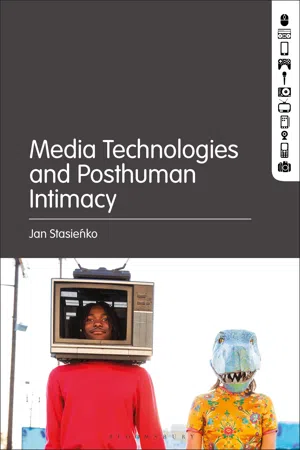
Constructing a theory of intimacy describing processes occurring between a 'human' subject and information creations, Jan Stasienko shows in what way and in what phases that relationship is built and what its nature is.
He discusses technologies and genres related to the construction of a new television message (teleprompter, interactive television forms appearing both in the analogue and digital eras), composition of the film image and specificity of cinematic technologies (peep show, hybrid animation, digital visual effects). Also new-media technologies and genres will be discussed (for example, aspects relating to computer games and Web portals making video materials available). This diversity is prompted by the desire to show that the building of intimacy protocols is not the domain of the digital era, and on the other hand, that the posthumanism of media apparatus is a wide-ranging problem, i.e. the area encompasses various vehicles findable throughout various historical periods.
- 304 pages
- English
- ePUB (mobile friendly)
- Available on iOS & Android
eBook - ePub
Media Technologies and Posthuman Intimacy
About this book
Information
Part One
Cinematic Intimacies
1
A kaleidoscope of pleasure: the erotic peep show as a game of subjects
The two oppositive concepts of posthumanism mentioned in the introduction – disintegrative posthumanism, one that motivates the disintegration of the subject, and ‘empathic’ posthumanism, one that founds the possibility of establishing a link with informational creations – are joined together into a single appliance I would like to discuss in this chapter. The erotic peep show is a special type of appliance, on the one hand situated at the intersection of the history of the visual attractions and development of the erotic industry, and on the other hand being a space, very rich in social, cultural, technological and philosophical contexts, for the meeting of the various orders of power and creation of complicated relationships among the spheres of technology, information and biology. The erotic booth is also the culmination of the long process of formation of an appliance that can be regarded as a mature example of posthuman space, i.e. space in which the appearing human subject adopts the previously discussed posthuman position.
The peep-show appliance weaves together the long histories of several different orders. The first among them is the one we could symbolically term ‘Salome’s dance’ – the individual erotic spectacle of the dancer’s submission to the man watching her. Another is the ‘keyhole’ case, with the peep show inscribing itself into the history of voyeurism, of which the intimate confines are delimited by the eyehole featuring in a selected range of visual technologies such as the boite d’optique,1 kinetoscope or mutoscope. The third order is the status of the slot machine, introducing to the erotic peep show the characteristic dehumanized discontinuity, or intermittence, of the dancer–customer relationship.
In this chapter I will embark on a historical reconstruction of this invention as the intersection of the above-described orders, and I will demonstrate in what way the modern peep show bears testimony of the dynamic relationship between that which is human and that which is non-human. My analysis of the peep-show appliance coincides greatly with the critical approach to the male gaze, initiated by feminist film studies, for example, by Laura Mulvey2 and her successors in thought.3
Although multiple posthuman contexts of the gaze in its Lacanian understanding will find their way into the following chapters of this book, in this part the outlook on the peep show will be linking me with the feminist understanding of ‘woman as the image and man as the owner of the gaze’,4 which appear to be definitionally inscribed into its operating principle. The study into the peep show will, however, in a way, be an elaboration on this dichotomy, introducing a more nuanced approach to it, one in which the technological appliance is characterized by potential for both the reconstruction of either female or male roles and disruption of the bonds joining the subjects with their biologicity, personality and sexuality. Simultaneously, this disintegration is connected with the transfers of affections and lusts in a technological appliance commoditizing sexuality in a variety of ways. While the skopophiliac dancer–observer relationship is a phallocentric frame and a frame of reference for the violent sexual relationship taking place in peep shows, the technological appliance in which the participants find themselves puts them in the roles of elements of a techno-biologico-informational assemblage. It is a vehicle for the satisfaction of sexual fantasies in which the male dominators themselves unwittingly become a market resource melting down in the mechanical formatting of lust.
The main material for analysis here will be several sources constituting the memories of dancers working in peep shows. It turns out that peep show is a place that elicits such confessions. Interestingly, numerous accounts of this type appear in reference to two famous establishments operating under the name of Lusty Lady, located in San Francisco and Seattle. This is, for example, the case with the blog kept by Pegan Moss, once a stripper at two such places in Seattle5 (www.peepshowstories.com) or the story told by Julia Query in Live Nude Girls Unite!, a documentary on San Francisco Lusty Lady strippers’ activism.6 Another former Seattle worker who has decided to share her reflections is Elisabeth Eaves. In their extraordinarily intimate tales, Moss and Eaves provide a thorough depiction of the technological phenomenon that is the peep show and of the intricate web of dependencies established between the human subjects (dancers and customers) and the technological back premises of the place, as well as between the humans and the pornographic video materials shown at the location. It will also be expedient to invoke John McNamara’s behavioural analysis of the visitors of New York peep-show establishments.7 As it turns out, a convenient methodological base for the analysis of peep show’s posthuman aspects can be found in this case in the ethnographic perspective, or one could even say auto-ethnographic, as with Jamie Berger’s essay.8 The accounts I will be drawing upon in this part of the book are either material gathered by researchers (McNamara, Berger) or the dancers’ confessions capable of supplying the basis for such analysis.9
In analysing the above materials, I will demonstrate on the one hand the distribution of intimacy in the peep-show vehicle and the extent to which the technology disposes of the integrity of that which is human. On the other hand, I will identify the various possible manifestations of the will of self-determination of the human subject negotiating its position in the vehicle and being equipped with a potential for subversive opposition to the informational and technological complex.
The erotic peep show – the ‘end of process’
When asking ourselves what orders make up the constitution of the erotic peep show, it will be necessary to realize that some of these orders are technological in nature, while some are the result of a tendency to impose a patriarchal-market power in the sexual sphere. The technological orders are the evolution of peeping appliances and slot-machine technologies. The aforementioned ‘Salome’s dance’, in turn, is the symbolic order of the imposition of sexual power and delimitation of hypocritical sexual roles in which the woman becomes active as a dancer but in reality she is the passive object of male arousal. The confessions of Pegan Moss analysed later in this chapter will, however, demonstrate that this traditional frame of erotic dance is not always accurate for peep show. Moss shows the booth dancer’s role to sometimes be that of a therapist and holder of the power that arises from familiarity with the peep-show space with its protocol. This feminist context of the sexual power wielded by strippers is also highlighted by the heroines of Live Nude Girls Unite!.10
Let us attempt a reconstruction of these three orders having led to the emergence of the peep show as a posthuman vehicle for pleasure. While Huhtamo asserts that the details of the development of the erotic version of the peep show are shrouded in mystery,11 a functional reconstruction of this pleasure appliance is worth the effort if only due to the opportunity to bring out the posthuman contexts I endeavour to highlight in this part of the book.
The order of the ‘Salome dance’
The ‘Salome dance’ is a Biblical theme, sufficiently attractive in later art history that we encounter a range of its artistic depictions, from paintings, through the celebrated Oscar Wilde drama and Strauss opera based on its text, to cinematic productions.12 The exotic-dance motif will proceed to become one of the paths in the development of erotic dancing and striptease, eventually leading to the emergence of dancers’ performances in erotic peep shows. There are several threads in the order of the Salome dance which are convincing candidates for the original foundations of the peep-show structure.
The first of these threads are the peculiar posthuman accents to be found in Salome’s story itself, eagerly seized upon by the authors of the various works (paintings especially) based on the theme, as well as the various interpreters. Another is the petrification of the dancing object of lust, which will be affecting the dancers. It is somewhat closely linked to the fascinating relationships of power forming in this history. Not less important is the separation from this public order of the private reception, which is followed by the gradual and increasingly complex framing of this situation until the arrival of the stage when a glass panel separates the two participants of the erotic act.
The non-human Salome
The motif of Salome’s dance could be said to contain considerable posthuman potential. In many takes and representations the heroine is depicted as a non-human form. This is, for example, how she is painted by Des Esseintes in Huysman’s À rebours, studying the Moreau paintings he had purchased.
In the first one, dated 1874–6:
In Gustave Moreau’s work, conceived independently of the Testament themes, Des Esseintes as last saw realized the superhuman and exotic Salome of his dreams. She was no longer the mere performer who wrests a cry of desire and of passion from an old man by a perverted twisting of her loins; who destroys the energy and breaks the will of a king by trembling breasts and quivering belly. She became, in a sense, the symbolic deity of indestructible lust, the goddess of immortal Hysteria, of accursed Beauty, distinguished from all others by the catalepsy which stiffens her flesh and hardens her muscles; the monstrous Beast, indifferent, irresponsible, insensible, baneful, like the Helen of antiquity, fatal to all who approach her, all who behold her, all whom she touches.13
In other interpretations Salome presents as a non-personal body and a symbol rather than character. As Karayanni puts it, ‘the decadent Salomé is an archetypal and notorious “scandalous body”’.14
The erotic dance as a cause of decapitation also provides a clear mark of separation. In the Deleuzian sense, John the Baptist’s body, after having the head severed from it, becomes a body without organs, losing its humanity following the loss of its face. On the other hand, Salome’s history is usually ‘stilled’ by painters in the situation after the dance, with John the Baptist’s head on the platter, as is the case with Artemisia Gethilesci, Ambrosius Francken or Lovis Corinth’s works. The plasticity and the dynamics of this distinctive ‘encounter’ arise from the fact that the protagonist somewhat frequently attempts to sustain the assemblage dynamics, seeking in the dead head the last traces of vanishing life or regarding the ‘organ’ as a symbolic representation of the whole. The head is thus more important than the rest of the body detached from it. This is what Huysmans writes about Moreau’s second painting, The Apparition:
The severed head of the saint stared lividly on the charger resting on the slabs; the mouth was discolored and open, the neck crimson, and tears fell from the eyes. The face was encircled by an aureole worked in mosaic, which shot rays of light under the porticos and illuminated the horrible ascension of the head, brightening the glassy orbs of the contracted eyes which were fixed with a ghastly stare upon the dancer.15
At times we are even dealing with a conflation of the dance and the execution. In Benozzo Gozzoli’s paintings the two rituals occur simultaneously, with Salome receiving her gift immediately. Much later, in the erotic peep show, the same festival of separation will be playing out, detaching organs from bodies and depriving the bodies of their constituent parts.
Petrification as the element of a power relationship
The Gospel tale of Salome inspires certain questions about the relationships of power, one of the consequences of which is the definition of a subject and of an object. This is because on the one hand Salome dancing in front of Herod functions as an erotic stimulus and is thus reduced to an object of lust, in the sense in which Bataille describes it, viz. in the sense of a human subject being regarded as a thing.16 Karayanni demonstrates that to the decadent Europe of Wilde’s time the entire Orient was such a petrified object of lust: ‘Salome incites the need for control, in the active and the passive, is a body of which the movement and sound are more of a theatrical incarnation of our phobias, lusts and fascinations.’17 Meltzer, in turn, interpreting the second of the Moreau paintings purchased by des Essaintes, The Apparition, notes that the Salome presented in it is almost void of life, depersonalized, static, equated with inanimate objects. Salome even presents as a naked body the elements of which are turning into heavy items of ornate jewellery.18
In this process description of the petrification of the subject, it will be expedient to pay some attention, however, to a different type of popular nineteenth-century shows – so-called tableaux vivants. Those are spectacles of unmoving silhouettes appearing at certain point in time, in the form of erotic shows shaped by the censorship regulations introduced in England and in the United States. The rule was that nude dancers could appear in a scene only if they were standing still. Sometimes the movement was animated by the spectators themselves turning them a...
Table of contents
- Cover
- Halftitle Page
- Title Page
- Dedication Page
- Contents
- List of Figures
- Acknowledgements
- Introduction
- Part 1 Cinematic Intimacies
- Part 2 Tele-visions
- Part 3 Digital Touches
- Final word (towards a theory of apparatus of posthuman intimacy)
- Notes
- Bibliography
- Index
- Imprint
Trusted by 375,005 students
Access to over 1.5 million titles for a fair monthly price.
Study more efficiently using our study tools.
Frequently asked questions
Yes, you can cancel anytime from the Subscription tab in your account settings on the Perlego website. Your subscription will stay active until the end of your current billing period. Learn how to cancel your subscription
No, books cannot be downloaded as external files, such as PDFs, for use outside of Perlego. However, you can download books within the Perlego app for offline reading on mobile or tablet. Learn how to download books offline
Perlego offers two plans: Essential and Complete
- Essential is ideal for learners and professionals who enjoy exploring a wide range of subjects. Access the Essential Library with 800,000+ trusted titles and best-sellers across business, personal growth, and the humanities. Includes unlimited reading time and Standard Read Aloud voice.
- Complete: Perfect for advanced learners and researchers needing full, unrestricted access. Unlock 1.5M+ books across hundreds of subjects, including academic and specialized titles. The Complete Plan also includes advanced features like Premium Read Aloud and Research Assistant.
We are an online textbook subscription service, where you can get access to an entire online library for less than the price of a single book per month. With over 1.5 million books across 990+ topics, we’ve got you covered! Learn about our mission
Look out for the read-aloud symbol on your next book to see if you can listen to it. The read-aloud tool reads text aloud for you, highlighting the text as it is being read. You can pause it, speed it up and slow it down. Learn more about Read Aloud
Yes! You can use the Perlego app on both iOS and Android devices to read anytime, anywhere — even offline. Perfect for commutes or when you’re on the go.
Please note we cannot support devices running on iOS 13 and Android 7 or earlier. Learn more about using the app
Please note we cannot support devices running on iOS 13 and Android 7 or earlier. Learn more about using the app
Yes, you can access Media Technologies and Posthuman Intimacy by Jan Stasienko in PDF and/or ePUB format, as well as other popular books in Social Sciences & Humanism in Philosophy. We have over 1.5 million books available in our catalogue for you to explore.