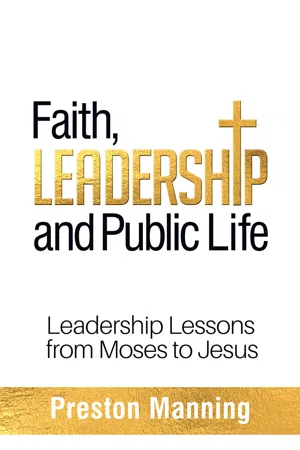
The connection between faith, leadership and public life is a complex one as Preston Manning knows all too well from his years as a scout and trailblazer on Canada's political frontiers. Now, in his new book Faith, Leadership and Public Life: Leadership Lessons from Moses to Jesus he fearlessly tackles this subject by drawing upon his own years in Canada's parliament and political arena and upon relevant lessons to be learned from the public lives of the founding giants of Judaism and the Christian faith. Starting with the public life of Jesus himself, he also draws upon the experience of those leaders whom Jesus most frequently referenced such as Moses and David, as well as examining the lives of leaders such as Joseph and Daniel who were called upon to exercise their faith in societies and political systems hostile to their beliefs. He challenges people of faith today to learn from their examples about how to conduct ourselves responsibly at the faith-political interface, while bringing what Jesus called "salt and light" to bear on the political issues and structures of our times. If you are a person of faith, currently active in politics or leadership, or contemplating involvement in either, the following pages will help you in meeting those challenges.
- 360 pages
- English
- ePUB (mobile friendly)
- Available on iOS & Android
eBook - ePub
About this book
Information
Topic
Theology & ReligionSubtopic
Christian ChurchPart 1:
Leadership Lessons
from the Public Life of Jesus
Introduction
For 30 years, from his birth to early adulthood,
Jesus of Nazareth lived and worked in obscurity. Then for three short years he taught and worked in public, and his public life is well documented in the Gospels of Matthew, Mark, Luke, and John.
Jesus of Nazareth lived and worked in obscurity. Then for three short years he taught and worked in public, and his public life is well documented in the Gospels of Matthew, Mark, Luke, and John.
Jesus never sought or held public office, yet he and his followers have been politically influential and controversial for twenty centuries. While his ultimate mission was a spiritual one, he nevertheless chose to use a political term—the “kingdom” of God—to define it.
Those of us who believe that Jesus was in fact the one he claimed to be—the Son of God sent by God to reconcile human beings to himself and each other—will tend to attribute the uniqueness and impact of his public life to the presence and power of the supernatural. But even those who do not acknowledge his deity should be drawn to examine the nature and lessons of his public ministry by virtue of its unique and enormous impact from that day to this.
In this regard, I once provided a small group of my political friends who were visiting Israel with a “sealed memorandum” to be opened, read, and discussed only after they had completed their first visit to the Galilean region where Jesus spent much of his life. The memorandum read as follows:
A Special Assignment
Imagine that you have just been parachuted into the Galilee region of Israel to carry out the following special assignment:
• Go into the towns and villages around the lake and recruit a team of twelve people.
• Persuade them to leave whatever they are doing and join you in a venture to change themselves, their community, and the world.
• By formal teaching and example, transform their pursuit of self-interest into the self-sacrificial service of others.
• Equip them to share with others what you will impart to them, so that 2,000 years afterwards more than one billion people will profess to be guided in some way by your teachings and example.
• Fiscal constraints require you to raise your own financial support for this assignment.
• Your initial base of operations will be a carpenter’s shop in a small town called Nazareth.
• You have three years to complete this assignment before you must leave the region and entrust the follow-up to your recruits.
Jesus of Nazareth undertook and successfully completed such an assignment, which is why, if for no other reason, I believe that his life and teachings deserve serious examination, especially by those of us who know from our own experience how difficult it is to create and sustain a public movement of any kind, even on a limited scale and for only a brief moment in time.
So, whether we are believers or not, if we are engaged in public life of any sort there is much to learn and profit from examining the public life of Jesus. And if we are operating at the interface of faith and politics this is doubly so.
1.1 INCARNATIONAL COMMUNICATION
To incarnate—to embody in flesh;
to put into a body, especially a human form.
to put into a body, especially a human form.
Providential Positioning
Providential positioning refers to movements by God’s spirit whereby human beings (unbelievers as well as believers) are placed or moved into particular positions and situations to accomplish some aspect of God’s work in the world. The biblical record draws attention to such movements at work in the lives of Moses, David, Joseph, Daniel, Esther, Ezra, and Nehemiah as well as in the lives of an Egyptian pharaoh and the kings of the Medes and Persians. It was in reference to such providential positioning that the Jewish exile Mordecai posed the haunting question to Esther when she rose to the position of queen in Medo-Persia, “Who knows but that you have come to your royal position for such a time as this?”4
In the entire record of God’s dealings with humanity, however, there is no more dramatic and consequential instance of providential positioning than the positioning of Jesus of Nazareth in a particular human family and community within an obscure province of the Roman Empire at a particular time in human history.
The physician Luke begins his Gospel by describing the work of Jesus’ advance man, John the Baptist. He does so by positioning the time of their public ministry politically:
In the fifteenth year of the reign of Tiberius Caesar—when Pontius Pilate was governor of Judea, Herod tetrarch of Galilee, his brother Philip tetrarch of Iturea and Traconitis, and Lysanias tetrarch of Abilene—during the high priesthood of Annas and Caiaphas, the word of God came to John son of Zechariah.5
Jesus himself, speaking in the synagogue of his hometown of Nazareth, describes his positioning as fulfilling the ancient prophecy of Isaiah:
He went to Nazareth, where he had been brought up, and on the Sabbath day he went into the synagogue, as was his custom. He stood up to read, and the scroll of the prophet Isaiah was handed to him. Unrolling it, he found the place where it is written:
“The Sp...
Table of contents
- Cover
- ENDORSEMENTS
- TITLE PAGE
- Copyright
- Preface
- PART ONE
- Part One Introduction
- 1.1 INCARNATIONAL COMMUNICATION
- 1.2 THE FIRST TEMPTATION: FEED THEM AND THEY WILL FOLLOW
- 1.3 THE SECOND TEMPTATION: GIVE THEM A SHOW AND THEY WILL FOLLOW
- 1.4 THE THIRD TEMPTATION: COMPEL THEM TO FOLLOW BY SEIZING POLITICAL POWER
- 1.5 TRAINING: ETHICS
- 1.6 TRAINING: MANAGING AMBITION
- 1.7 TRAINING: MANAGING CHANGE
- 1.8 THE GREAT GUIDELINE: WISE AS SERPENTS AND GRACIOUS AS DOVES
- 1.9 WISDOM AND GRACE IN ACTION: THE WILBERFORCE ANTI-SLAVERY CAMPAIGN
- 1.10 THE MINISTRY OF RECONCILIATION: THE JESUS WAY
- 1.11 RECONCILIATION: THE JESUS WAY APPLIED
- 1.12 THE JUDAS WAY
- 1.13 FOLLOW ME!
- PART TWO
- PART TWO INTRODUCTION
- 2.1 POLITICAL INVOLVEMENT
- 2.2 AT WORK WITH GOD
- 2.3 THE RULE OF LAW
- 2.4 THE ROLE OF THE LEADER
- 2.5 THE CHALLENGES OF LEADERSHIP
- 2.6 LAST WORDS
- PART THREE
- PART THREE INTRODUCTION
- 3.1 WHO WILL BE LEADER?
- 3.2 A LEADER AFTER GOD’S OWN HEART
- 3.3 THE SUBORDINATE LEADER
- 3.4 THE INNER LIFE OF A LEADER
- 3.5 THE LEADER STUMBLES
- 3.6 THE LEADER CHALLENGED—DOMESTICALLY
- 3.7 THE LEADER CHALLENGED—POLITICALLY
- 3.8 LAST WORKS OF A LEADER
- 3.9 LAST WORDS OF A LEADER
- PART FOUR
- PART FOUR INTRODUCTION
- 4.1 THE SOVEREIGNTY OF GOD
- 4.2 PROVIDENTIAL POSITIONING AGAIN
- 4.3 DELIVERANCE FROM EVIL
- 4.4 THE COUNTER-TRANSFORMATION OF EVIL INTO GOOD
- 4.5 THE GOOD AND EVIL OF BUREAUCRACIES
- 4.6 SAFEGUARDING PUBLIC BUREAUCRACIES FROM DOING HARM
- 4.7 DILIGENCE AND EXCELLENCE
- 4.8 CO-OPERATION AND COMPROMISE
- 4.9 RE-ESTABLISHING THE FAITH COMMUNITY UNDER HOSTILE CONDITIONS
- 4.10 GUIDELINES FOR BELIEVERS LIVING IN EXILE
- ACKNOWLEDGEMENTS
- OTHER BOOKS ON LEADERSHIP
Trusted by 375,005 students
Access to over 1.5 million titles for a fair monthly price.
Study more efficiently using our study tools.
Frequently asked questions
Yes, you can cancel anytime from the Subscription tab in your account settings on the Perlego website. Your subscription will stay active until the end of your current billing period. Learn how to cancel your subscription
No, books cannot be downloaded as external files, such as PDFs, for use outside of Perlego. However, you can download books within the Perlego app for offline reading on mobile or tablet. Learn how to download books offline
Perlego offers two plans: Essential and Complete
- Essential is ideal for learners and professionals who enjoy exploring a wide range of subjects. Access the Essential Library with 800,000+ trusted titles and best-sellers across business, personal growth, and the humanities. Includes unlimited reading time and Standard Read Aloud voice.
- Complete: Perfect for advanced learners and researchers needing full, unrestricted access. Unlock 1.5M+ books across hundreds of subjects, including academic and specialized titles. The Complete Plan also includes advanced features like Premium Read Aloud and Research Assistant.
We are an online textbook subscription service, where you can get access to an entire online library for less than the price of a single book per month. With over 1.5 million books across 990+ topics, we’ve got you covered! Learn about our mission
Look out for the read-aloud symbol on your next book to see if you can listen to it. The read-aloud tool reads text aloud for you, highlighting the text as it is being read. You can pause it, speed it up and slow it down. Learn more about Read Aloud
Yes! You can use the Perlego app on both iOS and Android devices to read anytime, anywhere — even offline. Perfect for commutes or when you’re on the go.
Please note we cannot support devices running on iOS 13 and Android 7 or earlier. Learn more about using the app
Please note we cannot support devices running on iOS 13 and Android 7 or earlier. Learn more about using the app
Yes, you can access Faith, Leadership and Public Life by Manning in PDF and/or ePUB format, as well as other popular books in Theology & Religion & Christian Church. We have over 1.5 million books available in our catalogue for you to explore.