- 200 pages
- English
- ePUB (mobile friendly)
- Available on iOS & Android
eBook - ePub
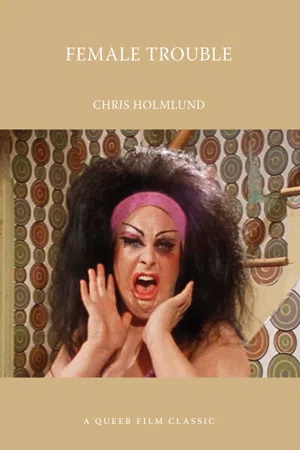
Female Trouble: A Queer Film Classic
Information
Subtopic
Film & VideoCHAPTER ONE: INTRODUCING FEMALE TROUBLE
John Waters’ Citizen Kane
A taste of trash we won’t soon forget.
—Von Wiedenman for The Advocate (1975, n. p.)
In its 2002 retrospective of John Waters’ films, Los Angeles’ Nu-Art Cinema hailed Female Trouble as “John Waters’ Citizen Kane.” Parallels can indeed be drawn. Producer-writer-director Waters was twenty-nine at the time he made Female Trouble (1974); producer-writer-director Orson Welles was twenty-six when he made Kane (1941). Both films feature big actors: the 300+-pound cross-dressing Divine (a.k.a. Harris Glenn Milstead, playing Dawn Davenport and Earl Peterson) and Welles himself (playing Charles Foster Kane). Both chart the rise, fall, and death of their larger-than-life protagonists.
There the parallels end. Dawn blossoms from teenage delinquent to street-smart model to convicted murderer. By film’s end, although imprisoned, she is neither alone nor unhappy: she has a lovely lesbian lover. Yet she is eager to be electrocuted because she is convinced the public will remember her. Kane begins as an ambitious reporter, becomes a media mogul, and dies a lonely recluse. Dawn’s life is an open book. Kane’s big secret is his sled. Female Trouble is decidedly independent, shot on a shoestring budget of $27,000 US; Kane was produced and released by one of the Big Five studios, RKO Pictures.1
While perhaps not Waters’ most “flaming” film—Mondo Trasho (1969), Multiple Maniacs (1970), and Pink Flamingos (1972) also compete for that honor—Female Trouble nonetheless stands out thanks to its ebullient performances, witty plot, striking sets, outrageous costumes, fabulous hairdos, and over-the-top makeup. In many ways, it holds up better than other early Waters films do. It was chosen to open the fifty-year retrospective of Waters’ work held at New York’s Lincoln Center in 2014. Andy Warhol loved the film, as did David Bowie, William Burroughs, Johnny Depp, and many others. When Waters screened Female Trouble at the Deauville Film Festival, John Travolta and Gloria Swanson were among the “society people in evening gowns laughing at shit marks on the behinds of underpants. It was very odd” (Waters in Giuliano 1981, 65). Waters and Divine frequently called Female Trouble their favorite film; other Dreamlander cast and crew members enthusiastically concur.2 Channing Wilroy (“Prosecutor”) raved about the script to me: “There are so many great lines in it. You have to see it more than once. There’s so many subtleties that you don’t catch right off the bat. It’s just loaded with funny stuff.”3 Marina Melin (“Cheryll”) praised the film’s “look,” attributable primarily to costume and makeup designer Van Smith and to production designer/art director Vincent Peranio. She said, “I feel I am truly an artist and I see it that way, and that film hits me because of the way it looks visually.” Peranio emphasized Divine’s performance: “It’s my favorite one of the older ones, and I think Divine’s greatest one.” Production chief and “Bitch Prisoner” Pat Moran said: “The genius of Van Smith [costumes and makeup] is overwhelming.”
Female Trouble holds up to repeated viewings. It consistently finds new fans who are appalled and exhilarated by Waters’ savvy genre mixes and film send-ups, extreme content, relentless themes, shocking images, and trashy aesthetics. With good reason Annette Insdorf begins her influential essay on contemporary American independent film, “Ordinary People, European-Style: Or How to Spot an Independent Feature,” by invoking Waters, even though she focuses on identity-based, regionally located features and documentaries (1981/2005, 27). Since the mid-1980s—and thanks to VHS, DVD, and most recently, digitally streamed releases—Female Trouble and many of the actors have acquired cult followings. Especially importantly for the Queer Film Classics series, virtually every survey of gay, lesbian, and queer film acknowledges Female Trouble’s place in queer film history. Indeed, Waters’ mischievous masterpiece has become more than a queer film classic: today it is a queer film essential because it so insistently refuses to promote facile sexual and gender politics and so assiduously makes room for people to be different.
Presciently Pre-Punk Politics
People can go to my films and say, “Jesus, and I thought I was fucked up.”
—John Waters (in Egan 2010/2011, 99)
Female Trouble is not politically correct, Waters proudly recognizes, but it is revolutionary—in a smutty if sincere kind of way. Emphasis is on reversal, as it was for Rabelais, Molière, Voltaire, Diderot, and Swift.4 At stake and in play are the “inside out,” the “turnabout,” the “continual shifting from top to bottom, from front to rear … humiliations, profanations, comic crownings and uncrownings” (Bakhtin 1965/1968, 34, 11).5 Waters himself has said as much: “All my films are based on reversals—good is bad; ugly is beautiful. I always try to cast heterosexual people as homosexuals and homosexuals as heterosexuals to further confuse people, because I think confusion is humorous” (in MacDonald 1982/2011, 86). “All John Waters movies are the good guys vs. the bad guys, but the bad guys are really the good guys—and the bad-good guys always win,” confirmed Mark O’Donnell, co-writer (with Thomas Meehan) of the book for Hairspray, the musical (in A. Levy 2008, 21).
Waters’ reversals go beyond overturning heterosexuality and homosexuality, good and bad. Commentators also make much of his unorthodox stance on class. He sides with misfits and the poor; he mocks authority; he skewers the bourgeoisie. “Central to his art is a canny understanding of American class issues in a society of supposed equality,” observed the Los Angeles Times’ Christopher Knight (2005, online). “John is consciously stabbing every social convention, everything that would mortify any self-respecting citizen in America. I … see him mostly as a social satirist, as someone exploding social conventions in a way that no one else really does. It’s easy to be perverse in a simple, stupid way. But he’s perverse in an ingenious way” (David O. Russell in Yeager, In Bad Taste, 2000).
Female Trouble is preoccupied with the idea that crime is beauty—building on gay French criminal turned novelist, poet, playwright, filmmaker, and activist Jean Genet.6 Waters’ film is also concerned with America’s growing obsession with celebrity. As Daniel Boorstin argues and Waters boldly illustrates, since the mid-1960s, the US has become steadily more image-conscious and media-saturated, with emphasis increasingly placed on what Boorstin calls “pseudo-events” wherein “ordinary” people are transformed into noteworthy figures by mass media reporters, executives, and agents intent on ratings and profits (1961/1992, 38–39).7 Others of Waters’ pet themes are on display here, too: “religion … sexual perversity, fashion … drugs, other movies” (Cotter 2004, E37). All of these subjects can be found with permutations in Waters’ other films, photographs, essays, books, speeches, stage shows, and artwork.
More than Waters’ earlier films did, Female Trouble adroitly mixes melodrama and comedy. As in Pink Flamingos—where the character Channing (Channing Wilroy) is clearly indebted to Genet’s The Maids—Waters adds elements of horror. Much as in Rabelais’ writings, “the material bodily principle, that is, images of the human body with its food, drink, defecation, and sexual life, plays a predominant role … [and] are offered … in an extremely exaggerated form” (Bakhtin 1965/1968, 18). Periodically Waters slips in close-ups of penises and medium shots of vaginas. He portrays rape and home birth. Characters mention sexual “tool kits” and abortion, and appear in S/M fetish gear or nude. But Female Trouble is not porn: it was rated NC-17. Adept at advertising his films through negative reviews, unafraid of contradiction, in one interview Waters happily quoted a reviewer who said that the sex scenes in Female Trouble “would offend the Marquis de Sade” (in Von Wiedenman 1976, 42). Later he insisted that “nudity was never a big thing in my movies. When my characters took off their clothes, you wanted them to put them back on” (in Giuliano 1981, 63).
Many critics, both mainstream and alternative, accorded Female Trouble tongue-in-cheek praise on its release. But Rex Reed, himself gay, was repulsed. He described the film as “filthy, repellent, beyond coherence, and so amateurish it looks like it was shot with a Brownie Instamatic … This compost heap is even dedicated to a member of the Charles Manson gang!” (in Hoberman and Rosenbaum 1983, 156–57). True to form, Waters seized on Reed’s excoriation for his own diabolical marketing purposes.
Waters has reflected on his generic and artistic mash-ups: “Hopefully I’ve created my own genre that I don’t believe anybody else copies and that you can tell is my movie in the first couple of minutes” (in Young 2000, 7). He knows a lot about movies and has been an avid movie-goer since childhood. What has been termed his “trash aesthetic” culls from exploitation film, underground film, art cinema, and Hollywood cinema, without simply copying or merely combining these forms. On the contrary, following J. Hoberman and Jonathan Rosenbaum’s astute evaluation of Waters’ influences in Midnight Movies (1983), Karl Schoonover suggests that Waters’ work is best seen as a “dialectical practice that represents the dynamics and conflicts among various types of cinema within the diegesis of one film” (2010, 164).
At the Lincoln Center retrospective, Hoberman described Female Trouble as “second generation underground” (2014, online).8 Waters quickly appended: “But in Baltimore”—which makes all the difference; the film’s locations and its locals are crucial to its values, look, and legend.
A Family Affair
Who could have imagined there was so much raw talent in Baltimore?
—Howard Kissel (1975, n. p.)
Waters’ drive, energy, creativity, and organization were essential to ensuring Female Trouble’s funding, production, completion, marketing, and distribution. But the movie would and could not exist without the other Dreamlanders’ dedication, smarts, and talent. Everyone who worked on the film was/is a committed artist, media professional, musician, and/or performer.9
A close-knit band of outsiders, the surviving Dreamlanders view each other as family. Waters described the “card-carrying Dreamland members” as a gang and explains: “To be in a gang—especially a gang whose colors are humor—has always been very satisfying to me” (in Ives 1992, 67). Bob Adams (“Ernie”) elaborated: “We’re very protective of each other, and [John] is the main lightning pole we have to be protective of. We watch out for each other. A lot of people think this group is closed, snobs. We’re not that. We’ve just had a lot of experiences of dealing with assholes. You know, Miss Sandy Sandstone: ‘There are two kinds of people in this world. My kind and assholes. Now get the fuck out of here.’”10
Devotion and inclusivity are important to the Dreamlander ethos. The original group met through family and friends, at parties and bars, on vacation, through summer jobs, in grade school, high school, and college. Rebelliousness against their upbringing (mostly, though not always, middle-class), hatred of school and especially of Catholic school, a penchant for the arts, and Baltimore outlier status has bonded them for life.
Waters and Mary Vivian Pearce (“Donna Dasher”) both grew up in Baltimore County. Their parents were best friends; their fathers had gone to school together.11 The two got in so much trouble as teenagers—playing hooky, shoplifting, crashing parties, dancing obscenely at Catholic Youth Organization functions—that Pearce was forbidden to see Waters, but she always managed to sneak out and meet him. They were introduced to Harris Glenn Milstead (later renamed Divine by Waters) by a mutual friend. Divine lived only a few streets away from Waters but was a year older and went to public school.
As young teens, many of the Dreamlanders-to-be watched Channing Wilroy dance on the Buddy Dean Show (1957–64), Baltimore’s answer to Dick Clark’s American Bandstand (1952–89). (Wilroy was a member of the original “permanent committee” of core dancers.) He knew Pat Moran because they lived two blocks from each other in Catonsville, another Baltimore suburb. They did not attend the same schools, however: Moran, like Pearce, Waters, Mink Stole (“Taffy”), and George Figgs (“Dribbles”), went to Catholic schools for part or all of their education.12 Moran was vituperative about her experiences, as was Waters. “I was pretty much the craziest of all,” she told me. “Now I’m a lapsed Catholic—proud of it … Any bit of creativity that you have, they don’t want it. They don’t want free thinking...
Table of contents
- Cover
- Title Page
- Copyright
- Contents
- Dedication
- Acknowledgments
- Synopsis
- Credits
- Chapter One: Introducing Female Trouble
- Chapter Two: Behind the Scenes
- Chapter Three: Before the Camera
- Chapter Four: The Trouble with Female Trouble
- Chapter Five: From Trash to Art to Celebrity
- References
- Filmography
- Index
- About the Author
- About the Editors
Trusted by 375,005 students
Access to over 1.5 million titles for a fair monthly price.
Study more efficiently using our study tools.
Frequently asked questions
Yes, you can cancel anytime from the Subscription tab in your account settings on the Perlego website. Your subscription will stay active until the end of your current billing period. Learn how to cancel your subscription
No, books cannot be downloaded as external files, such as PDFs, for use outside of Perlego. However, you can download books within the Perlego app for offline reading on mobile or tablet. Learn how to download books offline
Perlego offers two plans: Essential and Complete
- Essential is ideal for learners and professionals who enjoy exploring a wide range of subjects. Access the Essential Library with 800,000+ trusted titles and best-sellers across business, personal growth, and the humanities. Includes unlimited reading time and Standard Read Aloud voice.
- Complete: Perfect for advanced learners and researchers needing full, unrestricted access. Unlock 1.5M+ books across hundreds of subjects, including academic and specialized titles. The Complete Plan also includes advanced features like Premium Read Aloud and Research Assistant.
We are an online textbook subscription service, where you can get access to an entire online library for less than the price of a single book per month. With over 1.5 million books across 990+ topics, we’ve got you covered! Learn about our mission
Look out for the read-aloud symbol on your next book to see if you can listen to it. The read-aloud tool reads text aloud for you, highlighting the text as it is being read. You can pause it, speed it up and slow it down. Learn more about Read Aloud
Yes! You can use the Perlego app on both iOS and Android devices to read anytime, anywhere — even offline. Perfect for commutes or when you’re on the go.
Please note we cannot support devices running on iOS 13 and Android 7 or earlier. Learn more about using the app
Please note we cannot support devices running on iOS 13 and Android 7 or earlier. Learn more about using the app
Yes, you can access Female Trouble: A Queer Film Classic by Chris Holmlund in PDF and/or ePUB format, as well as other popular books in Media & Performing Arts & Film & Video. We have over 1.5 million books available in our catalogue for you to explore.