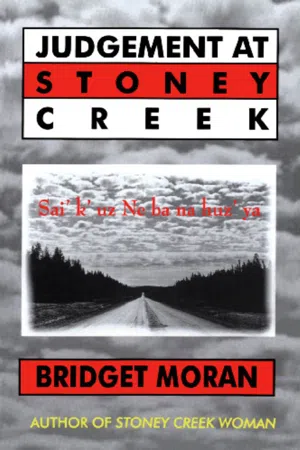
Judgement at Stoney Creek has been released in a new edition of an aboriginal studies classic: an engrossing look at the investigation into the hit-and-run death of Coreen Thomas, a young Native woman in her ninth month of pregnancy, at the wheels of a car driven by a young white man in central BC. The resulting inquest into what might have been just another small-town tragedy turned into an inquiry of racial tensions, both implicit and explicit, that surfaced not only on country backroads but in the courtroom as well, revealing a dual system of justice that treated whites and aboriginals differently. First published in 1990, Judgement at Stoney Creek has been hailed for its moving and deeply personal depiction of a controversial subject that continues to make news today?how the justice system has failed Canada's aboriginal people. This new edition includes a new preface by the author, who returns to the area to discover how much racial relations, and the relationship between Natives and the justice system, have changed.
- 203 pages
- English
- ePUB (mobile friendly)
- Available on iOS & Android
eBook - ePub
Judgement at Stoney Creek
About this book
Judgement at Stoney Creek has been released in a new edition of an aboriginal studies classic: an engrossing look at the investigation into the hit-and-run death of Coreen Thomas, a young Native woman in her ninth month of pregnancy, at the wheels of a car driven by a young white man in central BC. The resulting inquest into what might have been just another small-town tragedy turned into an inquiry of racial tensions, both implicit and explicit, that surfaced not only on country backroads but in the courtroom as well, revealing a dual system of justice that treated whites and aboriginals differently. First published in 1990, Judgement at Stoney Creek has been hailed for its moving and deeply personal depiction of a controversial subject that continues to make news today?how the justice system has failed Canada's aboriginal people. This new edition includes a new preface by the author, who returns to the area to discover how much racial relations, and the relationship between Natives and the justice system, have changed.
Information
1
IF SOMEONE WERE SEEKING the exact centre of the province of British Columbia, it would be well to pinpoint Stoney Creek Indian Reservation. The reserve, or a spot a very few miles from it, is the central point in the province.
As a matter of fact it was a mandarin or two in far-off Ottawa who in the year 1870 looked at this central part of British Columbia and, with the instruments of the day, drew up boundaries for an Indian reservation. These same mandarins noted that a busy wandering creek ran through much of the reserve. One can imagine a couple of Anglo-Saxon gentlemen, complete with sideburns and polished boots, sitting in a panelled office in Ottawa and saying with a touch of surprise at their own originality, “Right! We’ll name the reserve after that creek!” And no doubt, in some such way, with a local government agent and a priest or two explaining the boundaries to the Natives, Stoney Creek Indian Reservation was born. British Columbia was still a colony when the reservation of Stoney Creek was created; another year would elapse before this western territory joined confederation and henceforth bore the proud title of the province.
The elders on the reserve say that only after 1890 did the village of Stoney Creek, as distinct from the larger area of the reservation, come into being. “Long ago,” said Adnas Alexis, “there was no village down here at Stoney Creek. Tatchik, down about a mile, Nulki, at the end of Nulki Lake, and Laketown, four miles up the lake—these were the only places people lived. They lived in these places because of the fish. This was before 1890. All there was, was a trail going through where Stoney Creek village is now. One made a residing place just where the graveyard is now and from then on, people started moving into the village of Stoney Creek, one at a time. They all started moving in from Tatchik and Nulki Lake on account of the fish spawning up Stoney Creek. People were dependent for their livelihood on fish and that is why, you see, every Indian village is by a lake or a river or wherever there is fish.”
By the time the twentieth century was a few years old, Stoney Creek was a settlement of nearly two hundred people, housed in rows of log buildings, living on game and fish and berries, enduring the dry heat of summer, the bitter cold of winter. There were months when the village was almost empty of people, for Stoney Creek Natives were nomadic, moving from the settlement to hunting grounds and traplines as season followed season.
Their wanderings in those years are remembered with nostalgia by the elders of today. “Even as children,” says Mary John, a Stoney Creek great-grandmother, “we knew that the work at Stoney Creek in the summer, and the hunting and fishing in September in Cluculz Lake, meant food for the family. The trapline in winter was different. The skins we got there were sold, and it was this money which provided the family with clothing and flour and sugar and tea. Everything we did, the places in which we lived—all, all were important to the survival of the family. Even as a child, I understood that this was so.”
NINE MILES AWAY, NORTH AND a bit east, at a swampy stretch in a bend of the Nechako River, two brothers, Ruben and Clarence Lampitt, trapped for marten. Neither the people of Stoney Creek, nor the Lampitt brothers for that matter, could have foreseen that within a few years, with a rumour running wild that a railway was to be built through the territory, prospectors and merchants and land developers from North America and Europe would converge on this stretch of land beside the river and carve out the townsite of Vanderhoof.
By 1920, although Stoney Creek village had a larger population than the townsite on the Nechako River, the sign of things to come was there for all to see.
Stoney Creek had neither store nor school nor entrepreneur of any kind. In contrast, in this same year Vanderhoof had a doctor, a bank, drug and grocery and department stores, a restaurant, a school, a fur dealer, a hotel, a notary public, a land surveyor, a newspaper. A railway line skirted the settlement. Already the people of the townsite were talking of incorporation under the Village Municipalities Act. This in fact occurred in 1926, and the land along the bend of the Nechako River was henceforth known as the Village of Vanderhoof.
The growth of the village reflected the times.
“The year just closed,” wrote the editor of the local newspaper on January 6, 1934, “was not marked by outstanding events and signs of great progress; but Vanderhoof was able to do what many communities have not been able to do thus far in the thirties—mark time—and keep its head above the water line. . . . There have been few cases of real distress, so far as we know; and most people have sufficient to live with some degree of comfort.” Not all reports in those years were as sanguine. In a later edition of the paper, there is an account of a young widow who supported her three children on a homestead during the depression years. She borrowed a plow and a team of horses, in return for which she dug potatoes and raked hay for a neighbour. With the plow she cleared her land and put in vegetables and hay. Her gun kept her children supplied with moose and bear for food.
The 1940s saw a return to prosperity for Vanderhoof with a post-war boom, intensified by the opening of the Consolidated Mining and Smelting Mercury Mine at Pinchi Lake, north of Vanderhoof. During the Second World War this mine supplied most of the mercury required by the Allies. The 1950s brought construction of the Kenney Dam, south of Vanderhoof; in the 1960s, Endako Mines, Canada’s largest molydenum producer, the second largest in the world, began operations fifty miles west of the village of Vanderhoof.
These developments west, south, and north of Vanderhoof, together with a thriving lumber industry, assured the town a slow and steady growth. In 1976 Vanderhoof had a population of well over two thousand people, a deceptive figure since many more hundreds lived in the rich farming and ranching area which surrounds the town. When Vanderhoof celebrated the fiftieth anniversary of its incorporation in 1976, the village could boast of a hospital, a number of doctors, dentists and lawyers, a sprawling school system, a string of motels and restaurants, specialty stores, street lighting, a sewage system, paved streets, and an airplane landing strip a few miles outside the village.
The site which yielded a rich crop of furs sixty years before had moved ahead with the times.
THESE SAME DECADES, the thirties right up to the seventies, brought stagnation to the village of Stoney Creek. There, despite the fact that the number of band members was slowly decreasing, time seemed to have stopped, once and for all, soon after 1920.
Far from holding their heads somewhere above the water line, the people of Stoney Creek, used as they were to depression conditions for all of their lives, found the 1930s to be a desperate time on the reserve. “One time I’ll tell you about,” said elder Mary John, “both my sister-in-law and I had a batch of kids. Our husbands went trapping and it was in the midst of real hardship. We were left with nothing. We were just like a dog, you know, you see a dog with puppies, you leave the puppies at home and then you scrounge in the bush, hunting and fishing. That’s what we did. From day to day, we made our living that way. I don’t know what made us think of the Indian Department—maybe we heard someone talking. We asked the Indian Agent for a ration, so after much argument he gave us a little note. It was a single ration between the two of us and all our children—there was twenty-four pounds of flour, five pounds of sugar, half pound of tea, a bit of salt, a little rice, a little lard. He said not to come back. Oh, well, we were young and really tough. We thought we could tough it out.”
Tough it out they did, all the people of Stoney Creek.
Through the next thirty-five or forty years they hunted and fished, cut wood for the stoves of Vanderhoof and ties for the railway. They did roadwork and drove graders for the Department of Highways and they fought fires in the forest fire season. At Pinchi Lake and Endako mines and the Kenney Dam, in the hospital and the motels and restaurants of Vanderhoof they, with few exceptions, held the most menial of jobs and, as often as not, were the first to be laid off when work wound down or when profits dropped.
Through all the years into the 1970s, the settlement along the banks of Stoney Creek was almost untouched by the building, the modernization, that was going on all around.
In time electricity came to the reserve, but in 1976 Stoney Creek settlement had no paved roads or streets, no sewage system, no street lighting, no industry. For a few years there was a school in operation, but after the Department of Indian Affairs hired a series of teachers, many of whom proved to be racist or manic-depressive or just plain bewildered, the school reverted to a kindergarten and the older children were bussed into a school in Vanderhoof or boarded in a Catholic high school in Prince George, seventy miles away. Most of the log shacks had disappeared by 1976, to be replaced by houses which were deceptively modern in appearance—in fact, central heating was non-existent in these homes and only one in five had indoor plumbing.
In 1976 not a loaf of bread, not a quart of milk could be purchased in Stoney Creek—there was no store. Apart from the halcyon years in the fifties when the Kenney Dam was being built, there was no bus service between the village and Vander-hoof.
In 1976 the Natives of Stoney Creek knew that their settlement was an anachronism.
They talked of many things.
They spoke of the tax dollars which poured into the coffers of the Indian Affairs Department year after year, and they talked of how this green flow, like the channel of a river which had been diverted, never seemed to reach them. They looked at the experts in economic development and housing and education whom the federal government hired to plan for the Indians and they wondered how it could be, with so many high-priced professionals busily planning for them, that there was no economic development on Stoney Creek, that their housing program was a travesty and that in all the years up to 1976, only two Carrier in their area had ever graduated from a university.
By 1976 the Natives of Stoney Creek were speaking to each other, and sometimes they even spoke to the country’s leaders, about their lack of a sewage system, of the increase of tuberculosis on their reserve, of their desire to take over their own educational system, of their need for a bus service, shopping facilities, a recreation centre for their young people, an industry, perhaps a sawmill, which could replace welfare with employment for the residents of the reserve.
They did not speak of the sun rising in the east each morning, nor of the changing seasons, nor of the leaves dropping from the trees soon after the first frost each autumn, for these things had been a part of their lives since time immemorial.
Nor did they speak in 1976 of the fact that, although Vander-hoof and Stoney Creek were separated by only nine miles, each of these communities was isolated, one from the other, so that the distance might as well have been nine thousand miles. True, the Natives of Stoney Creek spent almost all their money in Vanderhoof, tens of thousands of dollars each month. But this spending of money in white businesses, the attendance of their children in white schools—these things, with few exceptions, did not mean that white people visited the homes in Stoney Creek, or that Natives dropped into white homes in Vanderhoof for a cup of coffee or a beer or a game of cards. It did not mean that when the school day was done, Native children stayed behind to socialize with white students.
The Natives of Stoney Creek, the white citizens of Vander-hoof, did not speak of these things, because this had been the relationship between the two communities for as long as the oldest living person could remember.
In 1976, if the Natives spoke of it at all, they would in all likelihood have said that some things had changed. Vanderhoof restaurants no longer refused them service; no longer did Natives, caught overnight in Vanderhoof, have to find a bed in the hospital because the hotels would not rent a room to them. Yes, Stoney Creek people would say, things like this had changed; they might add that many other places—Burns Lake, Kenora, Kamloops, Prince Albert—were not much better. In all of these places, and many more, they knew that Natives lived as a people apart.
And they would have said, if they thought in these terms, that it was surely not the fault of Vanderhoof that their reserve was poor or that their children seldom got beyond Grade 8 in school. They would have said no, it was not Vanderhoof’s fault, but on the other hand, Vanderhoof with its community organizations, its Board of Trade, its church groups, its village council, had never shown much concern either that life had been harsh and degrading and often brutal for the people of Stoney Creek.
These two communities, the one by a wandering busy creek, the other beside the bend in a proud river, each lived in a tight little world of its own. As if carved in marble, the two solitudes seemed doomed to last forever.
AND YET....
In the summer of 1976 beneath an apparently static, even a tranquil surface, there lurked an air of waiting in the land surrounding the Nechako Valley.
And in the early morning hours of July 3, 1976, when tires screeched on a street near the outskirts of Vanderhoof and the body of a young Native girl, within days of giving birth to a child, was lifted by an automobile and then dropped to the pavement, that quiescent surface was shattered.
There was to be little tranquility in Vanderhoof that summer of 1976.
2
THE HOLIDAY WEEKEND OF JULY 1, 1976, promised a gala few days for the Village of Vanderhoof. To commemorate fifty years of incorporation, community leaders joined together to arrange a program which included an old-time dance, a canoe race, a rodeo, a pancake breakfast, a family picnic, an old-timers’ reunion tea, and sports events of all kinds. Festivities ended with a street dance which went on until the early hours of the morning of July 3. The nearby settlements of Fort St. James, Fort Fraser, Fraser Lake, and Stoney Creek were nearly empty of people in the rush to join the midsummer celebration. Former residents of Vanderhoof from larger centres nearby, and the lower mainland too, joined with old friends and relatives to eat and talk and reminisce about the good old days when they, and Vanderhoof, were young.
The celebration meant weeks of hard work for many citizens of Vanderhoof; when it was over, these same community leaders could pronounce the celebration a success beyond anything they might have anticipated.
ON JULY 2, COREEN GAYTHOMAS, a twenty-one-year-old resident of Stoney Creek and into her ninth month of pregnancy, rented a room in the Vanderhoof Hotel and proceeded to enjoy the street dance with her friends and sisters. Later her friends were to say that after the dance she discovered she had lost the key to her hotel room and was refused another by an employee of the hotel. The manager of the hotel, Sandy Ingram, denied this—Coreen came to him after midnight, he said, and asked if one of her sisters could use the room in her place. Sandy Ingram said that he agreed.
Whatever the reason for Coreen leaving the hotel, sometime after 2:30 in the morning she started out with her sister Margie and a group of friends to walk the nine miles back to the reserve. The early morning air was warm and, despite the fact that Coreen was due to deliver her baby in a matter of days, she and her friends thought nothing of their trek back to the reserve. They had walked the same nine miles hundreds of times before.
Still within the boundaries of Vanderhoof, on a well-lit paved road leading up a hill, Coreen was struck by a car driven by twenty-one-year-old Richard Redekop. Witnesses said that Coreen was carried along by the impact for several feet before being dropped to the pavement. In due course RCMP and an ambulance arrived and, in due course too, Coreen’s body was placed in the hospital morgue.
Shortly after four in the morning, a statement was taken from Richard Redekop at the police station and breathalyser tests were administered. He was then allowed to go to the home of his parents, on the road to Stoney Creek.
Two or three hours later, Coreen’s fourteen-year-old sister Margie, hysterical and still in a state of shock, was taken back to the reserve by friends. Only when she returned and the church bells began tolling did the people on the reserve learn that death had come to their community again.
When the people of Stoney Creek heard that Coreen had been killed by a car driven by Richard Redekop, they were stunned. Redekop . . . Redekop . . . they spoke the name over and over to themselves. Only two years before, a younger brother of Richard, Stanley Redekop, driving a pickup truck, had struck and killed Coreen’s cousin, Larry Thomas. Stoney Creek people had never accepted the verdict of the inquest held after that death. Stoney Creek elders said that the lawyer for the Thomas family was not notified of the hearing until one hour before the jury sat, although he lived sixty miles away in Prince George. Larry Thomas’ mother, said the people, was picked up just before the inquest, ostensibly for talking too loudly, lodged in cells and released only when the inquest was over. Most unacceptable of all to the Thomas family and to everyone on the reserve was the jury’s decision that no negligence was involved, although the Thomas family believed that there had been too many people in the cab of the truck when Larry Thomas was struck and killed.
The news that another Redekop vehicle had killed another member of the Thomas family went through the reserve like a prairie fire.
Back along the road between Stoney Creek and Vanderhoof where the Redekop family lived, another tragedy was in the making. Seventeen-year-old Bonnie Redekop, sister of Richard and Stanley, was in Prince George hospital, critically injured after being in a car accident a week before. On July 3, just hours after Coreen was killed, young Bonnie Redekop died.
3
SOPHIE THOMAS, CONSIDERED the aunt of Larry and Coreen although the relationship was rather more distant, and president of the Stoney Creek Branch of the Indian Home-makers, was heartsick at the news that Coreen and her baby with her had been killed. As she helped to lay out Coreen and her baby for burial, she was numb with the knowledge that very bad things were happening to her people. All through her life Sophie had worked for better times for the Carrier. Now she wondered: are times better, or are they just as bad for us, just as violent, just as dangerous, as the worst of the bad old days?
Sophie Thomas could look back on many years of Stoney Creek history. Her parents, Pius and Melanie George, died on the reserve in the 1918 flu epidemic when Sophie was only ten months old...
Table of contents
- Cover Page
- Title Page
- Copyright Page
- Acknowledgements
- Preface to the New Edition
- Roads of My People
- Introduction
- 1
- 2
- 3
- 4
- 5
- 7
- 8
- 9
- 10
- 11
- 12
- 13
- 14
- 15
- 16
- 17
- 18
- 19
- 20
- 21
- 22
- 23
- Epilogue
- About the Author
Trusted by 375,005 students
Access to over 1.5 million titles for a fair monthly price.
Study more efficiently using our study tools.
Frequently asked questions
Yes, you can cancel anytime from the Subscription tab in your account settings on the Perlego website. Your subscription will stay active until the end of your current billing period. Learn how to cancel your subscription
No, books cannot be downloaded as external files, such as PDFs, for use outside of Perlego. However, you can download books within the Perlego app for offline reading on mobile or tablet. Learn how to download books offline
Perlego offers two plans: Essential and Complete
- Essential is ideal for learners and professionals who enjoy exploring a wide range of subjects. Access the Essential Library with 800,000+ trusted titles and best-sellers across business, personal growth, and the humanities. Includes unlimited reading time and Standard Read Aloud voice.
- Complete: Perfect for advanced learners and researchers needing full, unrestricted access. Unlock 1.5M+ books across hundreds of subjects, including academic and specialized titles. The Complete Plan also includes advanced features like Premium Read Aloud and Research Assistant.
We are an online textbook subscription service, where you can get access to an entire online library for less than the price of a single book per month. With over 1.5 million books across 990+ topics, we’ve got you covered! Learn about our mission
Look out for the read-aloud symbol on your next book to see if you can listen to it. The read-aloud tool reads text aloud for you, highlighting the text as it is being read. You can pause it, speed it up and slow it down. Learn more about Read Aloud
Yes! You can use the Perlego app on both iOS and Android devices to read anytime, anywhere — even offline. Perfect for commutes or when you’re on the go.
Please note we cannot support devices running on iOS 13 and Android 7 or earlier. Learn more about using the app
Please note we cannot support devices running on iOS 13 and Android 7 or earlier. Learn more about using the app
Yes, you can access Judgement at Stoney Creek by Bridget Moran in PDF and/or ePUB format, as well as other popular books in Social Sciences & Native American Studies. We have over 1.5 million books available in our catalogue for you to explore.